
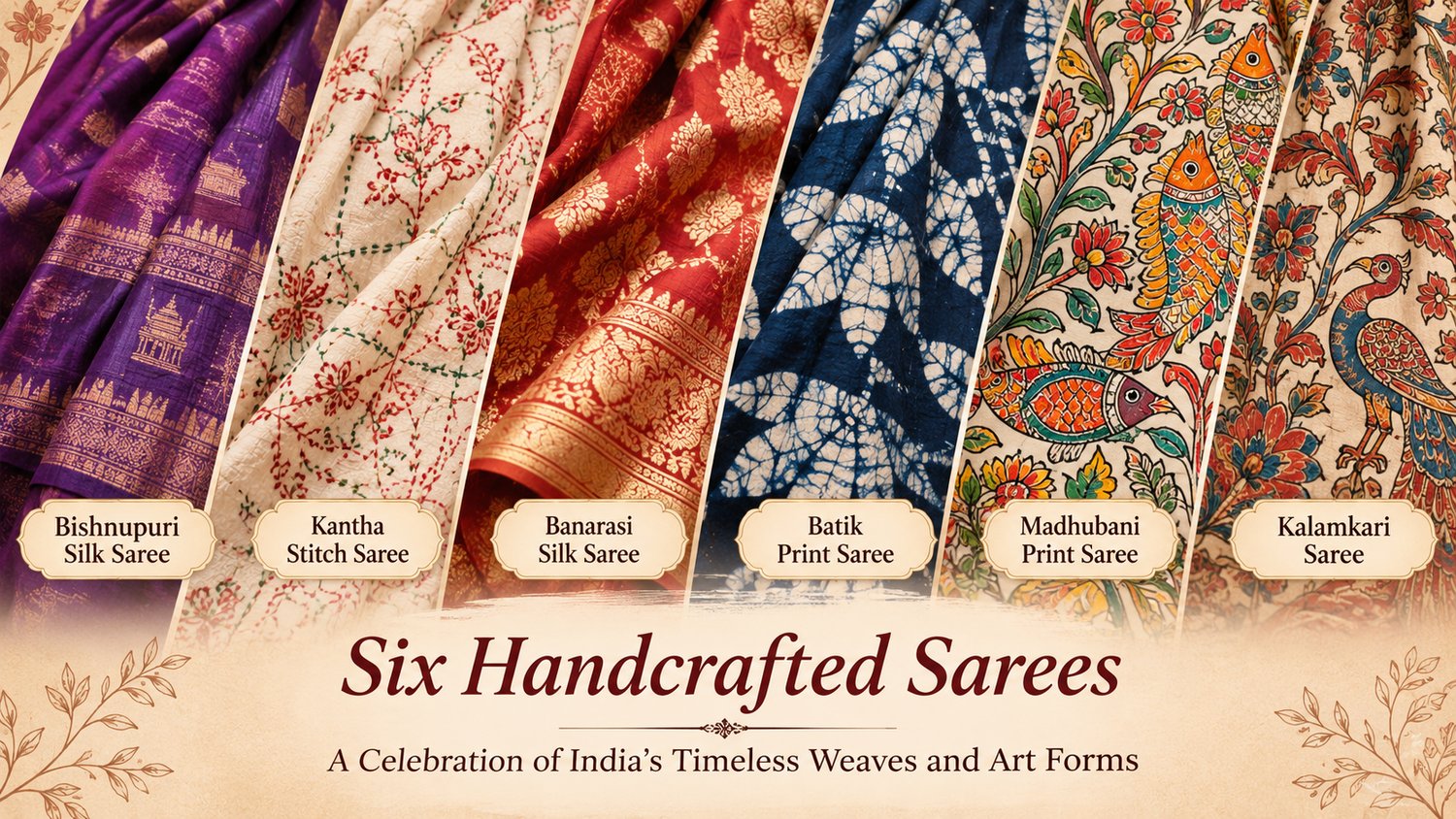
Ask any woman in Kolkata how many sarees she owns and she'll laugh before answering. Ask her how many she actually wears, and the number drops fast. Usually it comes down to five or six pieces that feel right every time she drapes them, and almost always those favourites are handcrafted.
There's a reason for that. A handloom or hand-printed saree carries small irregularities that a machine can't copy, and that's exactly what makes it look alive in daylight. But buying one online can feel like a gamble when every listing says "pure" and "authentic." So here's a plain guide to six craft traditions worth knowing, what to look for in each, and how to pick the right one for the occasion you have in mind.
Bishnupuri silk: Bengal's quiet favourite
Bishnupur, in Bankura district, is better known to travellers for its terracotta temples. Weavers there have been making silk for generations, though, and Bishnupuri silk has a soft, slightly crisp hand that sits between the heaviness of Banarasi and the airiness of tussar.
The katan weave gives it body without stiffness. It holds pleats well, which matters if you're draping it for a long Puja evening and don't want to keep fixing the pallu. Colours tend toward rich solids with contrast borders, so it works for family functions as well as a formal office event.
If you're looking for a Bishnupuri silk saree online, check the fall of the fabric in product photos taken in natural light. Real silk has a gentle sheen that shifts as the fabric moves. A flat, uniform shine usually points to a polyester blend.
Kantha stitch: patience you can see
Kantha started as a thrifty craft. Women in rural Bengal layered old sarees and stitched them together with simple running stitches to make quilts. Over time, that humble stitch moved onto silk and tussar, and the designs grew more elaborate: birds, vines, folk scenes, sometimes an entire story worked across the pallu.
A heavily worked kantha saree can take weeks to finish. You can tell good work by turning the fabric over. The stitches should be even and close, with very little thread floating loose on the back.
Kantha suits people who like texture more than shine. It's a great pick for daytime weddings, gallery openings, or any setting where you want to look dressed up without wearing zari. Browse a kantha stitch saree online collection and you'll notice the range goes from light, scattered motifs for regular wear to dense, all-over embroidery meant for occasions.
Banarasi silk: the wedding standard for a reason
Some sarees are trendy. Banarasi is permanent.
Woven in and around Varanasi, Banarasi silk is known for its zari work, Mughal-inspired florals, and heavy brocade pallus. Brides across North and East India still choose it, and so do their mothers, aunts, and half the guest list. The variety within the category is wider than most people realise, covering katan silk, tissue, and pieces that borrow from Kanjivaram or bandhani traditions.
A common mistake we see is buying a Banarasi purely for the pallu and ignoring the body. A well-woven piece has consistent motifs across the whole drape, not just a showy end panel. When you shop for a Banarasi silk saree online, zoom in on the body fabric and the border join. Clean, tight weaving at the border is a better quality signal than how much gold is on display.
Batik print: art school roots, everyday wear
Batik uses wax to resist dye. The artisan draws or stamps wax onto the fabric, dyes it, then removes the wax to reveal the pattern underneath. The fine crackle lines you see in batik come from the wax cracking during dyeing, and no two pieces crack the same way.
In Bengal, batik has a strong link to Santiniketan, where it became part of the art and craft culture around Visva-Bharati. That heritage shows in the designs, which lean toward bold, painterly motifs rather than tiny repeating prints.
Batik cotton sarees are easy to live with. They breathe well in Kolkata's humid months and look good with minimal jewellery. Silk versions dress up nicely for evening events. A batik print saree online is a smart buy if you want something artistic that you'll actually wear more than twice a year.
Madhubani print: stories from Mithila
Madhubani art comes from the Mithila region of Bihar, where women traditionally painted walls and floors for festivals and weddings. The style is easy to recognise once you know it: double-line outlines, filled-in patterns, fish, peacocks, the sun and moon, and figures from Ramayana stories. Madhubani painting received a Geographical Indication tag in 2007, which protects its identity as a regional art form.
On a saree, these motifs turn the fabric into something closer to a wearable painting. Printed versions make the art affordable and wearable, while hand-painted pieces cost more and take far longer to make.
Honestly, Madhubani works best when you let the saree do the talking. Pair it with a plain blouse and simple silver jewellery. When you pick a Madhubani print saree online, look at how the motifs are placed across the pallu. Thoughtful placement makes a big difference to how the drape looks when worn.
Kalamkari: natural dyes and a slower kind of craft
Kalamkari means "pen work," and it comes from Andhra Pradesh. There are two main styles. Srikalahasti kalamkari is drawn freehand with a bamboo pen, often showing mythological scenes. Machilipatnam kalamkari uses carved wooden blocks for printing, with more repeating floral and geometric patterns.
Both traditionally rely on natural dyes, giving the colours an earthy depth: rust, indigo, mustard, deep brown. The fabric goes through many rounds of printing, washing, and drying, which is part of why genuine kalamkari has a softness that synthetic prints never quite match.
A Kalamkari saree online is a good fit for anyone who prefers muted, intelligent colour over bright festive shades. It's also one of the more office-friendly handcrafted options, especially in cotton.
How to choose between them
If you're still unsure, start with the occasion and work backward.
- For a wedding where you're close family, Banarasi is the safe and expected choice.
- For Durga Puja evenings, Bishnupuri silk or a heavier kantha piece will look right without feeling overdone.
- Office wear and regular use? Kalamkari or batik in cotton, both easy to wash and comfortable through a long day.
- Art events or anywhere you'd like people to ask about your saree: Madhubani does that every time.
Climate matters too. Silk can feel heavy in a crowded June function, while cotton batik or kalamkari stays comfortable well into the evening.
A few buying habits worth keeping
Read the fabric details before the price. "Silk blend" and "pure silk" are very different things, and honest sellers state which one you're getting. Look for close-up photos of the weave, the border, and the back of any embroidery. And check the return policy before you order, since colour on a phone screen rarely matches the real fabric exactly.
Handcrafted sarees reward a bit of patience at the buying stage. Pick one tradition that fits the life you actually lead, buy a good piece of it, and you'll find yourself reaching for it long after the trend-led buys have gone to the back of the cupboard.
Brands like Loominators that sort their collections by craft make it easier to compare these traditions side by side, which is a sensible place to start if you're building a saree wardrobe with intention.