
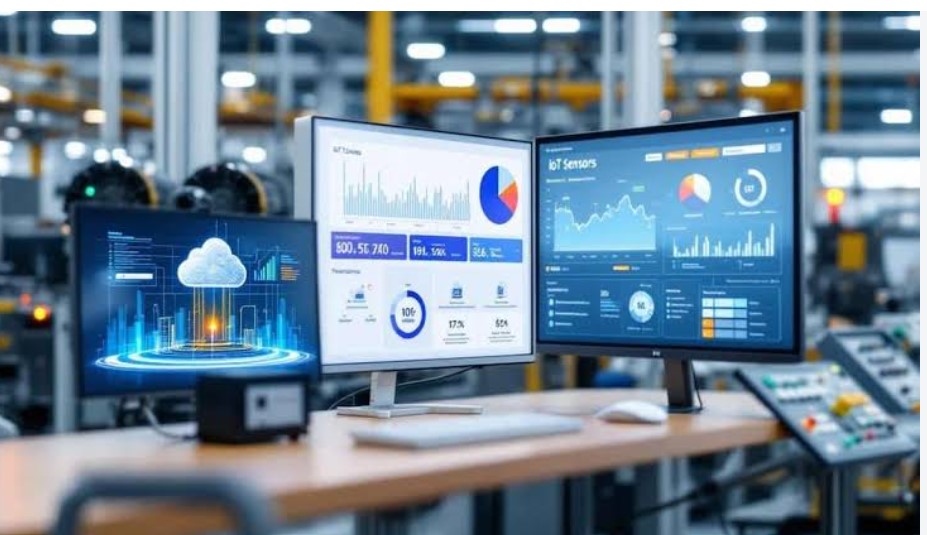
Consistent thickness is an important quality requirement in many manufacturing environments. Whether a company produces coated materials, films, sheets, packaging, or other industrial products, variations in thickness can affect both product quality and production costs.
Modern thickness measurement systems allow manufacturers to collect detailed information throughout production rather than relying only on occasional manual checks. This can provide greater visibility and support faster responses when production conditions change.
Why continuous thickness monitoring matters
Manufacturing conditions are rarely completely static.
Temperature, material properties, machine settings, production speed, and equipment condition can change over time.
If thickness is checked only occasionally, some changes may remain unnoticed until a significant quantity of material has already been produced.
Continuous monitoring can provide earlier visibility.
Understanding thickness variation
Variation can occur across the length or width of a product.
For example, a material may begin within specification and gradually become thicker or thinner as production continues.
Tracking these changes makes it easier to identify trends and investigate possible causes.
From quality inspection to process control
Measurement should not be viewed only as a final quality check.
When measurement data is available during production, it can become part of process control.
Operators can use current information to determine whether the process remains stable and whether additional investigation is necessary.
Reducing material waste
Over-thickness can result in unnecessary material consumption.
Under-thickness may create products that fail to meet requirements and require rework or disposal.
Better measurement can help manufacturers maintain production closer to the intended target while remaining within acceptable specifications.
Improving consistency between batches
Customers expect products to maintain consistent characteristics.
Historical measurement data can help manufacturers compare production batches and identify whether process performance is stable.
If one batch behaves differently from previous production, quality teams can investigate the relevant production conditions.
Monitoring the production width
In processes involving wide sheets or webs, thickness can vary across different areas.
Understanding the distribution across the production width can provide valuable information.
This can help manufacturers identify equipment alignment issues, process variation, or other conditions that may influence product uniformity.
Connecting data with production conditions
Thickness data becomes more useful when it can be linked to other production information.
For example, quality teams may want to compare measurements with machine settings, material batches, production times, or maintenance events.
This additional context can make troubleshooting more efficient.
Creating useful alerts
Not every measurement change requires immediate intervention.
If alerts are too sensitive, operators may receive unnecessary warnings. If thresholds are too broad, important changes may not be detected quickly.
Alert settings should therefore reflect actual production requirements and be reviewed periodically.
Supporting preventive maintenance
Long-term measurement trends may sometimes provide useful information about equipment behavior.
If a process begins showing gradual changes that repeatedly occur around certain operating conditions, maintenance teams may investigate whether equipment condition is contributing.
Measurement data does not replace technical inspection, but it can provide useful evidence.
Selecting suitable measurement technology
Manufacturers should consider several factors before choosing a measurement solution:
- Material type
- Thickness range
- Production speed
- Measurement accuracy
- Product width
- Surface characteristics
- Environmental conditions
- Installation requirements
- Data integration
The most appropriate technology depends on the application.
Making data accessible
Operators should not have to search through complicated reports to understand whether production is stable.
Clear displays, trend charts, alarms, and summary reports can make information easier to use.
Managers may need longer-term analysis, while operators may require immediate production information.
Implementation planning
A successful implementation begins with clear objectives.
Manufacturers should determine which products need monitoring, what specifications apply, how measurements will be stored, and who is responsible for responding to abnormal results.
Testing the system under real production conditions can also help identify practical issues before full deployment.
Manufacturers evaluating thickness measurement systems can use these factors to determine which measurement approach best matches their production environment.
Frequently Asked Questions
1. What is the advantage of continuous thickness monitoring?
It provides more frequent information about production conditions and can help identify changes before they affect a large amount of material.
2. Can thickness monitoring reduce production waste?
Accurate monitoring can help identify over-application, under-thickness, and other process variations, supporting better control of material use.
3. Should thickness measurements be stored historically?
Historical records can be valuable for comparing batches, investigating quality issues, identifying trends, and supporting continuous improvement.
Conclusion
Continuous thickness monitoring gives manufacturers greater visibility into production than occasional sampling alone. It can support quality control, material efficiency, process optimization, and troubleshooting.
The right measurement approach depends on the material, production process, accuracy requirements, and operating environment. By combining reliable measurement with useful data visualization and clear response procedures, manufacturers can create a more controlled and consistent production process.