
Walk down any supermarket aisle and the ingredient list on a coloured drink or sweet will often include a short code beginning with the letter E. These codes look technical, yet many of them simply identify a substance that has been used in food for a long time. Natural red colours are a good example. They come from plants, fruits and vegetables, and they give products the familiar red and pink shades shoppers expect. One of the best known plant sources for such a colour is red radish, a root vegetable whose deep colour comes from a family of pigments called anthocyanins. Understanding what sits behind the code helps product developers, buyers and curious consumers make better choices about the colours in food and drink.
Where Natural Red Colour Comes From
Anthocyanins are the pigments responsible for the red, purple and blue tones seen in many fruits and vegetables, from berries and grapes to red cabbage and radish. They dissolve in water, which makes them practical for drinks, jellies and sauces, and they have coloured food in home kitchens for centuries, long before modern labelling existed. Food manufacturers value them because shoppers increasingly prefer colours that come from recognisable plant sources rather than synthetic dyes. The shade can shift with acidity, so a drink with citrus notes may look brighter than a neutral dairy product coloured with the same pigment. That behaviour is normal for plant pigments and is something formulators plan for when they design a recipe.
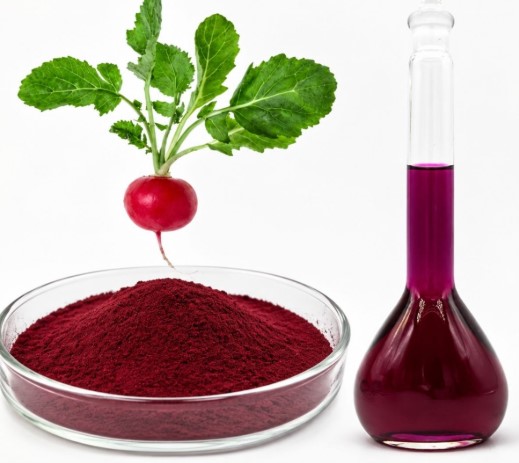
Red radish is a useful source because the root carries a strong, stable red pigment in a crop that grows widely and can be processed in large volumes. The pigment is extracted from the root, concentrated and dried or kept in liquid form, depending on how the customer plans to use it. Because the colour comes from a familiar vegetable, it fits well on labels that aim for short, understandable ingredient lists. For a manufacturer, a dependable plant source matters as much as the shade itself, since a colour that varies from batch to batch creates problems on the production line.
How the Colour Is Used in Food and Drink
Natural red colouring appears in soft drinks, flavoured waters, confectionery, yoghurt, ice cream, sauces and baked goods, anywhere a red or pink shade helps the product look appetising. The amount needed is small, and formulators start with a low dose, then adjust until the shade matches the target. For buyers who want to see the full specification before ordering, the listing for e163 gives a practical starting point, including the source material and the forms in which the colour is supplied. Checking the specification first saves time later, because the format and the colour strength determine how the ingredient behaves in a recipe and how much of it a production run will need.
The choice between powder and liquid formats usually depends on the factory setup. Powders travel well, store for longer and suit dry mixes, while liquids blend quickly into beverages and syrups without a separate dissolving step. Some buyers prefer powder because it is easier to weigh in small batches, while others choose liquid for high-speed lines where every second counts. Either way, the colour strength should be confirmed with the supplier so that dosing stays consistent from one order to the next. A clear specification also helps quality teams compare offers from different suppliers on equal terms, rather than guessing from a product name alone.
Stability and Handling
Like all plant pigments, anthocyanin colours respond to their environment. Acidity is the biggest influence: lower pH generally keeps the red shade bright, while a move toward neutral conditions can push the tone toward purple. Heat during processing can soften the colour, and long exposure to strong light may fade it over weeks on the shelf. None of this makes the colour impractical; it simply means the recipe and the packaging need to suit the ingredient. Opaque or tinted packaging, sensible storage temperatures and a realistic shelf life all help the finished product keep the shade it had on the day it was made.
Storage of the ingredient itself deserves the same care. Powders should be kept cool and dry, with containers sealed between uses so moisture cannot clump the contents. Liquids should be kept away from direct sunlight and used within the period stated on the specification. Production teams that log batch numbers and opening dates find it easier to trace any shade variation back to a cause, whether that is a new delivery, a change in storage or a shift in the recipe. Small habits like these protect colour consistency far better than any single purchase decision.
Frequently Asked Questions
Is this type of red colour natural?
Yes, it is derived from plant material, in this case red radish, and the colour comes from anthocyanin pigments that occur naturally in the root. It is used as a food colouring in products where a plant-based option is preferred, and it appears on labels under its approved code.
Which foods and drinks use it most often?
It is common in soft drinks, flavoured waters, sweets, yoghurt, ice cream, sauces and baked goods. Any product that needs a red or pink shade and suits a water-soluble plant colour is a candidate, though the final choice always depends on the recipe and processing conditions.
How should the ingredient be stored?
Keep powders in a cool, dry place with the container sealed, and keep liquids away from direct light. Follow the storage guidance on the supplier specification and use opened packs within the stated period so the colour strength stays reliable.
Conclusion
A short code on a label can hide a simple story, and in this case the story is a familiar root vegetable and a pigment family that has coloured food for generations. Anthocyanin red from radish gives manufacturers a plant-based option that shoppers recognise, in formats that suit both small kitchens and large production lines. The shade needs sensible handling around acidity, heat and light, but with a clear specification and good storage habits it performs reliably across drinks, sweets, dairy and sauces. For anyone choosing a natural red, the sensible path is to read the specification, request a sample, test it in the real recipe and confirm the shade holds through processing and shelf life. That careful approach turns a code on a label into a colour customers can trust.