
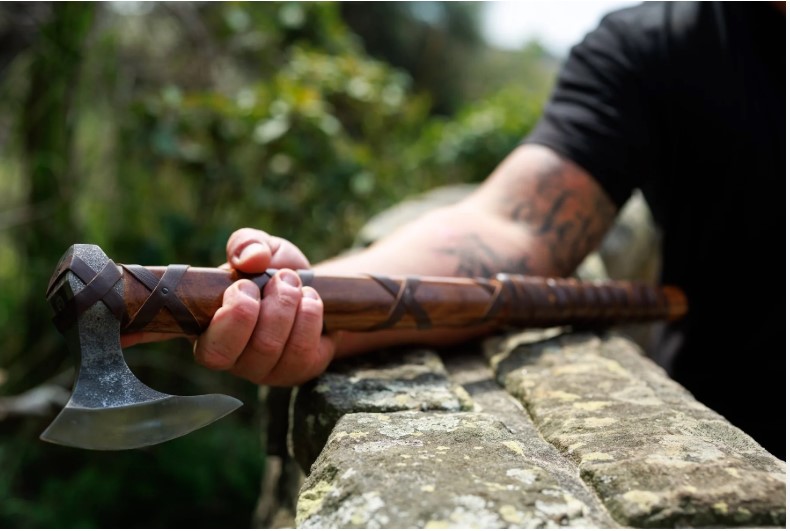
Viking axe is one of the most iconic symbols of the Viking Age (8th–11th centuries), representing both everyday life and warfare. Unlike many other weapons of the time, the axe did not begin as an instrument of battle. Instead, it started as a simple, practical tool that was essential for survival in the harsh Scandinavian environment.
In early Viking society, axes were primarily used for daily tasks such as cutting wood, building houses, and constructing ships. Wood was the main building material in Scandinavia, so a reliable axe was necessary for almost every aspect of life. Because of this, axes were widely owned and used by people of all social classes. In contrast, swords were expensive and often reserved for wealthy warriors, making the axe a far more accessible item.
As Viking society became more involved in raids, exploration, and warfare, the need for effective weapons grew. Rather than creating entirely new tools, Vikings adapted what they already had. Norse axe naturally transitioned into a weapon due to its availability, effectiveness, and ease of use. Even a simple tool axe could deliver powerful blows, making it dangerous in combat.
Over time, the design of Viking axes began to change to better suit battlefield needs. Blades became broader and thinner, allowing for faster swings and deeper cuts while keeping the weapon relatively lightweight. One of the most notable developments was the bearded axe, which featured an extended lower part of the blade. This design allowed warriors to hook enemy shields, pull weapons away, or control their opponents more effectively during combat.
Another important evolution was the Dane axe, a large two-handed weapon with a long handle and a wide blade. It offered greater reach and striking power, making it especially useful in open battles. Although less practical for everyday tasks, it became a specialized weapon used by skilled and experienced warriors.
Advancements in blacksmithing also played a key role in the evolution of Viking axes. Smiths improved their techniques by combining iron bodies with hardened steel edges, creating blades that were both durable and sharp. This method allowed axes to maintain their effectiveness in battle while still being relatively affordable compared to swords.
In combat, Viking axe for sale proved to be highly effective. Their design allowed for powerful strikes capable of breaking shields or armor, while their shape made it possible to hook and control enemies. When used together with a shield, the axe became part of a balanced and flexible fighting style.
Despite their development into weapons, axes never lost their importance as everyday tools. This dual function made them unique and deeply symbolic in Viking culture. They represented both creation and destruction—used to build homes and ships, but also to fight and conquer.
In conclusion, the evolution of Viking axes from simple tools to specialized weapons reflects the adaptability and ingenuity of Norse society. By modifying a common household item into a powerful weapon, Vikings demonstrated practical thinking and efficiency. The axe remains a lasting symbol of their culture, embodying both their daily lives and their reputation as formidable warriors.