
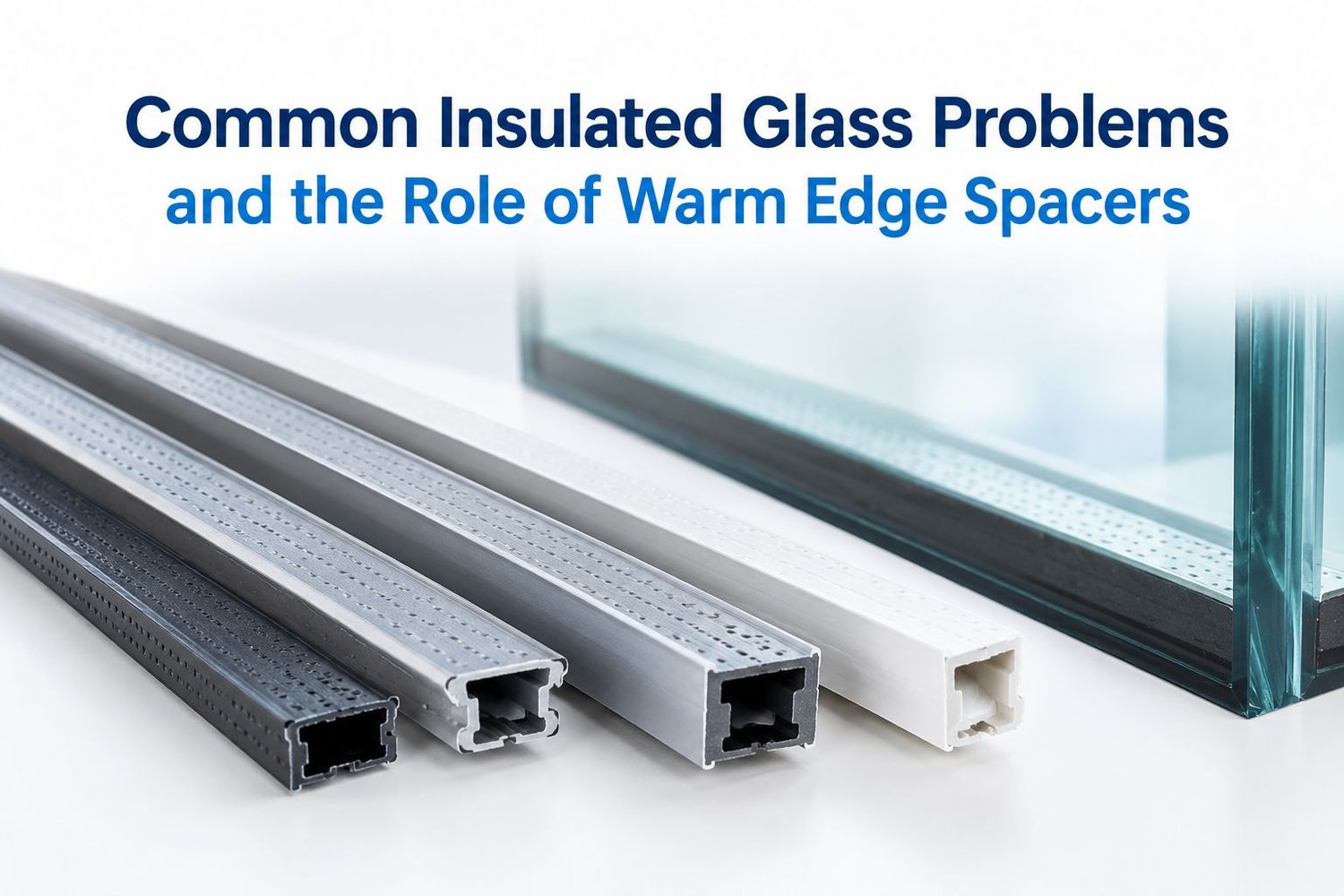
Warm edge spacers can help address several common insulated glass problems, including heat loss around glass edges, cold spots, condensation risk, and thermal bridging. Choosing the right warm edge spacer in India can help reduce heat transfer around the glass perimeter and support better thermal performance in insulated glass units. Understanding how these spacers work can help manufacturers make better decisions when selecting profiles for their glazing systems.
What Are the Most Common Insulated Glass Problems?
Insulated glass units, or IGUs, are designed to improve insulation by using two or more glass panes separated by a spacer and sealed around the edges. However, the spacer and edge area can affect how well the unit performs.
Common insulated glass unit problems include:
- Heat loss around the glass edge
- Cold spots near the window perimeter
- Thermal bridging through the spacer
- Condensation near glass edges
- Poor thermal performance
- Uneven surface temperatures
- Reduced energy efficiency
These problems can become more noticeable in buildings where windows cover large areas or where good thermal insulation is important.
How Do Cold Edges Affect Insulated Glass?
The edge of an insulated glass unit can become colder than the central glass area. This can happen when the spacer conducts more heat between the inside and outside of the window.
A colder glass edge can increase the difference between the indoor air temperature and the glass surface. When the surface temperature falls enough, moisture in the indoor air may condense on the glass.
This is why the edge region of an IGU needs careful attention during window design and manufacturing.
How Does Thermal Bridging Affect IGU Performance?
Thermal bridging occurs when heat moves more easily through one part of a building element than through the surrounding material.
In an insulated glass unit, the spacer sits between the glass panes at the perimeter. If the spacer has high thermal conductivity, it can create a path for heat to move through the edge of the unit.
This can lead to:
- Higher heat transfer at the glass edge
- Lower edge temperatures
- Increased condensation risk
- Less effective insulation
- Reduced overall window performance
Reducing thermal bridging at the glass edge is therefore an important part of designing energy-efficient glazing systems.
How Can Warm Edge Spacers Help?
A warm edge spacer is designed to reduce heat transfer through the edge of an insulated glass unit compared with conventional highly conductive spacer materials.
The spacer separates the glass panes while helping reduce thermal transfer at the perimeter. By keeping the glass edge warmer, the system can support improved thermal performance and help reduce the conditions that lead to condensation.
For manufacturers, selecting suitable warm edge spacer profiles can be an important consideration when developing insulated glazing systems for different building applications.
Warm Edge Spacers and Condensation Problems
Condensation can occur when a surface becomes colder than the surrounding air's dew point. In windows, the glass edge can be one of the colder areas.
Warm edge spacers can help by reducing heat transfer through the spacer area. This can support a higher edge temperature and reduce the likelihood of condensation under suitable indoor and outdoor conditions.
However, condensation does not depend on the spacer alone. Indoor humidity, outdoor temperature, glass design, ventilation, installation quality, and the overall window system also affect condensation.
This is why warm edge spacers should be considered as part of the complete IGU design rather than as a single solution to every condensation issue.
How Do Warm Edge Spacers Improve Window Thermal Performance?
The main purpose of using warm edge spacers is to improve insulation at the edge of the glass unit.
A suitable spacer can help create a better thermal transition between the glass panes and the surrounding frame. This can contribute to:
- Lower heat transfer at the window edge
- Warmer internal glass-edge temperatures
- Reduced thermal bridging
- Better insulation performance
- Improved comfort near glazed areas
The actual result depends on the complete glazing system, including glass type, spacer design, sealants, frame material, and installation.
What Should Manufacturers Consider When Choosing a Warm Edge Spacer?
Choosing the right spacer involves more than simply selecting a low-conductivity material. Manufacturers should consider how the spacer will work with the complete IGU production process.
Important factors include:
Profile dimensions
The spacer profile needs to match the required dimensions and design of the insulated glass unit. Accurate dimensions help support proper assembly and consistent production.
Material suitability
The material should be suitable for the intended glazing application and manufacturing conditions. Its physical and thermal properties should match the requirements of the final product.
Production requirements
The spacer should work with the manufacturer's production method and assembly process. Consistent profile dimensions can help maintain production quality across larger orders.
Application requirements
Different window and glazing systems may require different spacer designs. The right profile depends on the project, window construction, glass configuration, and performance requirements.
Customisation
For OEM and industrial manufacturers, standard profiles may not always match the required design. Custom extrusion can allow the profile to be produced according to specified dimensions and drawings.
What Happens When the Wrong Spacer Is Used?
Using an unsuitable spacer can affect the performance and production of an IGU.
Potential issues include poor dimensional fit, increased heat transfer, cold edge areas, assembly difficulties, and inconsistent production results.
The spacer should therefore be selected according to the technical requirements of the glazing system rather than based only on price or appearance.
For manufacturers producing insulated glass in volume, consistent spacer quality is also important for maintaining repeatable production.
How Can Indian Manufacturers Source Custom Warm Edge Spacer Profiles?
Indian window, façade, glazing, and insulated glass manufacturers may need spacer profiles with specific dimensions or design requirements. Custom extrusion can be useful when an existing standard profile does not meet the production requirement.
M3 Extrusion manufactures customised plastic extrusion profiles for industrial and commercial applications. With more than 13 years of manufacturing experience, the company supports OEM requirements and bulk production from its manufacturing facility in Sarigam GIDC, Gujarat, India.
For businesses looking for a suitable warm edge spacer, M3 Extrusion can manufacture customised profiles based on customer requirements. Samples can be provided before bulk production, helping buyers review the profile before placing larger orders.
For related information, see How Warm Edge Spacer Profiles Support the Construction Industry.
Key Factors to Check Before Ordering Warm Edge Spacer Profiles
Before placing a bulk order, manufacturers should confirm:
- Required profile dimensions
- Material requirements
- Application and glazing system
- Required quantity
- Drawing or sample availability
- Production and delivery requirements
- Quality inspection requirements
- Testing or documentation needed for the project
Providing accurate drawings or samples can help the extrusion manufacturer understand the required profile and reduce the risk of dimensional differences during production.
Frequently Asked Questions
What are insulated glass unit problems?
Insulated glass unit problems can include heat loss, cold glass edges, thermal bridging, condensation, sealing issues, and poor thermal performance. The exact cause depends on the glass, spacer, sealants, frame, installation, and operating conditions.
What is a warm edge spacer?
A warm edge spacer is a spacer used between glass panes in an insulated glass unit that is designed to reduce heat transfer through the glass edge compared with more conductive spacer materials.
Can warm edge spacers reduce condensation?
Warm edge spacers can help reduce condensation risk by supporting warmer glass-edge temperatures. However, condensation also depends on humidity, indoor temperature, outdoor conditions, ventilation, glass design, and installation.
Why is thermal bridging a problem in IGUs?
Thermal bridging allows heat to move more easily through a specific part of the window system. At the glass edge, this can result in lower surface temperatures and reduce the thermal performance of the overall glazing system.
Can warm edge spacer profiles be customised?
Yes. Custom extrusion can be used when a manufacturer requires specific profile dimensions or designs. Customer drawings, samples, and application details can help define the required profile.
What should manufacturers provide when requesting a custom spacer profile?
Manufacturers should ideally provide a technical drawing or sample along with the required dimensions, material requirements, application details, quantity, and other production specifications. This helps the extrusion manufacturer assess the requirement accurately.
Summary
Common insulated glass problems such as cold edges, thermal bridging, heat transfer, and condensation can affect window performance. Warm edge spacers help address these issues by reducing heat transfer around the edge of an insulated glass unit and supporting warmer edge temperatures.
For manufacturers, selecting the right spacer profile requires attention to dimensions, material, production method, and application requirements. Custom extrusion can also be useful when standard spacer profiles do not match the required design.
M3 Extrusion supports industrial and commercial buyers with customised plastic extrusion profiles, OEM production, samples before bulk production, and bulk manufacturing from India.
Looking for Custom Warm Edge Spacer Profiles?
If your business requires a customised warm edge spacer profile for insulated glass or window manufacturing, contact M3 Extrusion team with your drawing, sample, or profile requirements. The team can review the application and discuss suitable options for bulk production.