

You’ve finished your quilt top—now how much fabric do you need for the back?
Quilt backing calculations can feel more complicated than they need to be. The good news is that once you know the size of your quilt and the width of your backing fabric, figuring out how much to buy is fairly straightforward.
This guide will help you estimate how much backing fabric you need for common quilt sizes, from crib quilts all the way up to California king quilts.
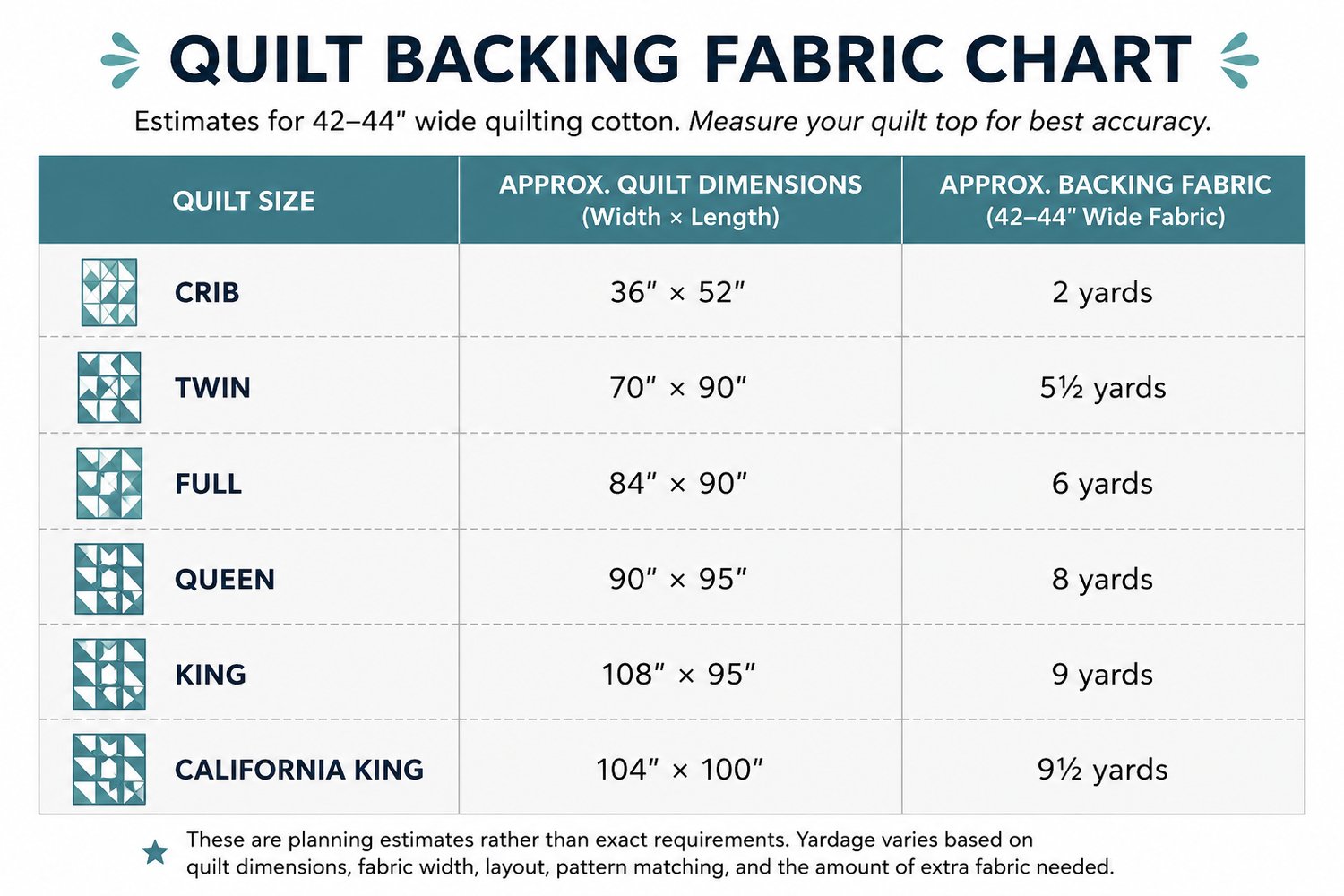
Quick Quilt Backing Fabric Chart
The amounts below are general estimates for standard 42–44-inch-wide quilting cotton. Because quilt dimensions vary by pattern, always measure your finished quilt top before purchasing or cutting your fabric.
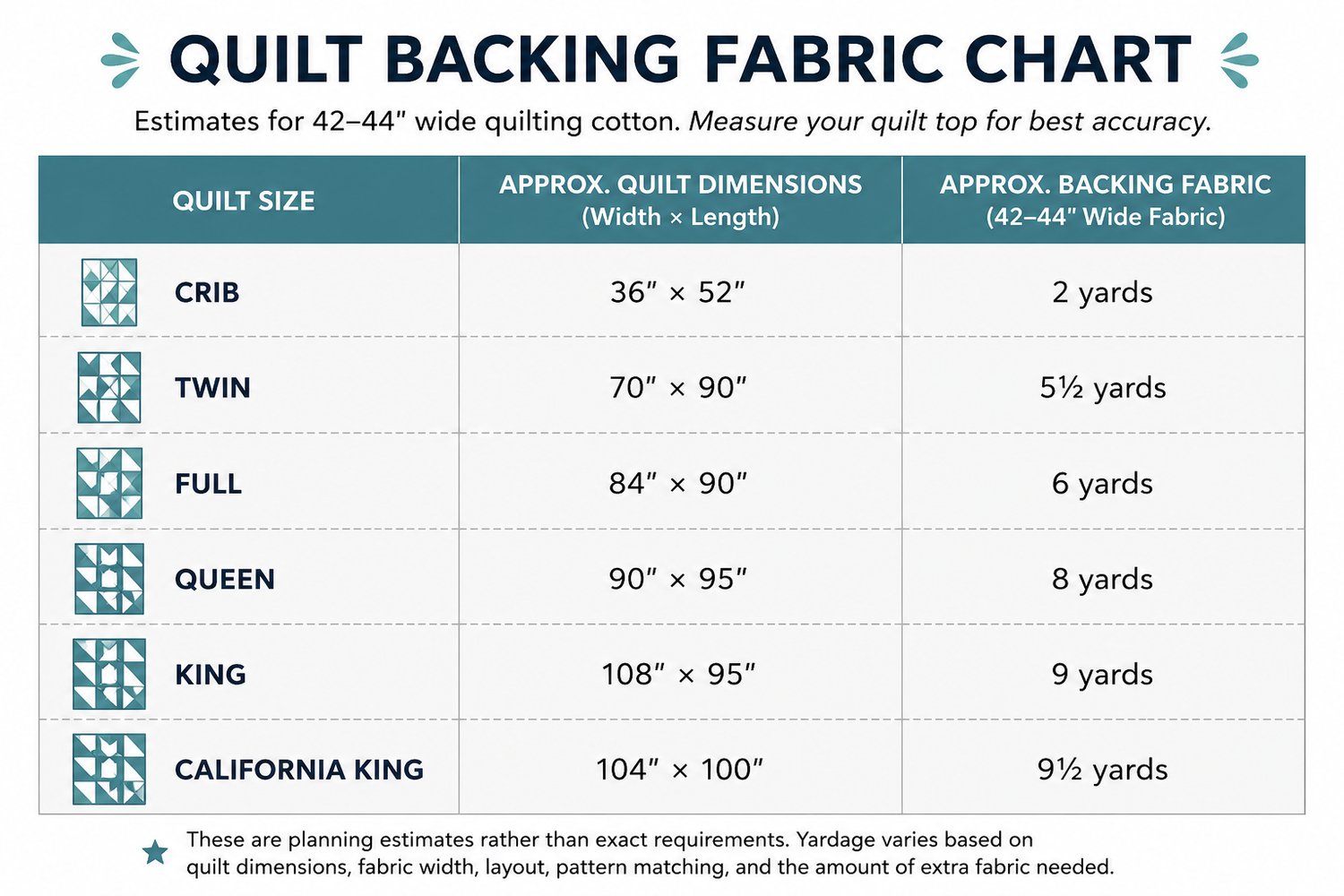
Important: These are planning estimates rather than exact requirements. Your actual yardage depends on the dimensions of your quilt, fabric width, backing layout, pattern matching, and the amount of extra fabric required for quilting.
Why Does a Quilt Back Need to Be Larger Than the Quilt Top?
Your backing shouldn’t be exactly the same size as your quilt top.
Extra fabric around the edges gives you room to layer and quilt the project without accidentally running out of backing.
A common approach is to make your backing approximately 4 inches larger than the quilt top on every side. That means adding about 8 inches to both the width and length of the quilt.
For example, if your quilt top measures:
60” × 72”
Plan for a backing measuring approximately:
68” × 80”
If you’re sending your quilt to a longarm quilter, ask about their requirements before cutting your backing. Your quilter may request a specific amount of extra fabric.
How to Calculate Quilt Backing Yourself
When you want a more accurate answer than a standard chart can provide, start by measuring your completed quilt top.
Step 1: Measure Your Quilt
Measure the actual width and length rather than relying entirely on the dimensions listed in your pattern.
Suppose your quilt measures:
60” wide × 72” long
Step 2: Add Extra Fabric for Quilting
Add approximately 8 inches to each measurement to provide about 4 inches of extra backing on every side.
Your target backing becomes:
68” × 80”
Step 3: Check Your Fabric Width
Most standard quilting cotton is approximately 42–44 inches wide before you account for selvages.
That means larger quilts usually can’t be backed with one single width of standard quilting cotton. You’ll need to piece multiple lengths of fabric together.
Step 4: Calculate the Number of Lengths You Need
Determine how many fabric widths you’ll need to cover the width of your backing.
For our 68-inch-wide example, two widths of standard quilting cotton will generally provide enough coverage.
Each piece needs to be approximately 80 inches long.
So:
80” × 2 = 160”
Then convert inches to yards:
160 ÷ 36 = 4.44 yards
Because it’s wise to leave yourself some room for trimming, straightening and minor measurement differences, you would round up rather than buying exactly 4.44 yards.
What About 108-Inch-Wide Quilt Backing?
Wide-back fabric can make this process considerably easier.
Instead of piecing several widths of standard quilting cotton together, 108-inch-wide backing fabric can cover many quilts with little or no piecing.
That doesn’t necessarily mean you’ll use fewer square inches of fabric, but you may need fewer seams—and considerably less backing math.
When comparing regular quilting cotton with wide-back fabric, compare the total cost of the fabric you actually need, rather than comparing the price per yard alone.
Should I Prewash My Quilt Backing?
This depends partly on how you handle the fabrics in the rest of your quilt.
If you prewashed the fabric used for your quilt top, you may also want to prewash your backing. If you normally quilt with unwashed fabric, you may choose to leave your backing unwashed as well.
Consistency is often more important than choosing one method universally.
Remember that fabric can shrink when washed, so if you prewash your backing, purchase enough to account for possible shrinkage.
Don’t Forget About Directional Prints
Backing calculations become a little more complicated when your fabric has an obvious direction.
Words, stripes, trees, animals and other directional designs may need to face the same way when you piece the backing.
You may therefore need additional yardage to match or orient the print correctly.
The same applies to fabrics with a large repeat that you want to pattern-match.
When in doubt, buy a little extra.
Can I Piece Together Leftover Fabric for My Quilt Back?
Absolutely.
A quilt backing doesn’t have to be made from one fabric.
Leftover yardage, extra blocks and larger pieces from your fabric collection can make beautiful pieced backs. It’s also a practical way to use fabric you already own.
Just remember that your completed pieced backing still needs to be larger than your quilt top.
The Easiest Rule to Remember
If you don’t want to memorize a pile of formulas, remember these three things:
Measure the actual quilt top.
Add extra fabric around all four sides.
Round your yardage up—not down.
A few extra inches of backing are useful.
Discovering that your backing is two inches too small after you’ve pieced it together is not.
Keep Your Quilt Math in One Place
Backing is only one of the calculations that comes up while making a quilt. There are also borders, binding, blocks, precuts and other fabric requirements to figure out along the way.
That’s why I created the Made to Learn Quilt Math Guide & Workbook: a printable reference designed to keep the quilt math you use most often together in one place.
Find it here: https://payhip.com/madetolearn
Use this free backing guide whenever you need it, and if you’d rather have your quilting calculations sitting beside you at the cutting table, the Quilt Math Guide is there when you’re ready for it.
Made to Learn
Learn to Make.