
How to Check Knitting Gauge: A Simple Guide for Knitters
Learn how to knit and measure a gauge swatch, what knitting gauge means, and how to adjust your needle size when your gauge is off.
What Is Knitting Gauge?
If you've ever looked at a knitting pattern and seen something like:
18 stitches and 24 rows = 4 inches
—that's the pattern's gauge.
Gauge tells you how many stitches and rows should fit into a particular measurement. It matters because two people can use the same yarn, the same needles, and the same pattern and still produce slightly different-sized stitches.
For a scarf, that may not matter very much.
For a sweater? It matters quite a lot.
How to Make a Gauge Swatch
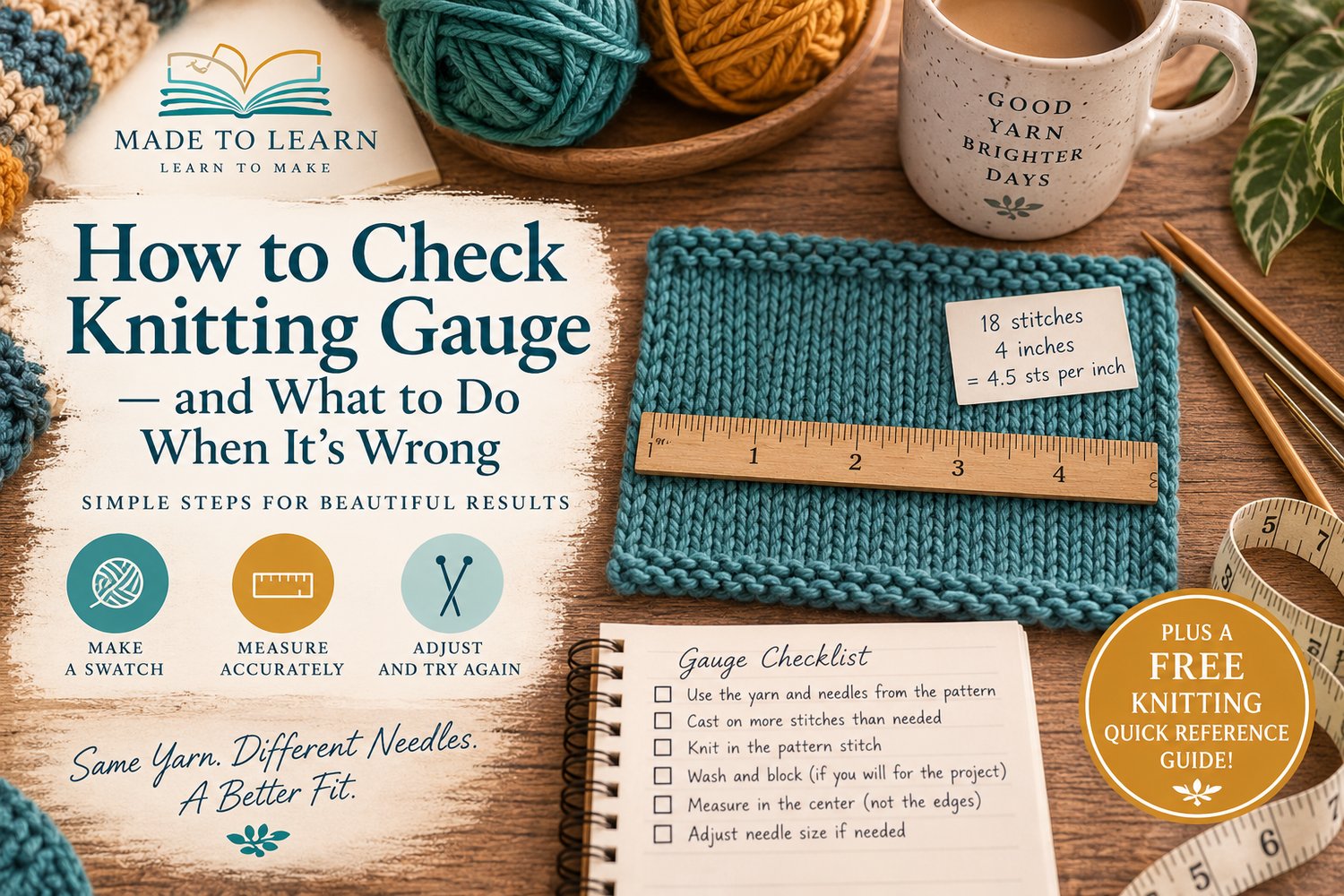
Start with the yarn and needle size recommended in your pattern.
Cast on enough stitches to make a swatch larger than the area you need to measure. If the pattern gives gauge over 4 inches, don't make your entire swatch exactly 4 inches wide. Give yourself room to measure stitches away from the edges.
Work the swatch using the stitch pattern specified in your pattern.
Then treat the swatch the way you intend to treat the finished project. If you'll wash and block the sweater, wash and block the swatch before taking your final measurement.
How to Measure It
Lay the swatch flat without stretching it.
Place a ruler across the center and count how many stitches fit within 4 inches. Do the same vertically to count rows.
You can also calculate stitches per inch:
number of stitches ÷ measured width = stitches per inch
For example, if 18 stitches measure 4 inches:
18 ÷ 4 = 4.5 stitches per inch
What If My Gauge Is Wrong?
Here's the part that's easy to mix up:
Too many stitches per inch? Your stitches are too small. Try a larger needle.
Too few stitches per inch? Your stitches are too large. Try a smaller needle.
Swatch again after changing needle sizes.
And remember: the needle size printed on a pattern is a starting point. The gauge is the goal.
Keep a Record
Once you've found the right combination of yarn, needles, and gauge, write it down.
Future-you will be very glad you did.
Free Knitting Quick Reference
I've put together a FREE Made to Learn Knitting Quick Reference Guide with common needle sizes, yarn weights, abbreviations, stitch examples, gauge help, and a before-you-cast-on checklist.
→ Download the FREE Knitting Quick Reference
Working on a bigger project? Pair it with the Made to Learn Knitting Project Planner to record your yarn, needles, gauge, sizing, modifications, and project notes.
Made to Learn.
Learn to Make.