

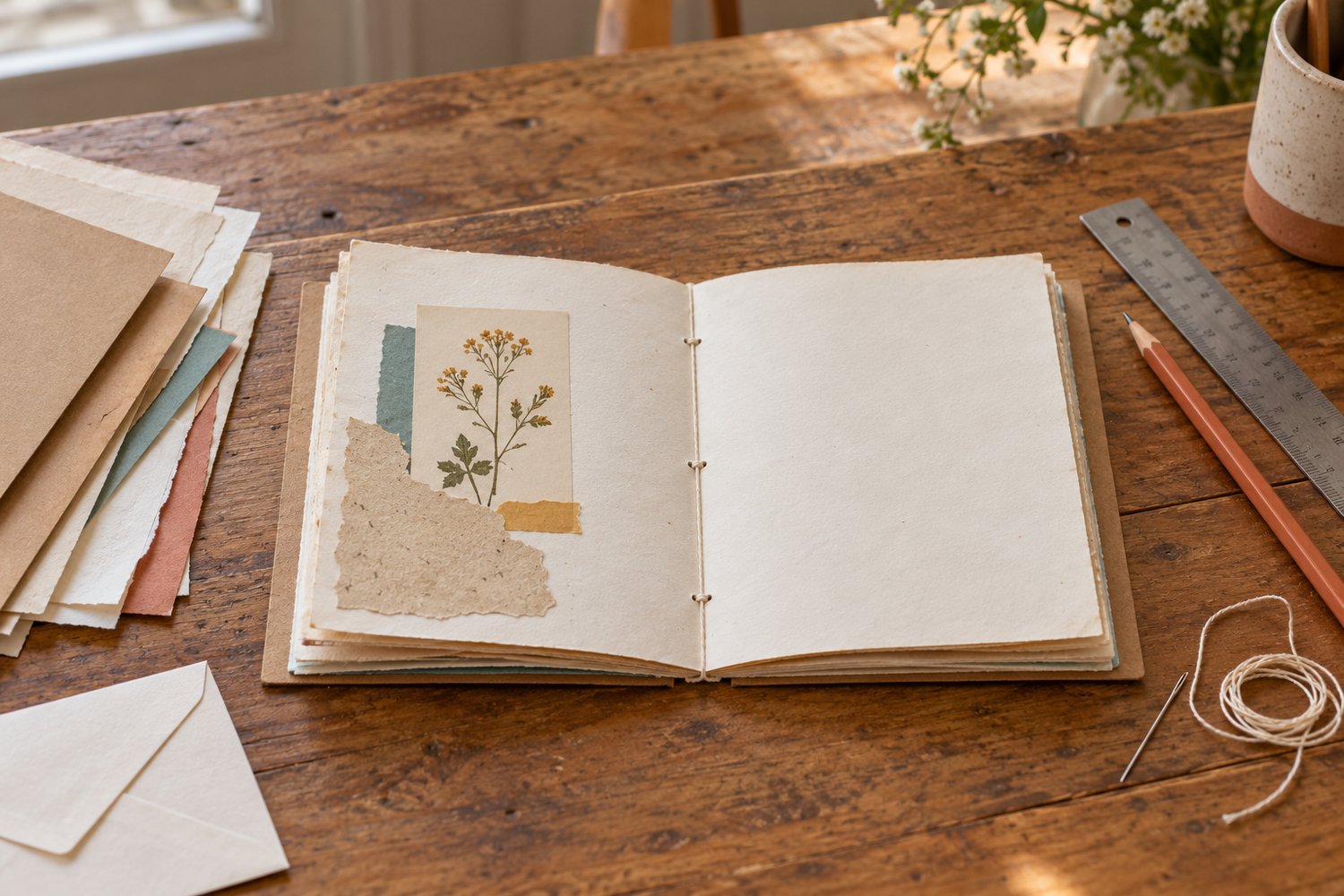
You have saved the envelopes, collected the paper scraps and found a particularly nice piece of packaging. Now comes the awkward question: how does this pile become an actual journal?
Start with one small booklet. A single-signature junk journal gives your papers a home without requiring a complicated spine or an entire bookbinding kit.
A signature is simply a group of folded sheets nested together. The name sounds considerably more impressive than the pile on the table.
Gather a small stack.
Choose four to six sheets of ordinary paper and one piece of flexible cardstock for the cover. Printer paper, leftover stationery and sturdy wrapping paper can work together. Save brittle paper and tiny scraps for decorating later.
You’ll also need a ruler, pencil, clips, strong thread, a needle and an awl for making holes.
Fold before you decorate.
Fold each sheet in half individually, then nest the folds together. Fold your cardstock around the stack. Trim any pages that extend farther than you want, and check that the booklet closes comfortably.
If the stack springs open or feels difficult to handle, remove a sheet or two. Lace, pockets and glued-on treasures will add thickness later. Leave them some breathing room.
Sew a simple three-hole binding.
Clip the pages and cover together. Mark three points along the fold: the center, then about 1 inch (2.5 cm) from each end.
With the fold supported in a thick old phone book or bookbinding cradle, pierce through the pages and cover at each mark. Keep your fingers clear underneath.
Cut thread roughly three times the booklet’s height. Then:
- Sew from inside to outside through the center hole, leaving a tail inside.
- Return inside through the top hole.
- Sew outside through the bottom hole, skipping the center.
- Return inside through the center hole without piercing the existing thread.
Place the two tails on opposite sides of the long interior stitch. Gently remove slack and tie a square knot around that stitch.
Finish one spread.
Choose one picture, one paper scrap and a few handwritten words. Arrange them before gluing. Keep thick embellishments away from the fold so the pages can turn easily.
You do not need to decorate every page today. An empty page is available space, not unfinished homework.
For help deciding what belongs on those pages, the Made to Learn Junk Journal Creative Guide and Vintage Ephemera Pack explores page structures, composition, color and storytelling. Its included historical imagery gives you material to experiment with as you develop your own style.
Start with a small book and the supplies within reach.
Made to Learn.
Learn to Make.