

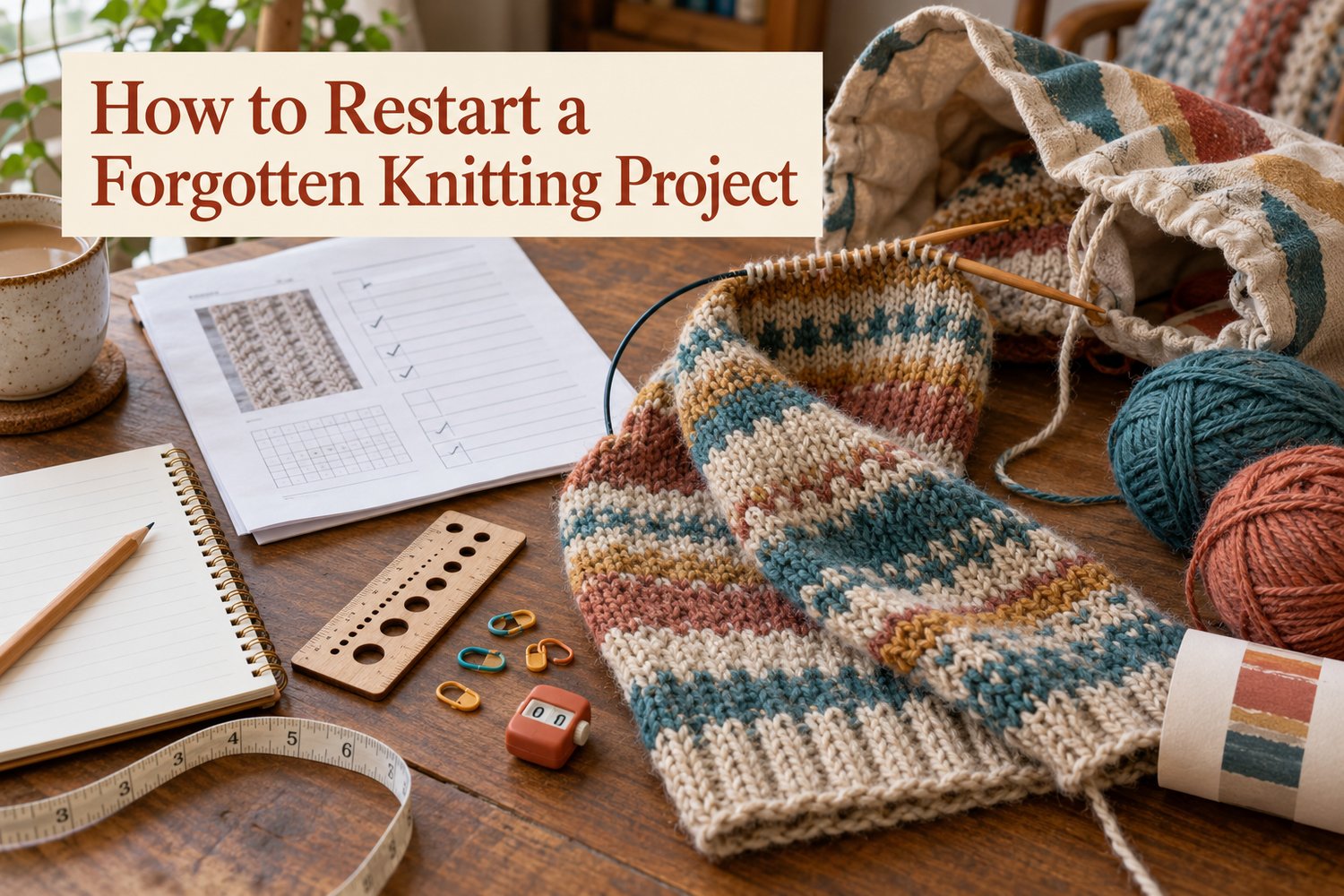
How to Restart a Knitting Project When You Forgot Where You Left Off
You open a project bag and find half a scarf, two needles and a pattern folded to a page that may—or may not—have anything to do with the knitting inside.
The project is not necessarily doomed. Before pulling out your work, spend a few minutes reconstructing what you already did.
Gather the Evidence
Empty only that project bag onto the table. Look for:
- The pattern or a saved digital copy
- Yarn labels
- Spare yarn
- Needle packaging or a needle gauge
- Row counters, stitch markers and handwritten notes
Identify the yarn and needle size first. If the needles are unmarked, use a needle gauge rather than trusting your memory. Memory is a lovely thing, but apparently it does not consider needle sizes important enough to retain.
Identify the Fabric
Determine which side of the knitting is the right side.
In stockinette, the right side usually shows smooth columns of V-shaped stitches, while the reverse shows purl bumps. Garter stitch has ridges on both sides, so use details such as a yarn tail, shaping or button band to compare the piece with the pattern photographs.
Next, examine the stitches closest to the needle. These help reveal whether the most recent row was knit, purled or part of a stitch-pattern repeat.
Count the Rows
For stockinette, choose one clear vertical column and count the V-shaped stitches from the cast-on edge toward the needle.
For garter stitch, count the raised ridges. One garter ridge usually represents two knitted rows. Check whether the pattern counts its cast-on or setup row before deciding on your final number.
If the project includes lace, cables or colorwork, locate one complete repeat and work upward from it. Do not rely on the total row count alone; you also need to know your position inside the repeat.
Check the Stitch Count and Shaping
Count the live stitches on the needle and compare that number with the pattern.
Look for visible increases, decreases, armhole shaping or completed pattern sections. Measuring the piece can also help you identify whether you stopped before or after instructions such as “continue until the work measures 12 inches.”
When two clues agree—such as stitch count and measurement—you can restart with much more confidence.
Write a Restart Note
Before knitting again, record:
- The last completed row
- The next instruction
- Current stitch count
- Needle size
- Any modifications
- The date you restarted
Keep the note inside the project bag.
The Made to Learn WIP + UFO Rescue Planner includes a “Where Was I?” reconstruction page, materials planning and a step-by-step rescue route. It helps turn a mysterious bag of yarn into a project with one clear next action.
You do not need to remember everything. You only need enough evidence to find your way back in.
Made to Learn — Learn to Make.