

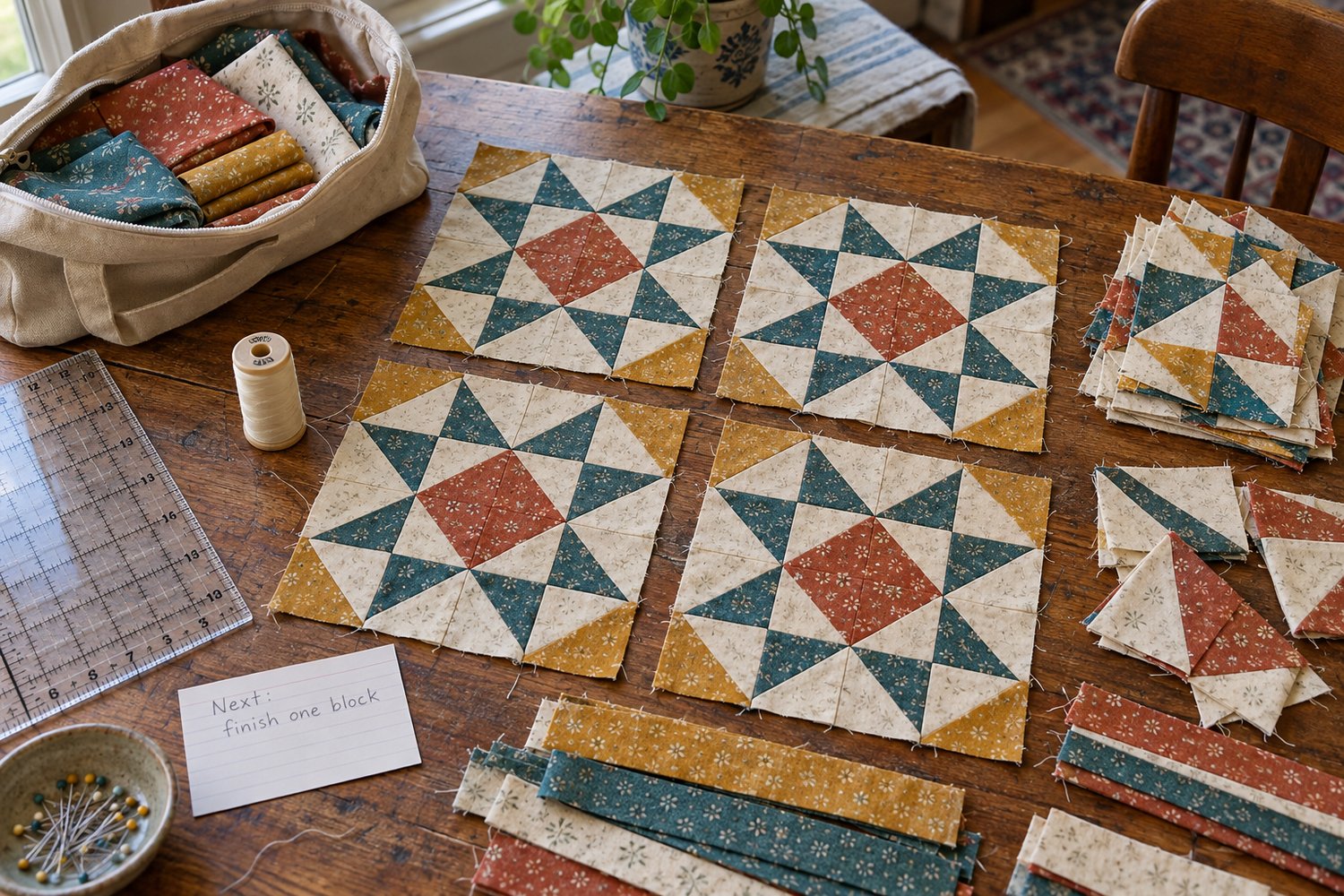
How to Restart an Unfinished Quilt When You’ve Forgotten Where You Stopped
You open a project bag and discover twelve blocks, several mysterious strips and a note that says “finish these.”
Helpful. Thank you, Past Me.
If you want to restart an unfinished quilt but cannot remember the plan, begin with a little detective work. You do not need to reorganize your entire craft room first. The chair wearing three projects can wait.
1. Gather the evidence.
Choose one project. Put its blocks, remaining fabric, pattern and notes together on a clear surface. Check your phone for progress photos and your downloads or purchase emails for the pattern.
Keep unidentified pieces aside until you know what they were meant to become. A narrow strip might be a leftover—or the last piece needed for a border.
2. Write down what is actually finished.
Count completed blocks and measure a few. Compare their unfinished measurements with the pattern, including seam allowances.
Be specific: “Twelve blocks assembled; four still need their final seams” is more useful than “top nearly done.” If blocks differ in size, investigate before trimming anything.
Photograph the pieces laid out together. That picture becomes a reference when the kitchen table needs to return to kitchen duty.
3. Find the first unanswered question.
What prevents you from continuing?
Maybe you cannot remember the layout. Maybe you ran short of background fabric. Maybe one block went wrong and the whole project was quietly promoted to cupboard resident.
Write that obstacle as a question: “How many background squares do I still need?” Then answer that question before adding more tasks. One clear problem is easier to tackle than a vague feeling that everything needs fixing.
4. Choose a small restart task.
Give yourself a task with a visible stopping point: locate the pattern page, arrange one row, count the missing pieces or complete one block.
If the original quilt no longer appeals, consider a smaller finish. A group of blocks could become a cushion or table runner. Check the layout and fabric requirements before committing.
5. Leave instructions for your next visit.
Before packing up, write three things: what you completed, what comes next and where the supplies are. Keep that note with the project.
For a printable place to work through this process, the Made to Learn WIP/UFO Rescue Planner includes a project reconstruction page, a stalled-project assessment and a step-by-step rescue plan. These help you capture the missing information and decide how to move forward.
Today’s goal can simply be making your quilt understandable again. That counts as progress.
Made to Learn.
Learn to Make.