
What Is a Chaos Blanket? How to Use the Viral Crochet Trend in Any Fiber Art
If you’ve been on the crafty side of TikTok lately, you may have seen people making chaos blankets.
The idea immediately appealed to me for two reasons.
First, I have enough leftover yarn, fabric, scraps, and partially formed project ideas to supply a small craft store.
Second, I spend a lot of time thinking about what I’m going to make.
What colors should I use? Which stitch? Which fabric? Should this part be three rows or five? Would the mustard look better here? Maybe teal? What if I changed the entire plan halfway through?
Sometimes having endless creative choices isn’t particularly freeing.
Enter: chaos.
What Is a Chaos Blanket?
A chaos blanket is a crochet project where some of the design decisions are made randomly instead of being planned in advance.
Makers have been using things like slips of paper, dice, random-number generators, or spinning wheels to select different elements of the blanket.
A simple version might have three categories:
Color + Stitch + Number of Rows
You make a pool of options for each category and randomly select one from each.
You might draw:
Mustard + moss stitch + 3 rows
You crochet those three rows.
Then you draw again:
Cream + double crochet + 1 row
And that’s what you do next.
Eventually, the random decisions build into a blanket that you probably never would have designed intentionally.
And that is kind of the point.
But I Don’t Actually Want
Complete
Chaos
This is where my teacher brain gets involved.
I love the idea of giving up some creative control.
I do not love the idea of getting halfway through a project and discovering that my experiment has become structurally impossible.
So my version of the Chaos Method has one rule:
Randomize the design. Not the construction.
You can let chance decide your colors, textures, stitches, blocks, placement, or number of repeats.
But some things shouldn’t be random.
Your stitch count still matters.
Gauge can still matter.
Yarn weights need to work together.
Quilt blocks eventually need to fit together.
Seam allowances do not care that we’re embracing spontaneity.
The goal isn’t to stop understanding what you’re doing.
It’s actually the opposite.
Understand the construction well enough that you know which rules you can safely break.
That’s much more interesting to me.
How to Make Your Own Crochet Chaos Project
You don’t need anything fancy.
Grab three bowls, envelopes, jars, or bags and some little pieces of paper.
Your first container is COLOR.
Write down the yarn colors you’ve chosen for your project.
Your second is STITCH.
Depending on your skill level and stitch count, you might include things like single crochet, half-double crochet, double crochet, moss stitch, lemon peel, granny stripe, or another stitch you enjoy.
Your third container is ROWS.
Add numbers such as 1, 2, 3, 4, 5, and 6.
Then draw one slip from each container.
That’s your assignment.
When those rows are finished, draw again.
One important tip before you begin
Don’t fill your stitch bowl with every crochet stitch you’ve ever encountered.
Build a collection of stitches that will work reasonably well together.
If one stitch pattern requires a multiple of 4 and another requires a multiple of 5 plus 2, you may spend considerably more time doing math than embracing chaos.
Unless doing unexpected crochet math is your particular brand of chaos.
In that case, carry on.
What If We Took the Chaos Blanket Outside of Crochet?
This was the question that really interested me.
Because once you strip away the crochet-specific part, a chaos blanket is really just a randomized creative process.
And there is absolutely no reason yarn gets to have all the fun.
Chaos Knitting
Knitting is probably the easiest translation.
Try:
Color + Stitch/Texture + Number of Rows
Your texture pool could include garter, stockinette, seed stitch, ribbing, moss stitch, or other compatible patterns.
This could make an especially good stash blanket or scarf.
Again, build the randomness around a stable foundation. Choose stitches that work with your established stitch count and think about how dramatically different textures may affect the width of your fabric.
The Chaos Scrap Quilt
This might be my favorite.
I’ve already talked about organizing quilting scraps by useful sizes rather than just throwing everything into one enormous scrap bin.
Now we can put those organized scraps to work.
Try:
Fabric + Block + Orientation
Or:
Color Family + Block + Placement
You could establish a finished block size first and create a pool of blocks that all finish at that measurement.
Then draw your instructions one block at a time.
Imagine a quilt where you choose the framework but don’t get to choose exactly what happens inside it.
That’s a project I want to make.
Chaos Embroidery
Embroidery offers even more freedom because you’re not necessarily trying to maintain rows or block sizes.
Try:
Color + Stitch + Motif/Area
Create a sampler with different sections and let each draw determine what happens next.
You might pull:
Mustard + French knots + leaves
Then:
Teal + backstitch + border
Instead of following a predetermined sampler, you’re essentially documenting your stitch vocabulary as you go.
It becomes both artwork and practice.
Chaos English Paper Piecing
EPP could work beautifully with a controlled version of the method.
If you’re working with one template shape, randomize:
Fabric + Placement + Orientation
For a more complicated project, you could create a carefully selected group of compatible shapes first and then introduce randomness within that system.
The geometry stays intentional.
The fabric decisions don’t have to.
Chaos Junk Journaling
Junk journaling was practically made for this.
Try four categories:
Background + Focal Image + Ephemera + Technique
You might draw:
Book page + botanical + ticket + stitching
That’s your page recipe.
The next page might be:
Ledger paper + portrait + postage stamp + torn edges
If you tend to collect beautiful paper and ephemera and then become completely paralyzed when it’s time to actually use it, this could be a very effective cure.
What Doesn’t Work With the Chaos Method?
Not every fiber art needs to be forced into a trend.
I initially considered adapting this to tablet weaving, for example, and decided against including it in my Chaos Project Planner.
Tablet weaving depends heavily on the relationship among threading, card orientation, turning direction, and sequence. Randomly changing those elements isn’t the same kind of low-risk creative experimentation.
And that’s an important part of learning a craft too:
Knowing when randomness is fun—and when structure is doing important work.
The Chaos Method Is Really About Learning
That’s what I find most interesting about this trend.
At first glance, a chaos blanket looks like a way to avoid making decisions.
But I think it can actually teach us quite a bit.
You’ll start noticing which colors you love together.
You’ll discover textures you wouldn’t have intentionally combined.
You’ll learn which stitches behave well beside one another.
You’ll probably draw a combination you dislike—and then discover whether you actually dislike it once you see it worked up.
And occasionally you’ll pull something that makes you think:
There is absolutely no way those belong together.
Then you’ll make it anyway.
Sometimes you’ll be right.
That’s useful information too.
Free Chaos Project Planner
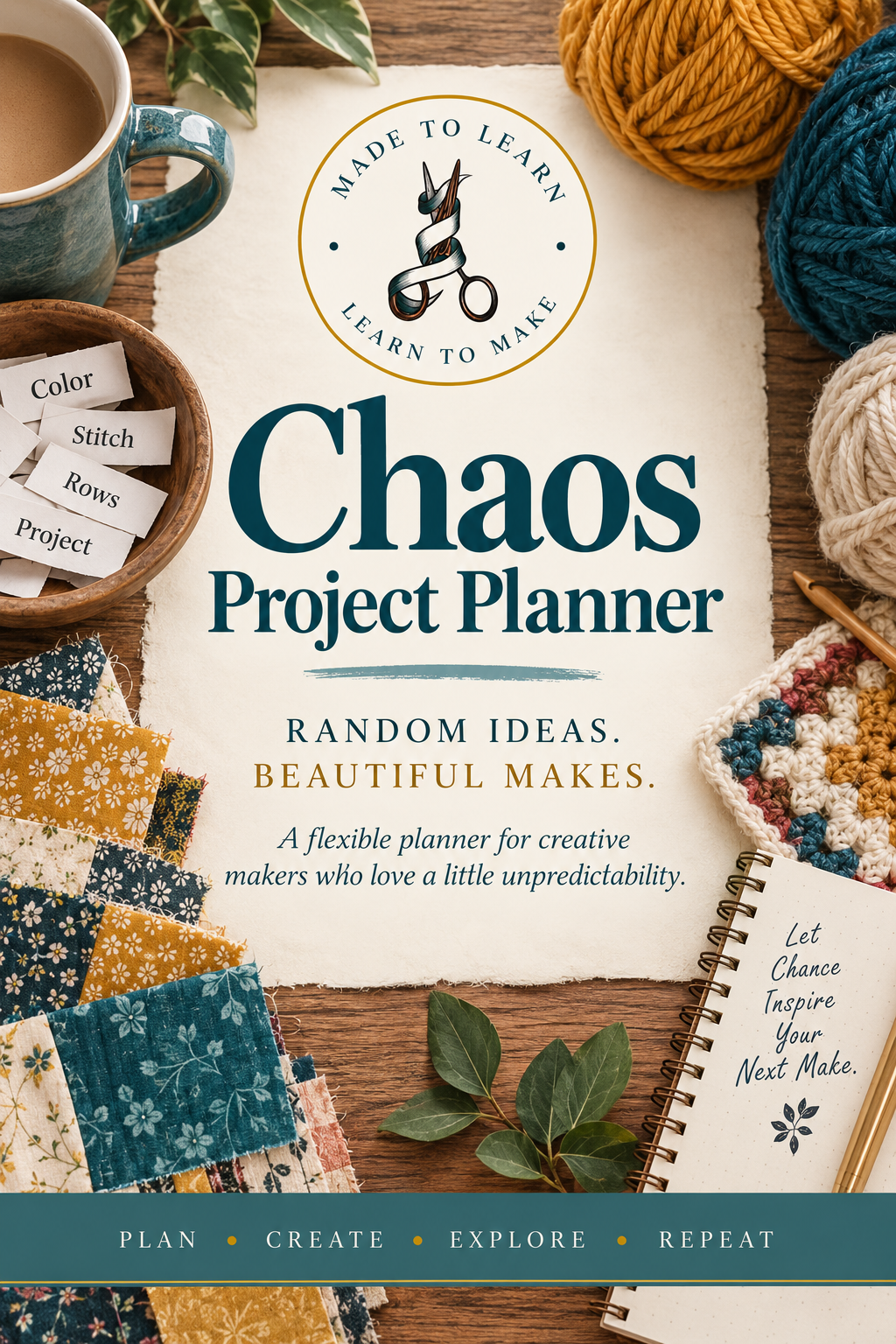
I created a Made to Learn Chaos Project Planner to make experimenting with this idea a little easier.
Instead of being exclusively a crochet chaos-blanket printable, I designed it so you can use the same method across several crafts.
Inside you’ll find space to establish your project’s non-negotiable construction rules, decide what you’re willing to randomize, build three Chaos Pools, record your draws, keep project notes, and reflect on what the experiment actually taught you.
It includes starting formulas for crochet, knitting, quilting, embroidery, English paper piecing, and junk journaling.
→ Download the Made to Learn Chaos Project Planner
Then go find three containers.
Apparently we’re letting tiny pieces of paper make our creative decisions now.
I’m surprisingly okay with that.
Made to Learn
Learn to Make.