


Japanese business emails follow a standard format.
By following this structure, you can create professional and well-organized emails every time.
First, let’s look at the basic structure and simple rules of Japanese business emails.
Basic Email Format
Japanese business emails follow a basic, required order for their structure.
The required elements are: Subject/Recipient・Address/Opening Greetings/main text/Closing Lines/Signature.
[Email Example]
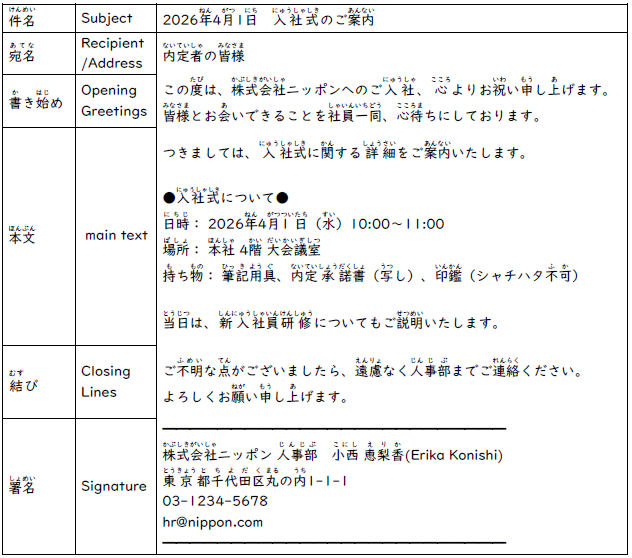
Each part has its own set of rules, so let’s go through them one by one.
1. Subject Line: Be Clear and Concise
The subject line should be specific and brief so the recipient immediately understands the purpose of the email.
For example, a subject like “Please check「確認お願いします」” is too vague—the recipient won’t know what they are supposed to check.
Similarly, even if you try to be polite with a subject like “I would kindly appreciate it if you could check this.「確認の程どうぞよろしくお願いいたします。」” it is too long and still lacks specific details, which is not ideal for business.
Instead, it’s best to include the specific name of the item, such as “Request for Review: Tomorrow’s Meeting Materials.「明日の会議資料の確認依頼」”This makes it clear exactly what needs to be checked.
Using nouns (Meishi) instead of verbs helps keep your subject lines short and professional.
[Examples]
- Verb form: 報告します (Reporting/I will report) → Noun form: (ご)報告 (Report)
- Verb form: 問と合わせます (Inquiring/I will inquire) → Noun form: (お)問い合わせ (Inquiry)