
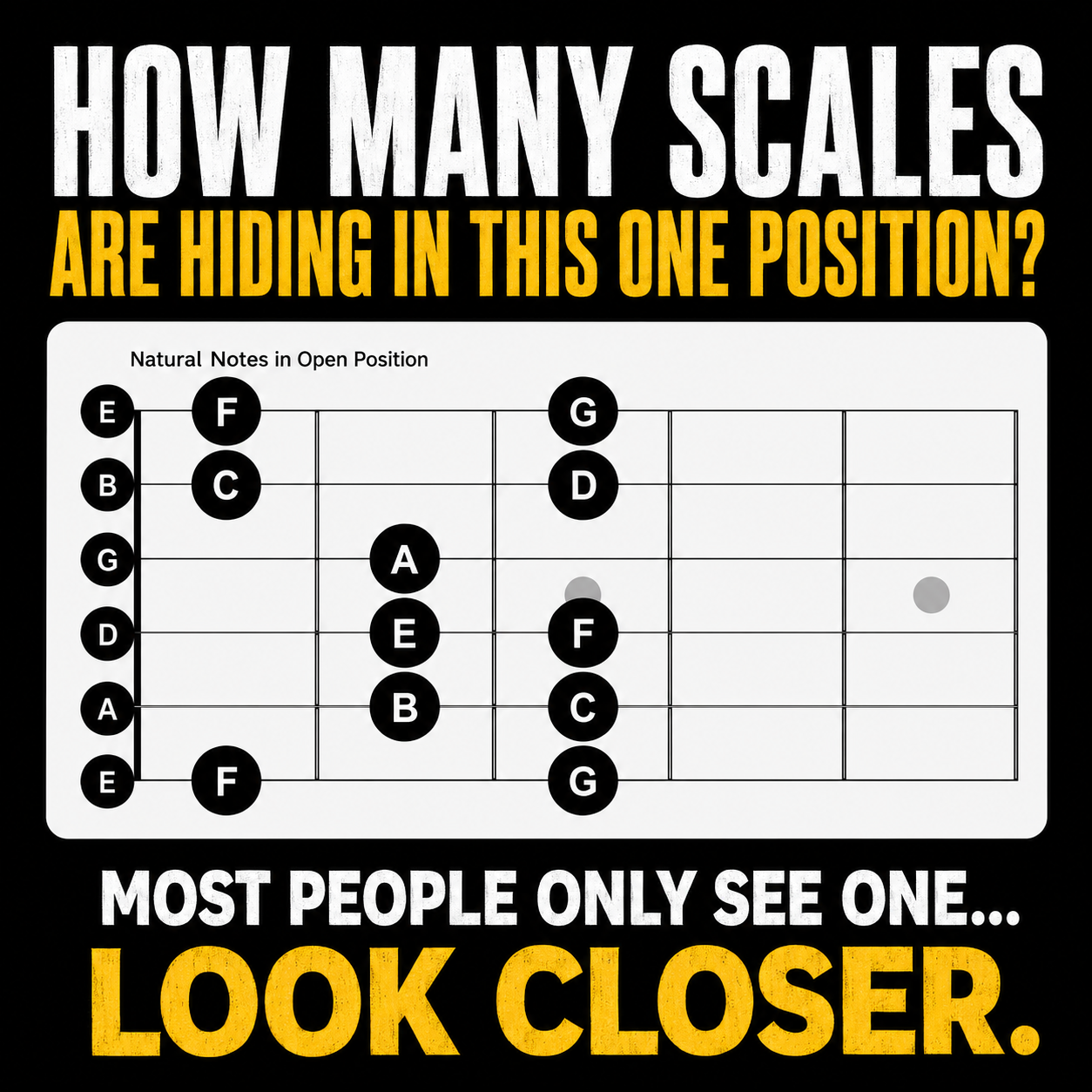
How Many Scales Are Hiding in One Position?
Most guitar players look at one position on the neck and see a single scale.
Maybe it’s C major.
Maybe it’s A minor.
Maybe it’s just a shape they’re trying to memorize.
But that’s not what’s actually there.
A single position is not just one scale.
It’s a zone.
And inside that zone, multiple scales already exist.
It’s Not a Box. It’s a Zone.
The word “box” makes it feel small.
One shape. One idea. One thing to memorize.
But what you’re really looking at is a section of the neck defined by pitch.
Think of it like this:
- The low E string is the floor
- The high E string is the ceiling
Everything inside that space is your zone.
And that zone is not limited to one scale.
It’s only limited by how far the notes can reach within that space.
One Note Pool, Multiple Scales
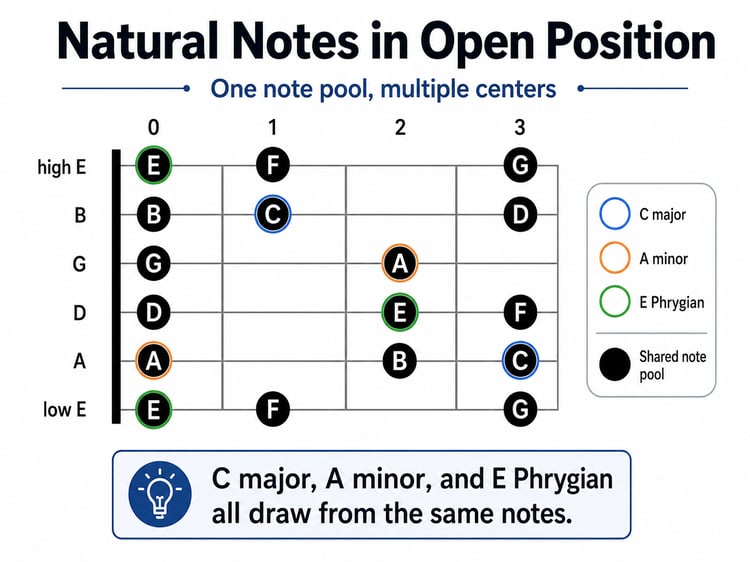
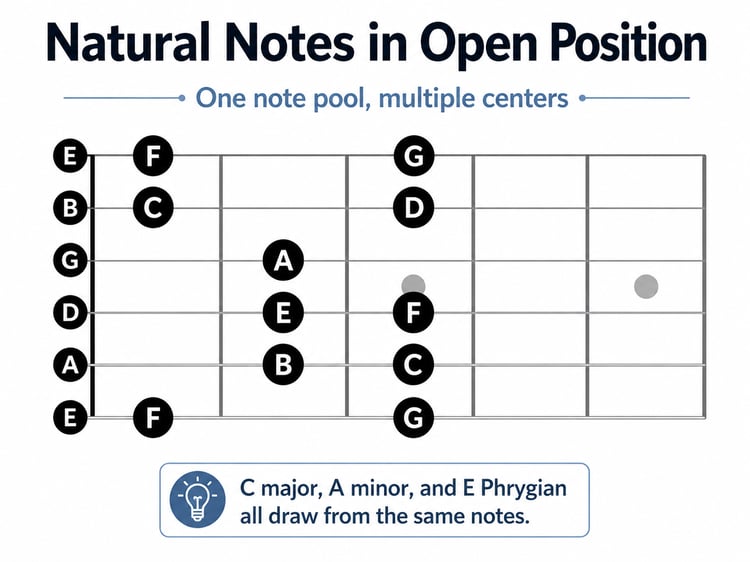
Let’s look at the open position using the natural notes:
A, B, C, D, E, F, G
That’s one note pool.
From that same set of notes, you already have:
- C major
- A minor
- E Phrygian
Nothing new was added.
Nothing changed on the fretboard.
You didn’t move positions.
You’re still in the same zone.
Not All Notes Reach the Same Distance
Here’s where it gets interesting.
Inside any zone, some notes stretch further than others.
A few notes have a two-octave reach.
They exist from the floor all the way to the ceiling.
Most of the other notes have a one-octave reach, with extra notes either above or below.
So even though everything lives in the same zone, the range of each note is different.
That’s part of what shapes how each scale feels inside the same position.
The Zone Is the Constant
This is the shift.
Instead of thinking:
“I need to learn another scale shape”
You start thinking:
“What’s already inside this zone?”
Because inside this one area, you already have:
- multiple scales
- chord tones
- pentatonic pathways
- melodic movement
The fretboard didn’t change.
The notes didn’t change.
The position didn’t change.
Only your understanding of it did.
Scales Are Not Separate Shapes
Once you see the zone clearly, scales stop feeling like isolated patterns.
They become different ways of organizing the same note pool inside a fixed space.
That’s a completely different way to understand the guitar.
Try This
Stay in one position.
Play through the notes slowly.
Don’t move.
Now start listening to how different notes feel when you land on them.
You’ll notice something:
The position didn’t change.
But the sound did.
That’s because the zone already contains more than one possibility.
Why This Matters
This is where the guitar starts to open up.
Instead of stacking more and more shapes in your head, you start seeing depth inside one area.
This one zone is not just a box.
It’s a living section of the neck.
And once you see that, everything connects faster.
Want the Full Breakdown?
I put together a free course that walks through this open position step by step.
It shows how the notes, chords, and scale relationships all live inside this one zone.
You can start here: