
The Four Dimensions of Guitar
Before you learn TAB or note names or rhythm, it helps to understand what the guitar actually is. Not just an instrument with strings and frets, but a layered system.
Most beginners get confused because they jump into information without knowing the layers that hold it all together. When you don’t acknowledge those layers, everything feels random. When you do, the whole instrument starts to make sense.
Think of guitar as something you read in four dimensions:
- Placement
- Identification
- Value
- Function
Each one reveals a deeper truth about the note you’re playing.
Let’s break them down.
1. Placement- Where the note lives
This is your most physical layer. It answers one question:
Where am I on the guitar?
String and fret.
That’s it.
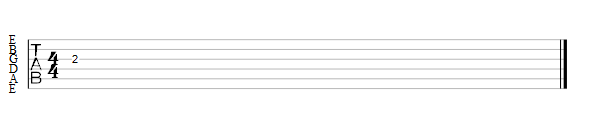
If you’re on the third string, second fret, that’s a location on the map of the instrument. TAB lives in this dimension. It doesn’t tell you the note name or what it means, it just tells your fingers where to go.
This is why beginners start here. Placement is the gateway. It gives your hands something to grab onto while your brain catches up.
2. Identification- What the note is called
Once you know where a note lives, the next layer is figuring out its name.
That same third string, second fret?
It’s A.
This is the layer where most confusion sneaks in, because some notes have two names depending on context. A sharp and B flat. G sharp and A flat. Same pitch, different identity.
Musically, this isn’t “two different notes.”
It’s the same sound wearing different clothes, depending on the key you’re in.
Identification is your language layer. It lets you talk about music, not just imitate it.
3. Value- How long the note lasts
Now we enter the timing dimension.
TAB and note names tell you what to play.
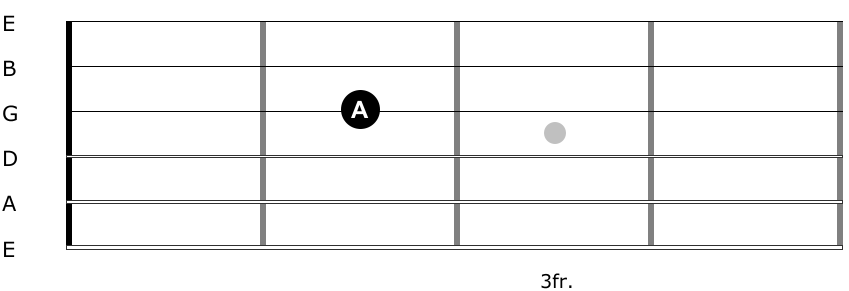
Value tells you how long to play it and where it sits in time.
This dimension is the one that gives music its shape. Whole notes, halves, quarters, eighths, all of it.
You can play all the right pitches and still sound wrong if the timing isn’t right.
And you can make simple notes sound incredible if your timing is solid.
Value is the heartbeat of your playing.

4. Function- What the note means
Here’s the most important dimension, and the least talked about among beginners.
Function answers this:
What does this note do inside the key or chord?
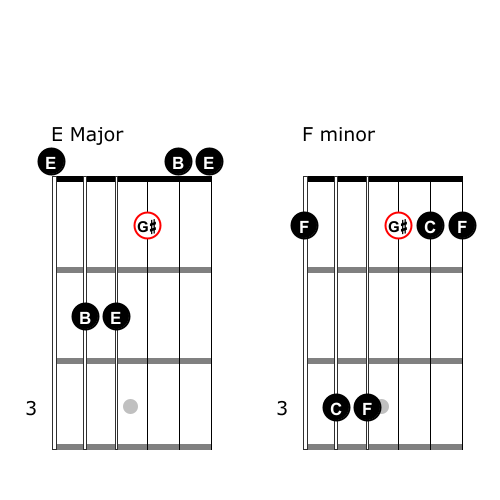
A G sharp in one context is a major third, smooth and warm.
In another context it becomes a sharp fifth, tense and unstable.
Same pitch, totally different meaning.
This is the layer that ties theory together.
It’s where your ear begins to understand emotion and intention.
Function is the “why” behind every note you play. (Shown as vertical chord diagram)
Putting it all together
So reading guitar isn’t just reading symbols.
It’s reading layers.
Every note you play exists in four dimensions at once.
- Placement tells your fingers where to go
- Identification gives you language
- Value lets the music breathe in time
- Function reveals the meaning behind the sound
When you stack these four together, the instrument becomes clear and predictable.
When you skip one, everything feels scattered.
From here on out in this course, every skill you learn will plug into one of these four dimensions. You’ll start seeing guitar not as a wall of confusing information, but as a structured, readable system.
Next step
Now, we’ll take the first dimension, Placement, and dive into how to read TAB correctly, how to avoid the common mistakes, and how TAB interacts with value and timing.
How to Read Tablature the Right Way
(The First Dimension: Placement)
Now that you understand the Four Dimensions of Guitar, we’re going to zoom in on the first one: Placement.
Placement is the physical world of the instrument. It’s where TAB lives. Before you try to read notes or rhythms or patterns, you need to understand how TAB actually works and how to avoid the common traps beginners fall into.
TAB is simple once you see the logic behind it, so let’s walk through it.
What TAB Actually Shows You
TAB doesn’t tell you:
- the note name
- the timing
- the key
- the function
TAB tells you one thing: where on the instrument to put your fingers.
Six lines for six strings.
Numbers for frets.
That’s it.
The String Orientation Problem (and the fix)
Most beginners assume the top line in TAB is the thickest string.
But TAB flips that.
The top line is the thinnest string.
The easiest way to explain it:
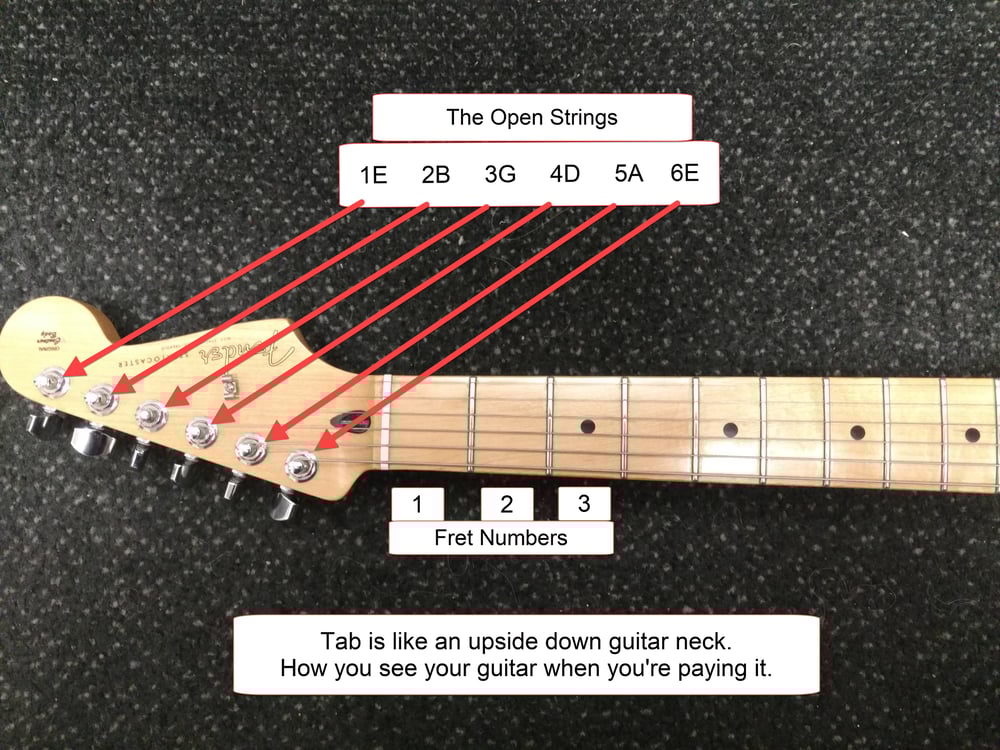
Once you see TAB as a view from above, the orientation makes perfect sense.
How to Read a Single Number
If you see: 1 on the second line from the top, that means:
- second string
- first fret
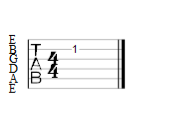
That’s the whole idea, TAB gives you location only.
How to Read Multiple Notes
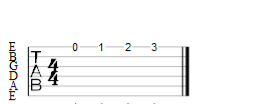
If you see: 0-1-2-3 It means:
- open string
- first fret
- third fret
Spacing is not rhythm.
TAB only cares about placement.
How TAB Connects to Note Value
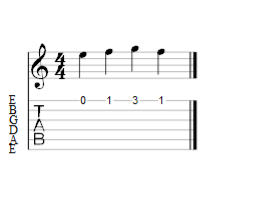
TAB does not show timing by itself.
You get value from:
- rhythm notation above the TAB
- counting
- rests
Placement tells you where.
Value tells you when.
Special Symbols: Slides, Hammers, Pull-offs, Bends
TAB adds symbols to describe mechanics:
- h = hammer-on
- p = pull-off
- / or \ = slide
- b = bend
- ~ = vibrato
These are movement directions.
They don’t change the note value or note name, they just tell you how to move to the next placement.
How to Read Vertical Stacks (Chords)
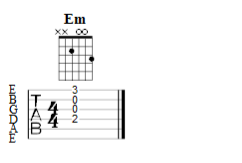
A vertical stack of numbers means play everything at the same time.
That’s TAB’s version of a chord.
The Big Picture: TAB is the First Door
TAB is the first dimension of reading guitar because it teaches your hands the map.
It’s the simplest entry point for melodies, riffs, chords, or scale shapes.
Once placement is comfortable, you’re ready for the deeper layers.
Next
Next, we’ll step into the second dimension: Identification, naming notes across the neck and understanding the logic behind natural notes, sharps, flats, and enharmonics.
Naming Notes Across the Neck
(The Second Dimension: Identification)
Placement tells you where a note lives.
Identification tells you what that note is actually called.
This is the layer where the guitar starts to feel like a real language. When you understand note names across the neck, everything else becomes easier: scales, chords, keys, songwriting, improvising, sight-reading.
And the best part is, it’s simpler than most people think.
Let’s clear it up.
Why naming notes feels confusing at first
Most beginners struggle with this dimension for three reasons:
- The guitar repeats itself across strings.
- Some notes have two names depending on context.
- Players jump into theory without a consistent method for finding notes.
You’re going to avoid all of that by using a structure that always works.
Step 1: Know the natural notes
The natural notes are the foundation of everything AND they are just the alphabet, in order from A to G:
A B C D E F G
These seven notes are your landmarks on the guitar map.
Every sharp or flat exists between natural notes.
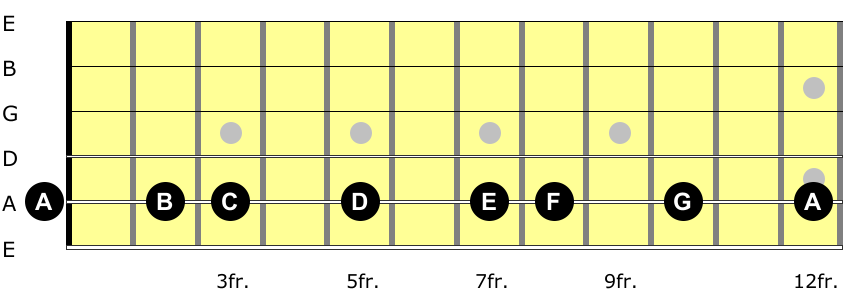
Two natural note pairs have no sharp/flat between them:
- E to F
- B to C
Every other pair has a space between them.
This one rule simplifies the entire fretboard.
Step 2: Learn the notes
Instead of memorizing every single note, learn the patterns that repeat:
One is to go string by string.
Every 12 frets is the same note again, one octave higher.
So if you find a note anywhere, you can find it again:
- 12 frets up on the same string
Step 3: Understand sharps, flats, and why they have two names
This is where most people get confused, but it’s simpler than it seems.
A sharp raises a note by one fret.
A flat lowers a note by one fret.
If you’re on A and move one fret up, you get A sharp.
If you’re on B and move one fret down, you get B flat.
Those two notes land on the same pitch, which is why A sharp = B flat.
They’re called enharmonics.
The name depends on function, which is the fourth dimension.
So for now, just understand:
Two names.
One sound.
Context decides which name you use.
Step 4: The fastest way to identify notes on any string
Here’s the simple process to find any note, anywhere:
- Start from the nearest natural note you know on that string.
- Move up or down using half steps.
- Remember E to F and B to C have no extra space between them.
- Decide whether the note is sharp or flat based on the direction you traveled.
Example:
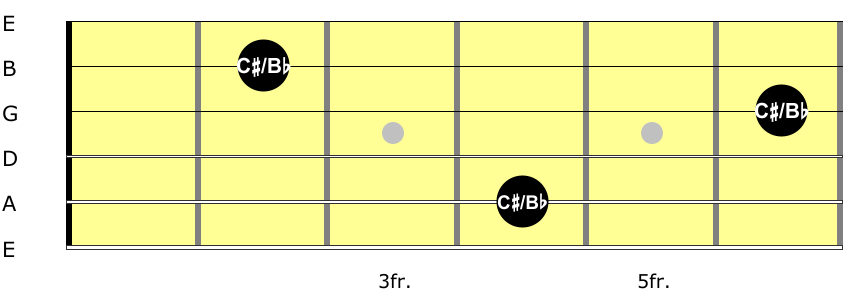
You want to find the note at the 4th fret on the 3rd string.
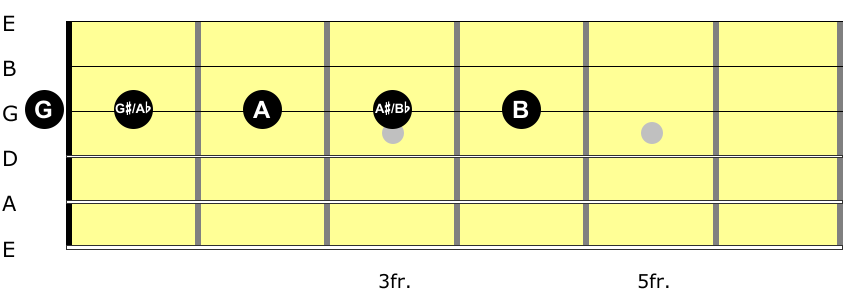
- Open 3rd string is G
- 1st fret is G# / Ab
- 2nd fret is A
- 3rd fret is A# / Bb
- 4th fret is B
Same method works everywhere.
Step 5: The anchor-note method (My Favorite)
This is the “one long string bent into six” perspective.
I teach students to treat each string like a branch of the same linear map.
The open string becomes the anchor:
- open E (low or high)
- open A
- open D
- open G
- open B
Once you know the natural notes on one string, you can read every string.
Why this dimension matters
Identification is the glue between placement and meaning.
Without it, you can only copy shapes.
With it, you can:
- name chords
- build scales
- understand functions
- read music
- improvise with intention
- write better melodies
When you know the names of notes, every other dimension becomes clearer.
Next
Next up is Understanding Rhythm and Timing, the third dimension.
This is where you learn how note value works and how it connects to TAB without overwhelming beginners.
Understanding Rhythm and Timing
(The Third Dimension: Value)
You’ve learned where notes live (Placement).
You’ve learned what they’re called (Identification).
Now we step into the dimension that actually turns sound into music: Value, how long a note lasts and when it happens.
If Placement is the body, and Identification is the name, then Value is the breath. It’s the pulse, the movement, the life of the note.
This is where timing becomes your superpower.
Why timing matters more than notes
A beginner can play the right notes in the wrong rhythm and the whole thing collapses.
A pro can play simple notes with powerful timing and it sounds great.
Rhythm is the foundation of feel.
Without value, everything is guesswork.
Let’s simplify it.
The Mighty Measure
(The Container of All Value)
The measure is where music finally becomes organized. It’s the container that holds everything that comes after. Before a single note is played, the measure quietly tells you three essential things:
- How many beats fit inside this space
- What key you’re in
- Which clef you’re reading
All of that information sits right at the front, almost invisible, but it sets the entire stage. Once the measure is defined, everything that follows has a home.
A measure is like a room with a clear size and purpose.
You can place any combination of notes inside it, long, short, loud, soft, as long as the total value fits the boundary.
It’s the architect of rhythm.
It’s the frame for timing.
It’s the box that music lives in.
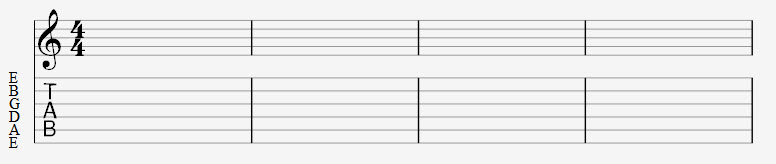
Everything you read, everything you count, everything you play is shaped by the measure. Here are 4 empty measures in Treble clef, key of C and 4/4 time
What Value Actually Means
Every note has a length.
That length determines how it sits inside time.
Value is not volume.
Value is not pitch.
Value is duration.
It answers one question:
How long does this note last?
The Rhythm Grid Explained
Music divides time into equal slices, like a ruler.
These slices create the basic note values:
- whole
- half
- quarter
- eighth
- sixteenth
Think of it as splitting time into smaller and smaller pieces.
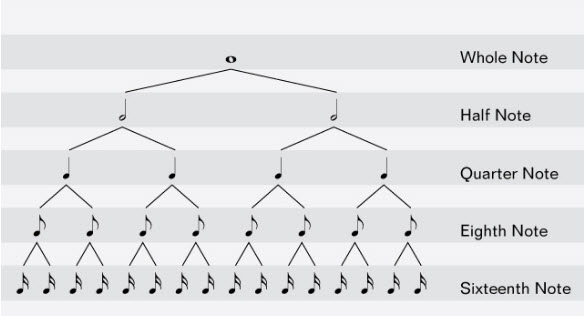
This visual is essential.
Students who see the grid once never forget it.
Counting: The Secret Language of Rhythm
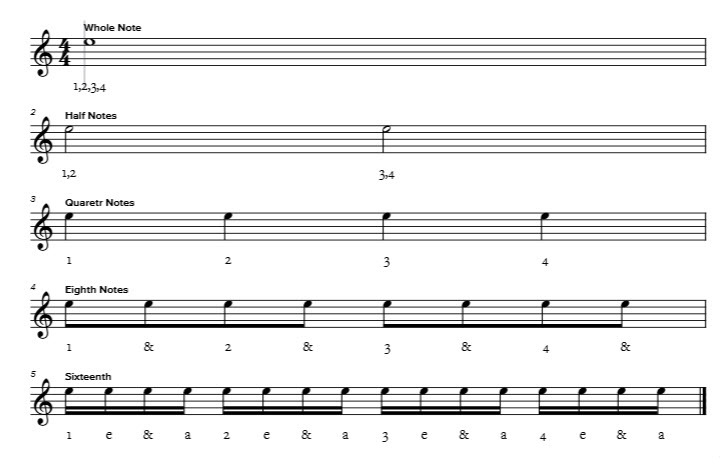
Reading rhythm is really about counting.
Here’s the simplest way to internalize it:
- Whole note = “1 2 3 4”
- Half note = “1 2”
- Quarter note = “1”
- Eighth notes = “1 &”
- Sixteenth notes = “1 e & a”
Counting is what connects your inner pulse to your hands.
How Value Connects to TAB
TAB doesn’t show timing by itself.
It needs Value to come alive.
This means notes on the TAB are just coordinates until you add rhythm notation above or beside them.
When you see TAB with stems, beams, or rhythmic symbols on top, that’s where Value is added to Placement.
Placement = where
Value = when
Together, they form real reading.

Subdivision: How rhythm gets its feel
Subdivision is how you cut time into smaller pieces:
- Wholes
- quarters
- eighths
- sixteenths
This is where grooves come from — rock, blues, funk, folk, everything.
Even if you’re playing one note, the subdivision you feel underneath changes the vibe.

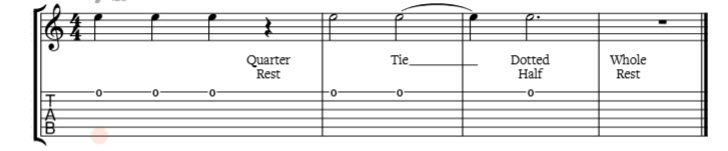
Ties, Rests, and Held Notes
Value isn’t only about playing.
It’s also about not playing.
- Rests are silence with purpose.
- Ties hold notes across beats.
- Dots extend notes by half.
These tiny markings change the shape of a melody instantly.
A Simple Way to Practice Timing (your voice included)
Try this:
- Clap quarter notes and say “1 2 3 4.”
- Then clap eighth notes and say “1 & 2 & 3 & 4 &.”
- Then clap sixteenth notes and say “1 e and a 2 e and a…”
- Now play a single note on the guitar and match the clapping pattern.
This exercise builds rhythmic precision faster than any metronome alone.
If you narrate this in a short video, students will immediately feel the difference.
Why this dimension matters
Value is the layer where musicianship begins.
When students understand timing, the entire instrument changes. They can:
- read melodies correctly
- feel grooves more naturally
- improvise and stay locked in
- control tension and release
- sync rhythm and picking
- play confidently with others
Timing is the hinge that connects technique to feel.
Tempo
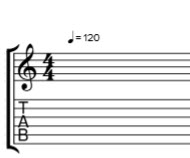
Tempo ties all these together and can move them into faster or slower speeds. This is one of the reasons we use metronomes. You will usually see the BPM (Beats per minute) at the top or beginning of a chart. This one is at 120 beats per minute.
Mini Exercise
Pick one note anywhere on the guitar.
Play that note using:
- four quarter notes
- eight eighth notes
- a whole note
- a half note
- a quarter-note rest followed by four eighth notes
This teaches spacing, counting, and control all at once.
Next
Next up is: Function, the final and deepest dimension. This is where notes stop being dots and start becoming meaning. You learn why certain notes feel stable, sad, bright, tense, or powerful.
Understanding Note Function
(The Fourth Dimension: Function/meaning)
You’ve learned where notes live (Placement).
You’ve learned what they’re called (Identification).
You’ve learned how long they last (Value).
Now we get to the heart of music.
The layer that explains why a note feels the way it feels.
The layer most beginners never learn, and most intermediate players never fully understand.
This is Function.
Function answers one question:
What does this note do inside the key or chord?
This single idea changes everything about how you hear and play music.
Why Function Matters
Two notes can have:
- the same pitch
- the same placement
- the same name
- the same value
…but totally different emotional impact depending on the harmony behind them.
Function is meaning.
It’s relationship.
It’s context.
Once you understand this, the fretboard becomes a story instead of a bunch of dots.
The Major Scale is the Key to Function
Function lives inside the major scale.
Every note inside the scale has a role.
1 = root
2 = supertonic
3 = mediant
4 = subdominant
5 = dominant
6 = submediant
7 = leading tone
You don’t have to memorize the terms.
You just have to understand the feel.
Function Changes with the Key
A note’s meaning changes depending on the key you’re in.
Example: G sharp
- In E major, G sharp is the 3rd (warm, bright)
- In C major, G sharp is the #5 (sharp tension, unstable)
Same pitch.
Completely different function.
This is why enharmonics matter.
This is why naming notes matters.
This is why understanding keys matters.
Function Changes with the Chord Underneath
Function isn’t only about the key.
It’s also about the chord you’re playing over.
Take the note E:
- Over a C major chord, E is the 3rd (sweet)
- Over an A minor chord, E is the 5th (strong, stable)
- Over a G major chord, E is the 6th (open, melodic)
Same note.
Different worlds.
Why This Solves the Fretboard Mystery
Guitarists get confused because they see the same note in multiple places and assume it’s always the same.
Function shows you that’s not true.
Function explains:
- why certain notes sound right
- why some notes want to resolve
- why melodies work the way they do
- why scale positions feel different
- why modes make sense or fall apart
- why chords change the emotional color instantly
Once you see function, you stop guessing and start hearing.
A Simple Way to Feel Function
Here’s an exercise that changes how students hear:
- Play a C chord.
- Then play the note E on any string.
- (That’s the 3rd, feels warm.)
- Now play the same E over an A minor chord.
- (Now it’s the 5th, feels grounded.)
- Now play it over a G chord.
- (Now it’s the 6th, feels open.)
Same note.
Three meanings.
This is function in action.
Intervals: The Connector Between Identification and Function
Intervals explain the distance between notes.
But their real job is showing why a note feels the way it does.
- minor 2nd = tension
- major 3rd = brightness
- perfect 5th = stability
- minor 6th = melancholy
- major 7th = dreamy
Intervals are the emotional fingerprints of music.
Using Function While You Read Guitar
When you’re reading a melody or riff, you’re not just reading numbers or note names.
You’re reading relationships.
You start asking different questions:
- “What is this note doing?”
- “Why does this one feel stable?”
- “Why does this one feel unresolved?”
- “How does this note change when the chord changes?”
That’s functional thinking.
What's Next
Ready to go deeper? The Key to Guitar Beginner's Journey is a full free course that picks up right here.