
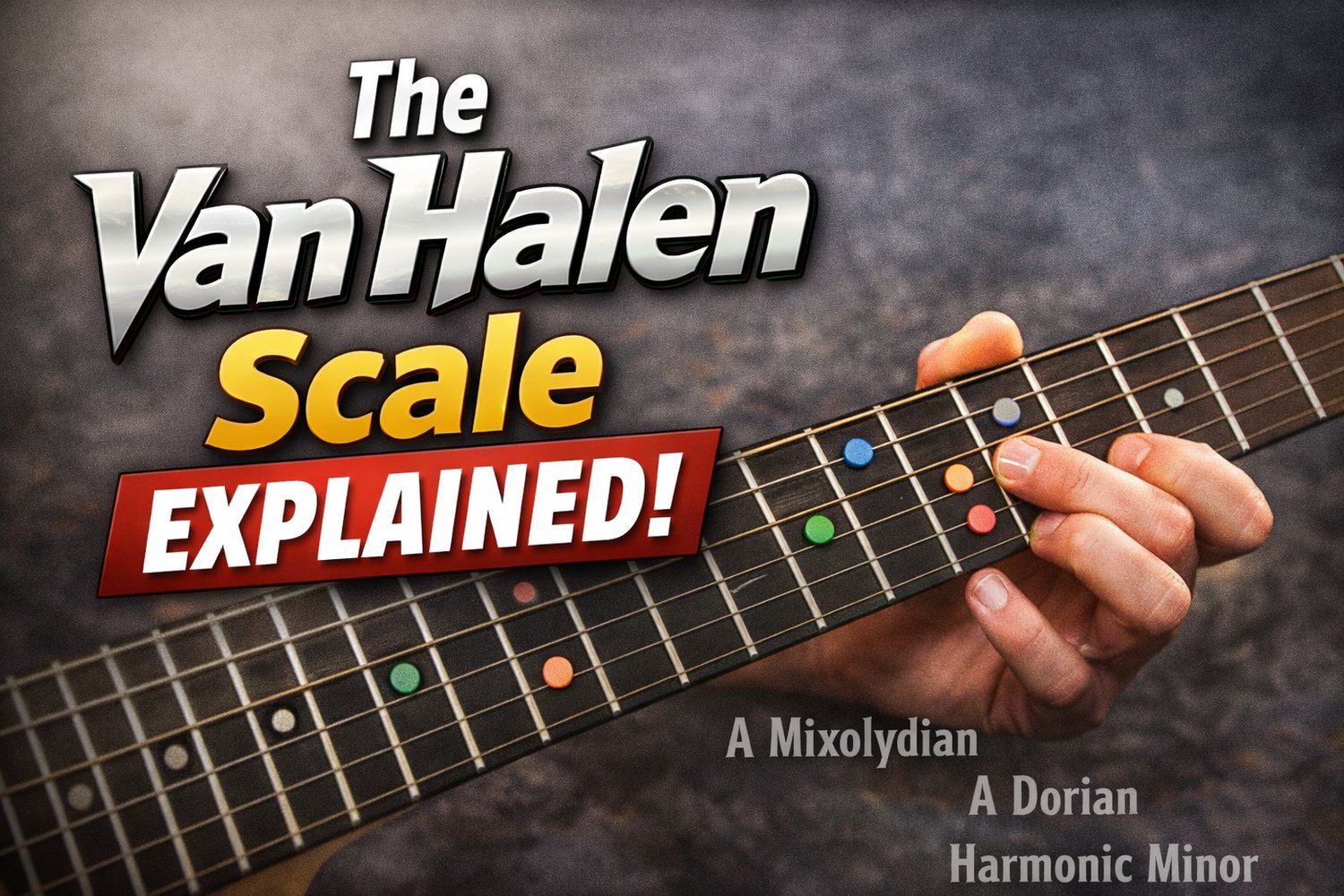
The Van Halen Scale Explained, Pitch Axis in Plain English
When people talk about the “Van Halen scale,” they often treat it like a mysterious, custom scale Eddie invented. In reality, it’s something much deeper and more musical. The core idea behind it is pitch axis.
Instead of changing keys in the traditional sense, the tonal center stays fixed, in this case A, while the surrounding scales shift underneath it. That single root note becomes the anchor while different parent scales rotate around it, creating that unmistakable Van Halen sound.
In this breakdown, I show how Eddie blends A Mixolydian, A Dorian, Dorian blues, natural minor, and harmonic minor, all while keeping A as the tonal center. Each of these scales comes from a different parent key, but because the root never moves, they feel unified rather than scattered. This is why the sound works so well over a pedal tone and why it shows up so clearly in songs like I'm the One and Jump.
What ties it all together is the way these scales overlap into a single fingering shape, what many players refer to as the Van Halen scale. Once you see it as one integrated shape instead of a bunch of separate scales, the logic clicks. You’re no longer guessing notes, you’re navigating sound.
Here's the video
If this kind of theory feels a bit advanced, no worries. If you’re just getting started and want to build a solid foundation, check out the free beginner course here at mclessons.com