

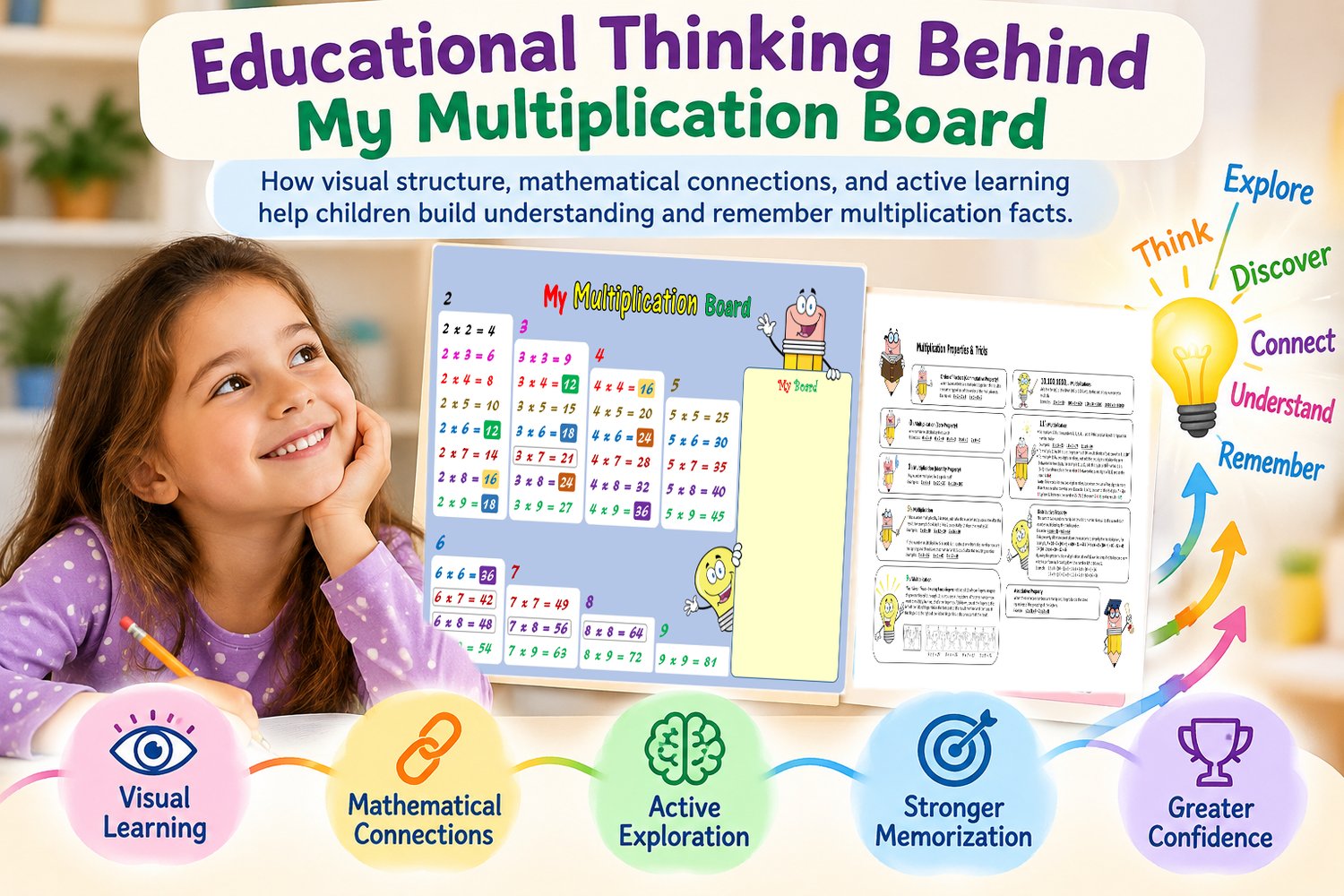
The Educational Thinking Behind My Multiplication Board
How visual familiarity, mathematical connections, and purposeful practice shape the learning system
An ordinary multiplication chart can show a child that 3 × 7 = 21. But what if the child also learned to find the connection between 3 × 7 and 7 × 3—and use that connection when learning other facts?
That question is central to My Multiplication Board. The aim is still to remember multiplication facts confidently. The difference is to give children opportunities to become familiar with, explore, recognize relationships, calculate, and practice on the way toward recall.
1. Learning multiplication as a connected system
Multiplication facts are not all unrelated pieces of information. The Commutative Property tells us that changing the order of two factors does not change their product: 3 × 7 = 7 × 3 = 21.
The Board turns this relationship into something children can investigate. To explore the 5 times table, a child first finds 5 × 5 and identifies its table color. The child then searches earlier tables for 2 × 5, 3 × 5, and 4 × 5, before returning to 5 × 5 and continuing vertically through 5 × 6 to 5 × 9.
This is more than looking up answers: it invites the learner to follow a visual path and recognize why multiplication sentences are connected.
Research connection: The National Research Council's Adding It Up describes mathematical proficiency as a combination of conceptual understanding, procedural fluency, strategic competence, adaptive reasoning, and productive disposition. These strands work together.
Read the National Academies chapter.
2. Colors that have a mathematical purpose
On this Board, color is not simply decoration.
Each multiplication table has an identifying starting color. Children can follow that color through earlier tables to locate related multiplication facts, using the Commutative Property.
Matching colored squares help children recognize different multiplication sentences that share the same product, while highlighted rectangles draw attention to selected facts that may benefit from additional focus and practice.
These visual features serve different purposes, encouraging children to explore multiplication facts and recognize mathematical relationships.
Research connection: Research on the signaling principle examines how visual cues can guide learners' attention toward important information and relationships. This is a relevant design principle—but it is not evidence that the Board's particular color-searching method has been tested or proven effective.
Read Tamara van Gog's chapter in The Cambridge Handbook of Multimedia Learning.
3. Visual familiarity, exploration, and a sense of achievement
My Multiplication Board encourages children to actively search for mathematical relationships rather than simply observe multiplication facts.
The Board can also remain visible in a child's bedroom or study area. Seeing it outside dedicated study sessions may help children become more familiar with its colors, arrangement, and multiplication facts.
This visual familiarity complements active learning; it does not replace exploration, understanding, or purposeful practice.
Following a color path, finding equivalent multiplication sentences, recognizing matching products, or discovering a connection to another table can become a small puzzle to solve.
Each successful discovery may bring a sense of achievement, encouraging curiosity and motivating children to continue exploring.
These positive experiences may help children develop familiarity and a personal connection with the Board, making repeated engagement more appealing.
This creates a potential learning cycle:
Curiosity → Exploration → Discovery → Achievement → Enjoyment → Further Exploration
Through continued visual exposure, active exploration, and purposeful practice, children have opportunities to strengthen their familiarity with multiplication facts and gradually develop confident recall.
4. Learning mathematical properties while using them
The companion Multiplication Properties & Tricks poster introduces practical ways to work out unfamiliar answers. Children can apply the Commutative, Associative, and Distributive Properties while learning multiplication facts, instead of treating the properties as a separate set of rules.
For example:
7 × 12 = 7 × (10 + 2) = 70 + 14 = 84.
In this example, a child uses the Distributive Property to calculate an answer. With repeated opportunities to apply the method, the property can become more meaningful and the fact more familiar.
Research connection: The National Council of Teachers of Mathematics (NCTM) emphasizes connecting mathematical concepts with procedures and developing flexible ways to reason about basic facts.
Read the NCTM Procedural Fluency position statement.
5. A way forward when the answer is not yet remembered
Children do not always recall a multiplication answer immediately. A helpful next step is to use a known relationship or a calculation strategy, rather than simply stop.
The companion poster introduces mathematical properties and useful calculation techniques for the 1, 10, 11, and 12 times tables, along with the 9s finger trick.. These offer different routes to an answer and give children further opportunities to work with the same facts.
Research connection: NCTM highlights number relationships and flexible strategies; the Education Endowment Foundation (EEF) also provides broader evidence-informed guidance on teaching mathematics.
Explore the EEF mathematics guidance.
6. From working out an answer to remembering it
One of the system's central goals is confident recall.
Visual familiarity, exploring connections, and calculating answers can support the learning process. However, recognizing an answer while looking at the Board is different from remembering it independently.
Repeated exposure alone should not be confused with retrieval from memory.
A simple way for a parent or teacher to build recall practice into the activity is to ask the child to cover the answer, try to remember it, check, and revisit it later.
In this way, the Board supports a progression from visual familiarity and understanding toward independent recall, with purposeful practice helping to connect these stages.
Research connection: In studies using written passages, cognitive psychologists Henry L. Roediger and Jeffrey D. Karpicke found that testing memory could improve delayed retention compared with restudying. This supports the general value of retrieval practice; their study did not evaluate multiplication posters or this product.
7. Making mathematics feel approachable
The Board's friendly illustrations and discovery-based activities aim to encourage curiosity and a sense of progress.
The National Research Council describes a productive disposition toward mathematics: seeing mathematics as understandable and worthwhile, and believing that effort can lead to progress.
That is a worthwhile design aim. It would not, however, be accurate to promise that the Board reduces stress or creates emotional attachment for every child. Those outcomes have not been measured for this product.
What this means for parents and teachers
My Multiplication Board brings together two complementary learning posters: the main Board organizes multiplication facts from 2 through 9, while Properties & Tricks extends the learning approach to support facts from 1 through 12.
Together, they encourage children to become familiar with multiplication facts, explore mathematical connections, understand useful properties, and practice with purpose.
The invitation to the child is simple: find a connection, explain it, use a strategy if needed, and then try to recall the answer independently.
The Goal Is Remembering. The Journey Is Understanding.
A note on research and evidence: The sources below explain recognized educational principles relevant to the system's design. They do not mean that the cited institutions or researchers have reviewed, certified, endorsed, or proven the effectiveness of My Multiplication Board. Product-specific learning outcomes would require independent testing.
Research and further reading
National Research Council (2001). Adding It Up: Helping Children Learn Mathematics.
National Council of Teachers of Mathematics. Procedural Fluency position statement.
van Gog, T. (2014). “The Signaling (or Cueing) Principle in Multimedia Learning”. In The Cambridge Handbook of Multimedia Learning.
Education Endowment Foundation (2017). Improving Mathematics in Key Stages 2 and 3.
Roediger, H. L., & Karpicke, J. D. (2006). “Test-enhanced learning: Taking memory tests improves long-term retention”. Psychological Science.
See the learning system: My Multiplication Board on Payhip.
Comments ()