

Multiplication facts can feel like a large collection of separate equations that children must memorize one by one.
But many multiplication facts are closely connected.
For example:
3 × 7 = 21
and
7 × 3 = 21
The numbers have changed places, but the answer stays the same.
This is called the Commutative Property of Multiplication.
What Does the Commutative Property Mean?
The commutative property tells us that changing the order of the numbers being multiplied does not change the product.
In general:
a × b = b × a
For example:
2 × 5 = 5 × 2 = 10
4 × 6 = 6 × 4 = 24
7 × 8 = 8 × 7 = 56
This simple idea is extremely useful when children are learning multiplication.
Instead of treating both orders as completely different facts, they can recognize that the two equations belong together.
One Fact Can Help With Another
Suppose a child already knows:
4 × 7 = 28
Later, the child sees:
7 × 4 = ?
The second equation does not need to feel unfamiliar.
The child can recognize:
7 × 4 = 4 × 7
so:
7 × 4 = 28
This gives the learner another way to recall an answer rather than relying only on repetition.
Seeing the Connection Visually
The relationship becomes even clearer when multiplication facts are arranged visually.
Imagine studying the 7 times table.
Before reaching the main 7-times-table facts, a child can already find several facts involving 7 inside earlier tables:
2 × 7
3 × 7
4 × 7
5 × 7
6 × 7
These correspond to:
7 × 2
7 × 3
7 × 4
7 × 5
7 × 6
Once the learner understands the commutative property, these are no longer isolated pieces of information.
They become connected parts of the same multiplication system.
Why This Matters for Learning
Recognizing these relationships can help children:
- see multiplication as a connected system
- reduce unnecessary repetition
- recall facts using relationships they already know
- notice patterns more easily
- focus more attention on genuinely difficult facts
- understand multiplication instead of relying entirely on memorization
The goal is not to eliminate memorization.
Children still need practice until important multiplication facts become familiar.
But understanding the relationships between facts can make that practice more meaningful.
An Example With the 7 Times Table
Consider these two equations:
3 × 7 = 21
7 × 3 = 21
A child may first encounter 3 × 7 while studying the 3 times table.
Later, when studying the 7 times table, the child does not need to approach 7 × 3 as an entirely new idea.
The learner can think:
“I already know 3 × 7 = 21, so 7 × 3 must also equal 21.”
That small moment of recognition is important.
The child is no longer simply recalling a number.
The child is using a mathematical property to reach the answer.
From Memorizing Facts to Recognizing Relationships
Multiplication becomes easier to understand when children begin asking questions such as:
Have I seen this fact before in another form?
Can I use something I already know?
Which two facts are connected?
These questions encourage active thinking rather than passive repetition.
Over time, children can begin to see multiplication facts as a network of relationships instead of a long list of unrelated equations.
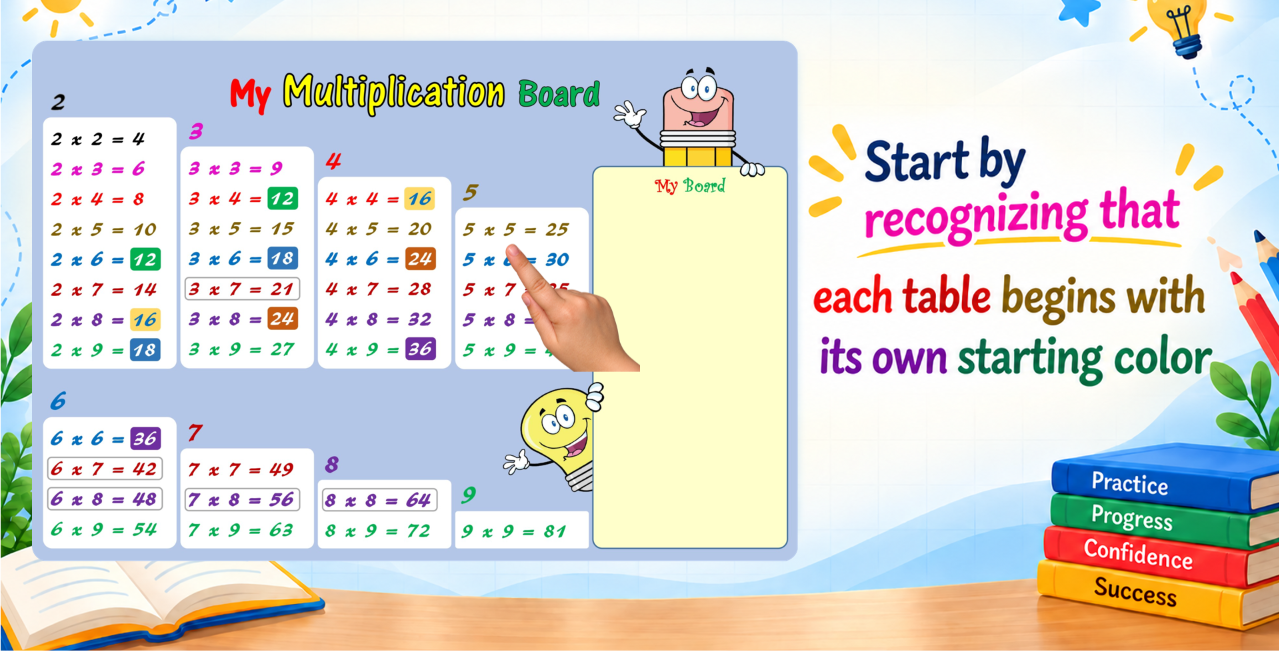
How My Multiplication Board Uses This Idea
My Multiplication Board uses color and visual organization to make these connections easier to notice.
When studying a selected multiplication table, the learner can follow its color through earlier tables to recognize multiplication facts that are connected through the commutative property, and then continue through the selected table itself.
For example, while working with the 7 times table, the learner can recognize earlier facts such as:
2 × 7, 3 × 7, 4 × 7, 5 × 7, and 6 × 7
before continuing with the remaining 7-table facts.
The board is designed to encourage children to:
FOCUS • RECOGNIZE • THINK • CALCULATE • PRACTICE • REMEMBER
The commutative property is just one example of how understanding the structure of multiplication can make learning more meaningful.
Explore My Multiplication Board in the Minhow store to see how multiplication facts can be studied through color, connections, properties, and focused practice.
Comments ()