

You have a planner. Possibly three of them. A colour-coded calendar, a notes app, a browser with 39 open tabs, and a to-do list that’s somehow both overwhelming and incomplete.
And yet, things still fall through the cracks.
That’s not a discipline problem. It’s a systems problem.
Most entrepreneurs and creators treat their to-do list as the foundation of their business. But a list is just a memory aid — it captures tasks without context, tracks activity without direction, and collapses the moment your business gets even slightly complex.
A business system is something entirely different. And once you have one, you’ll wonder how you ever ran without it.
The Problem With To-Do Lists
To-do lists were designed for a simpler era — grocery runs, quick errands, standalone tasks with no dependencies. Applied to a modern solopreneur’s business, they buckle almost immediately.
Here’s what a to-do list can’t tell you:
- Why a task exists and what it’s connected to
- What happens before or after it
- Who’s responsible, and by when
- Whether it’s blocking something else from moving forward
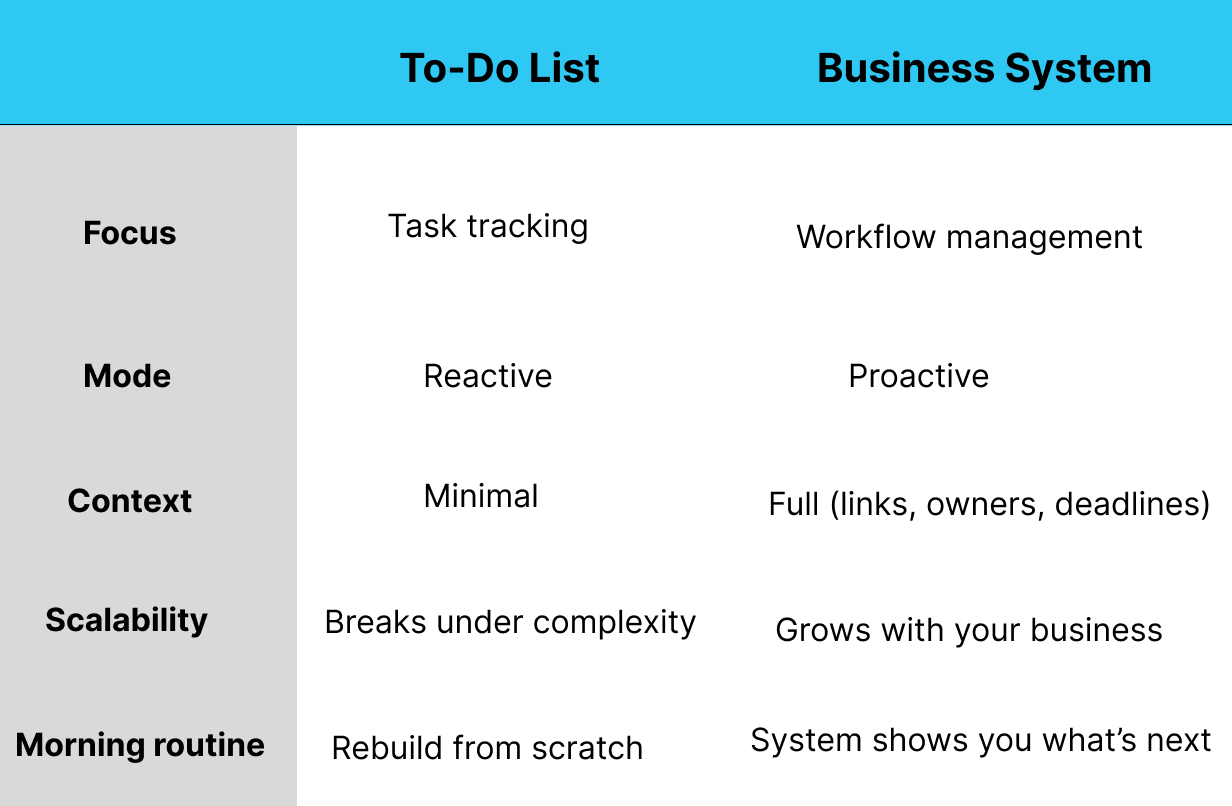
The result? You’re reactive by default. You spend your mornings figuring out what to do instead of doing it. You rebuild context from scratch every time you sit down to work. And as your business grows, the list grows with it — without getting any clearer.
What a Business System Actually Is
A business system is a connected set of processes, databases, and workflows that runs your operation — with or without you in the driver’s seat.
Think of it like your phone’s operating system. Individual apps are useful, but it’s the OS underneath that makes them work together: sharing data, syncing state, maintaining a single source of truth. Without it, you’d have a drawer full of disconnected gadgets.
A solid business OS typically connects four core areas:
- Projects: Where your work lives, with timelines, status, and deliverables linked together.
- Tasks: The individual actions, tied to their parent project and owner.
- Knowledge: SOPs, meeting notes, templates, and reference docs — findable in seconds.
- Habits & Reviews: Weekly check-ins, recurring rituals, and the feedback loop that keeps the whole machine healthy.
When these four areas talk to each other, everything changes. You sit down in the morning and your system tells you exactly where to focus. Nothing is forgotten. Nothing is rebuilt from memory.
System vs. To-Do List: The Honest Comparison
Why Notion Is the Ideal Foundation
Plenty of tools claim to be all-in-one workspaces. Notion is the only one that genuinely earns it — because its core building block isn’t a page, it’s a relational database.
That means your projects can link to your tasks. Your tasks can link to your content calendar. Your content calendar can link to your SOPs. Everything is connected. Nothing is siloed.
Add flexible views (board, calendar, gallery, list) and you’re not just storing information — you’re building a workspace that shows you exactly what you need, when you need it.
5 Signs You’re Ready to Build a Proper System
Not sure if this applies to you? Ask yourself:
- You manage more than one project at a time.
- You’ve said “I forgot about that” in the last 30 days.
- You spend the first 20 minutes of your work day figuring out what to do.
- You’ve re-explained your own process from scratch — to yourself.
- You’re growing, and you can’t afford for anything important to slip.
If two or more of those sound familiar, you’re not struggling with productivity. You’re working without an operating system.
How Moussa Studio Can Help
At Moussa Studio, I build complete business systems in Notion — done-for-you workspaces designed for creators and solopreneurs who are ready to stop patching together tools and start running a real operation.
Every system comes with:
- Pre-filled sample data so you can see it working before you touch it
- Full documentation so you’re never guessing what something does
- Direct support from me personally
These aren’t generic templates. They’re built around how creators actually work — with the workflows, views, and automations already in place.
The Bottom Line
A to-do list manages chaos. A system prevents it.
If you’re serious about growing your business as a solopreneur or creator, the most valuable investment you can make right now isn’t a new app or another productivity hack. It’s building a system that works the way your brain does — connected, clear, and always ready for what’s next.
Take one action today: open your current setup and ask yourself, “If I were away for a week, could someone (or future me) pick this up and know exactly what’s happening?”
If the answer is no, you know what to do next.
Comments ()