
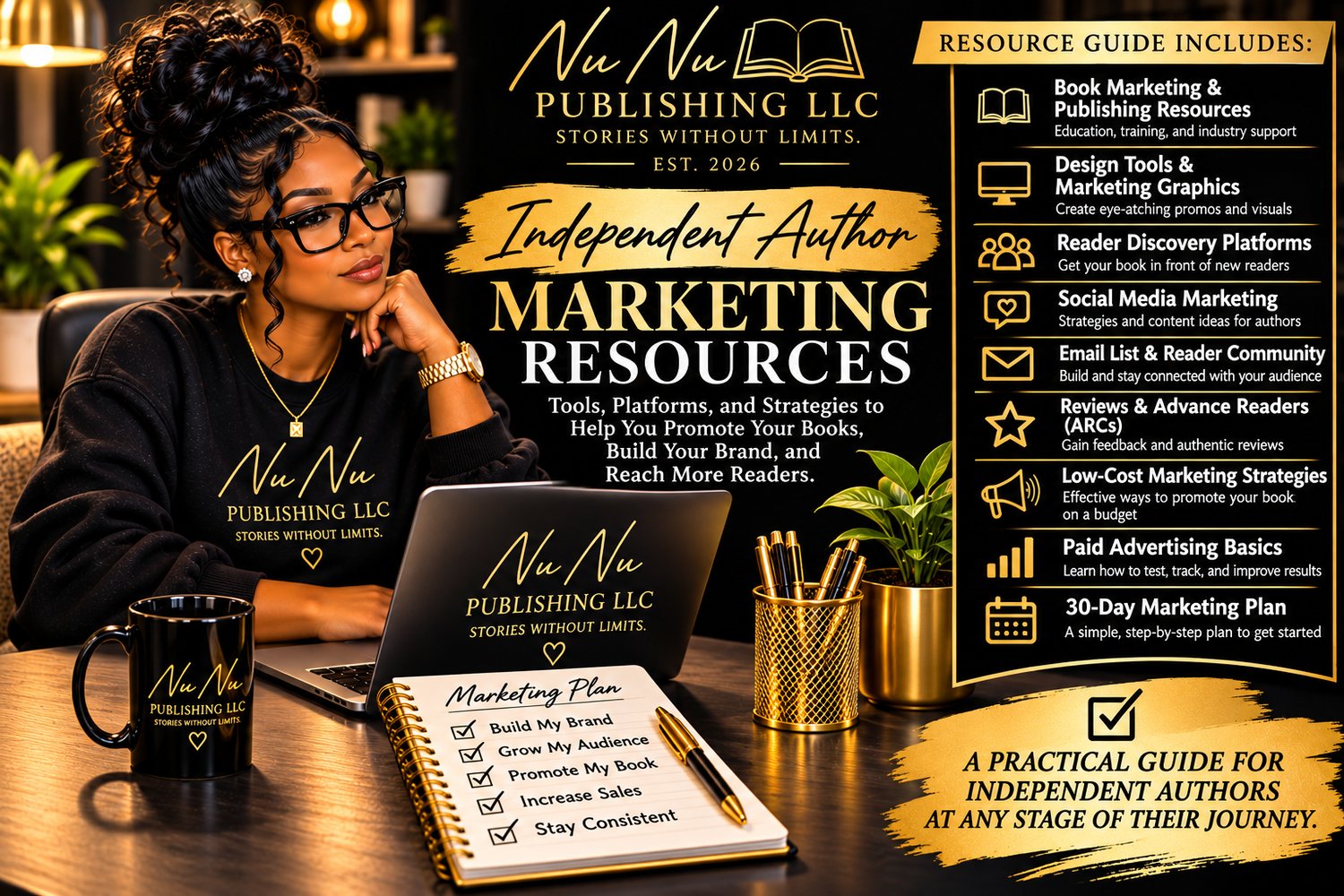
By Nu Nu Publishing LLC | Stories Without Limits.
Being an independent author means wearing many hats. You are the writer, editor, creative director, publisher, and sometimes your own marketing department. Writing the book is a major accomplishment, but helping readers discover it is another part of the journey.
The good news is that you do not have to figure everything out alone, and you do not need a massive marketing budget to begin building your author platform.
Whether you are preparing to release your first ebook, promoting a growing book catalog, or trying to reach readers beyond your immediate circle, there are resources available to help you improve your marketing strategy.
At Nu Nu Publishing LLC, we believe independent authors deserve access to information that helps them make informed decisions, develop their brands, and reach the readers who may connect with their stories.
This guide brings together useful websites, creative tools, promotional platforms, and practical strategies to help you get started.
1. Book Marketing and Publishing Resources
Before investing in advertising or promotional services, take advantage of educational resources that explain how book marketing works.
The Authors Guild — Book Marketing and Publicity Resources
Website: https://authorsguild.org/resource/ag-launchpad-book-marketing-and-publicity-resources/
The Authors Guild provides a collection of marketing and publicity resources covering author websites, newsletters, publicity, book launches, social media, reader engagement, and working with professionals. Some resources are intended for members, while others are publicly available.
Amazon Kindle Direct Publishing — Book Promotion
Website: https://kdp.amazon.com/en_US/help/topic/GQSKV8L8EM6APYHN
Authors publishing through Amazon KDP can explore available promotional options, advertising information, author pages, and other ways to help readers discover their books. Available features depend on the publishing program, marketplace, and eligibility requirements.
Alliance of Independent Authors
Website: https://www.allianceindependentauthors.org/
The Alliance of Independent Authors, also known as ALLi, provides information and advocacy related to self-publishing. It can be a useful starting point for authors who want to learn more about independent publishing practices, professional standards, and industry resources.
2. Tools for Creating Marketing Graphics and Book Promotions
You do not need to hire a designer for every social media post. Design tools can help you create promotional graphics, quote cards, launch announcements, and other marketing materials.
Canva
Website: https://www.canva.com/
Canva can help you create graphics for Instagram, Facebook, TikTok, Pinterest, newsletters, promotional flyers, and book launches. You can use it to develop consistent colors, fonts, and visual elements for your author brand.
BookBrush
Website: https://bookbrush.com/
BookBrush specializes in tools for authors who want to create book mockups, promotional graphics, advertising images, and marketing visuals. Explore its current features and pricing to determine whether it fits your needs.
Reedsy
Website: https://reedsy.com/
Reedsy offers publishing education and a marketplace for publishing professionals, including editors, designers, and marketers. It can help you research professional services when a project requires skills or support beyond what you can comfortably handle yourself.
Marketing tip: Keep your book cover, author name, title, and promotional message easy to recognize. A beautiful graphic is helpful, but readers should also be able to understand what you are promoting and where they can find the book.
3. Platforms That Help Readers Discover Books
Marketing is not just about posting on social media. It is also about making your books and author profile discoverable in places where readers already explore books.
Goodreads Author Program
Website: https://www.goodreads.com/author/program
Goodreads allows eligible authors to claim their author profiles, maintain their information, connect their books to their profiles, and engage with readers. Its author tools can help you establish a presence in a community centered on reading and book discovery.
BookBub Partners
Website: https://www.bookbub.com/partners/free_tools
BookBub provides free author tools, including author profiles, recommendations, and new-release alerts for followers. It also offers paid promotional opportunities, such as Featured Deals, which have their own submission criteria and costs.
Amazon Author Central
Website: https://kdp.amazon.com/en_US/help/topic/G200644310
If your books are available on Amazon, Author Central can help you maintain your author page, biography, and book information. Readers can also follow eligible author pages to receive certain release-related notifications.
Marketing tip: Keep your author biographies, book descriptions, cover images, and links accurate and consistent. When readers discover you on different platforms, they should be able to identify your work and find the correct purchase page.
4. Social Media Marketing for Independent Authors
Social media can help authors introduce their books to new audiences, share their personalities, and create conversations around their stories.
You do not have to use every platform. Choose the channels that make sense for your audience and the type of content you can realistically create.
TikTok
TikTok can be useful for short videos featuring book recommendations, writing updates, character introductions, story themes, author routines, and behind-the-scenes publishing content.
Ideas to try include:
- Introduce a book in 20–30 seconds.
- Share a short, spoiler-free excerpt.
- Explain what inspired a character or storyline.
- Show the process of preparing a book for publication.
- Share a lesson you learned as an independent author.
Instagram can support visual storytelling through Reels, Stories, carousels, book graphics, and author updates.
Consider posting cover reveals, quote graphics, reading recommendations, launch announcements, and short educational posts about writing and publishing.
Facebook can help authors connect with existing readers, participate in appropriate reader communities, announce releases, and share longer updates.
Before posting promotional content in groups, check the group's rules. Focus on genuine participation rather than repeatedly advertising your books.
Pinterest can help organize visual content around book genres, reading lists, writing tips, character inspiration, book aesthetics, and author resources. Create clear graphics that link back to a relevant page on your website or storefront.
Marketing tip: Instead of posting the same advertisement every day, rotate between educational content, entertaining content, personal stories, book information, and occasional sales promotions.
5. Building an Email List and Reader Community
Social media can be valuable, but your reach depends partly on the platform and its rules. Building an email list gives you another way to communicate directly with readers who have chosen to hear from you.
Consider researching email marketing services such as:
- Mailchimp: https://mailchimp.com/
- MailerLite: https://www.mailerlite.com/
- Substack: https://substack.com/
Compare current plans, subscriber limits, features, and pricing before selecting a service.
You can encourage interested readers to subscribe by offering something relevant, such as a free short story, a sample chapter, a reading guide, a writing resource, or advance information about upcoming releases.
Your emails do not need to be complicated. You might send a monthly update featuring new releases, writing progress, book recommendations, special offers, and links to your latest blog posts.
Always obtain consent for marketing emails, provide a clear way to unsubscribe, and follow applicable email marketing and privacy requirements.
6. Advance Readers, Reviews, and Reader Feedback
Getting your book in front of interested readers before or around its release can help you gather feedback and build awareness.
One approach is to organize an advance reader copy campaign, often called an ARC campaign. You provide eligible readers with an early copy of your book and invite them to consider sharing an honest review if they choose.
You can look for readers through your existing audience, genre-specific communities, book clubs, relevant creator networks, and legitimate reader outreach opportunities.
Keep these principles in mind:
- Choose readers who are interested in your genre.
- Provide a clear description of the book and any relevant content considerations.
- Set a reasonable timeline for optional feedback.
- Never require a positive review in exchange for a free copy.
- Do not purchase fake reviews or pressure readers to change their opinions.
- Check each retailer's review policies before organizing a campaign.
Honest reader feedback can help you understand how people respond to your book, while authentic reviews may help prospective readers evaluate whether a title interests them.
7. Low-Cost Book Marketing Strategies
You can begin marketing without immediately purchasing advertisements or expensive promotional packages.
Here are several approaches to consider.
Repurpose your content. Turn a blog post into a short video, a carousel, a quote graphic, and an email newsletter. One useful idea can support several pieces of content.
Create a book introduction series. Introduce your book's genre, themes, premise, and intended audience across several posts instead of trying to communicate everything in one advertisement.
Collaborate with relevant creators. Research book bloggers, reviewers, podcasters, reading communities, and creators who discuss your genre. Approach them professionally, follow their submission guidelines, and respect their time.
Develop a simple author website or landing page. Give readers one reliable place to learn about you, explore your books, and find purchase links.
Participate in appropriate community events. Depending on your genre and location, consider book clubs, library programs, author fairs, writing workshops, community events, and independent bookstore opportunities.
Use promotional offers strategically. Discounts, limited-time promotions, and giveaways can support specific marketing goals when the terms, costs, and eligibility requirements make sense for your book.
Build relationships instead of chasing every sale. Answer questions, share useful information, celebrate other creators, and participate in relevant conversations. Readers are people, not merely sales figures.
8. Understanding Paid Advertising
Paid advertising can help you reach audiences beyond your existing following, but spending money does not guarantee sales.
Before launching an advertisement, define what you want it to accomplish. You might want to generate awareness, drive visits to a book page, increase sales, or promote a new release.
Potential advertising channels include Amazon Ads, Meta ads on Facebook and Instagram, and eligible promotional opportunities through book marketing platforms.
Start by researching how each platform charges for advertising and what reporting tools it offers. Set a budget you can afford to lose while testing, especially if you are new to paid promotion.
Track meaningful results where possible, including:
- Advertising spend.
- Clicks and visits.
- Sales attributed to the campaign when measurable.
- Revenue and estimated profit.
- Email subscriptions or other relevant actions.
A campaign that receives many clicks but produces few sales may need a different audience, clearer messaging, a stronger book description, or a more suitable landing page.
Do not assume that every book or audience responds to the same advertising strategy. Test carefully and use your results to guide future decisions.
9. Create a Simple 30-Day Marketing Plan
If marketing feels overwhelming, begin with a manageable schedule instead of trying to do everything at once.
Week 1: Prepare Your Foundation
- Review your book cover, description, author biography, and purchase links.
- Choose one primary book to promote.
- Identify the readers most likely to enjoy it.
- Select one or two social media platforms.
- Decide what you want your marketing to accomplish.
Week 2: Create Your Content
- Design two or three promotional graphics.
- Prepare a short book introduction video.
- Write one blog post related to your book or genre.
- Create several posts that highlight the book's themes, inspiration, or reading experience.
- Draft an email update if you have a mailing list.
Week 3: Connect With Readers
- Share your content consistently.
- Participate in relevant reading and writing communities.
- Research appropriate reviewers or creators.
- Respond to genuine questions and comments.
- Invite interested readers to visit your book page.
Week 4: Review and Improve
- Identify which posts generated meaningful engagement.
- Review website or storefront visits when the information is available.
- Track any measurable sales or newsletter growth.
- Note questions readers asked about your book.
- Decide which activities deserve more attention next month.
The purpose of this plan is not to guarantee a specific number of sales. It is to establish a repeatable process that helps you learn about your audience and improve your marketing over time.
10. A Final Word to Independent Authors
Independent publishing offers opportunities to develop your own creative vision, but it also asks you to learn new skills and make decisions about how to introduce your work to the world.
You may not have a large advertising budget. You may not have a marketing team. You may not have thousands of followers waiting for your next release.
You can still begin with the resources available to you.
Learn the tools. Research the platforms. Build relationships with readers. Experiment with different ways of presenting your work. Pay attention to your results, and give yourself room to improve.
You do not need to be everywhere at once, and you do not need to purchase every service someone recommends. Choose resources that support your goals, fit your budget, and help you connect with the readers you want to reach.
Your book deserves the opportunity to be discovered, and your marketing journey can begin with one intentional step.
A Message From Nu Nu Publishing LLC
At Nu Nu Publishing LLC, we believe in empowering independent creators through storytelling, learning, and creativity.
We hope this resource guide gives you a useful starting point as you develop your author platform and explore ways to promote your work.
Continue learning, continue building, and continue sharing the stories only you can tell.
Explore our books and creative projects:
https://payhip.com/nunupublishing
Read more articles on our blog:
https://payhip.com/nunupublishing/blogs/nunublogs
Nu Nu Publishing LLC — Stories Without Limits. EST. 2026.
Comments ()