

Welcome to the intersection of creativity and education, where the language of arts takes center stage in our online classroom. As we embark on this drawing tutorial, we invite both teachers and students from middle school to junior high to join us in a journey of artistic discovery. Our Fundamentals in Drawing (Lesson 3) is more than just a resource; it’s a workshop designed to inspire and refine your drawing and sketching skills.
In today’s class of art, we’re not just drawing on sketch; we’re sketching a path to mastery. With simplified drawings, we’ll show you how to draw a simple line that speaks volumes and easy drawing techniques that bring your sketches to draw to life. Whether you’re an educator seeking to enhance your teaching students experience or a student looking to expand your easy drawings ideas, this pencil drawing guide is your gateway to drawing for simple, yet profound, artistic expression.
So, grab your pencils and let’s dive into the world of simple drawing, where every drawing of a drawing is a step towards becoming the artist you aspire to be. It’s time to make your mark in the class of art—one proportion at a time.
Here are 10 ways you can improve your proportion drawing:
- Use a Scale Divider: You may transfer the accurate proportions from your reference to your sketch with the use of a scale divider. Use the tool to precisely measure and scale things after adjusting it to the required ratio.
- Flip Your Canvas: Turning your canvas will give you a new viewpoint. This can assist you in identifying proportional differences that you might have overlooked when creating your drawing.
- Practice Finding Midpoints: Develop the ability to see the midpoint between two lines or objects. This ability is necessary to arrange pieces in your creation effectively.
- Measure with Ticks: Mark measurements on your paper with a pencil by using ticks. This aids in keeping your drawing's dimensions constant.
- Draw Symmetrical Shapes: Get comfortable creating symmetrical and identical shapes. Your ability to draw in a balanced and proportionate manner will improve after doing this exercise.
- Create Proportional Shapes: Practice creating a variety of shapes with the appropriate dimensions. Gradually advance to more complicated forms by starting with simpler ones.
- Recognize Edges: Take note of an object's edges. Accurate proportions depend on knowing where one edge finishes and another begins.
- Understand Negative Space: Examine the area surrounding and separating topics. To achieve proportion, the negative space is just as crucial as the actual items.
- Observe Light and Shadow: You can learn to retain proportion and comprehend an object's three-dimensional form by observing the interactions between light and shadow.
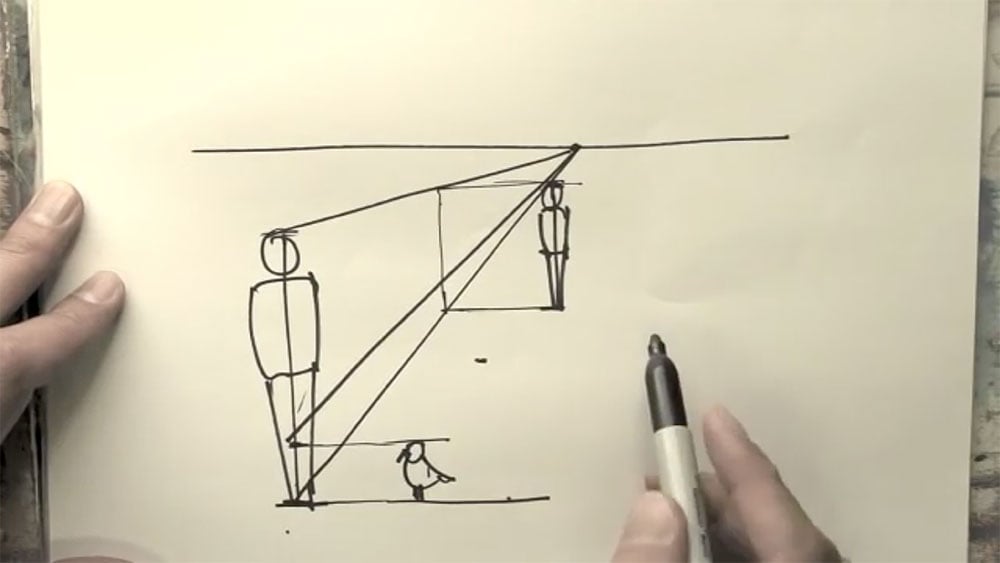
- Practice Perspective Drawing: Learn the principles of perspective and practise drawing from it. It's essential for retaining object size as it recedes into the distance and adding depth.
Your ability to depict proportions in your drawings will significantly increase if you use these pointers to your practice sessions. Recall that all of these concepts and more are covered in detail in Lesson 3 of our Fundamentals of Drawing series, which offers a thorough tutorial on acquiring the skill of proportion in drawing.