
Reading slumps can either be a really fun place to be or it can feel like a tiny little pebble in your shoe because you can either accept that you are in a slump and spend that time doing anything else that you love, or you can be stuck with feeling like you want to read but at the same time you don't want to read anything.
What Is a Reading Slump?
A slump in general is defined as a sudden decline or deterioration in the progress or achievement of something that interests you. When applied to reading, the idea stays the same.
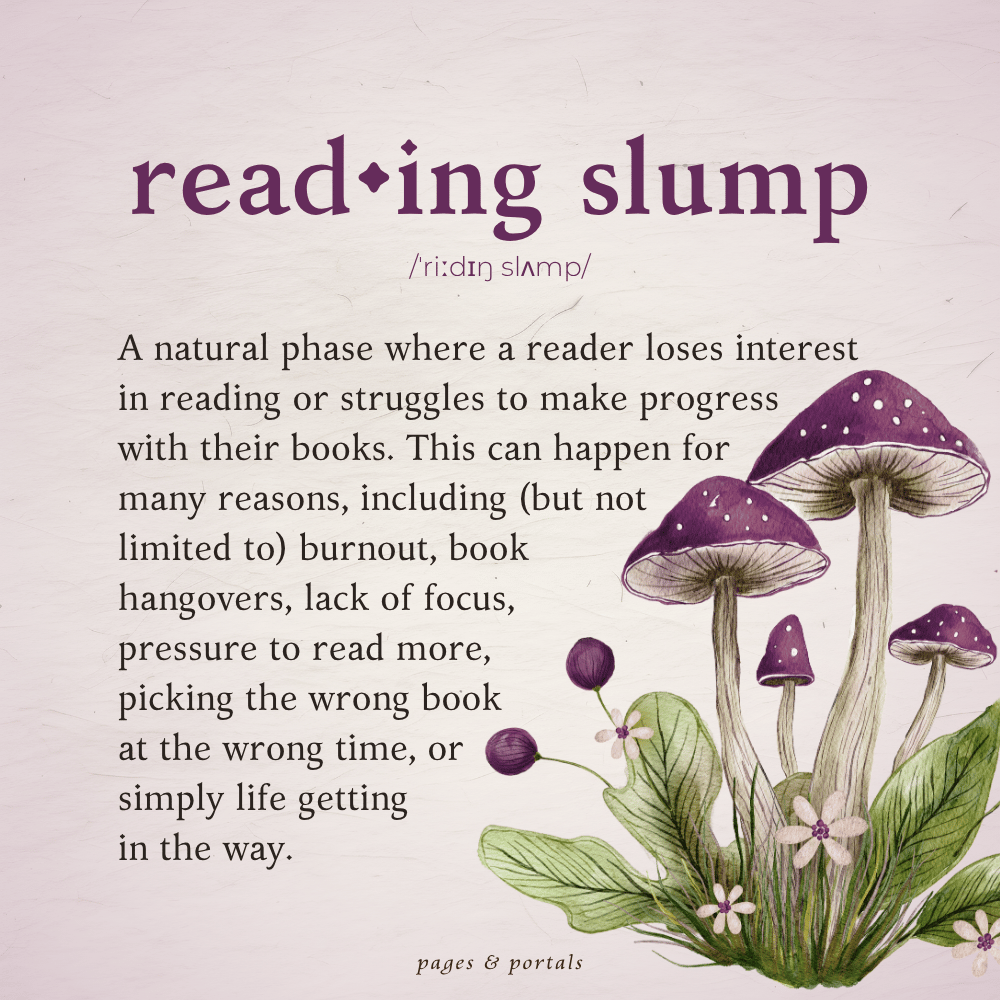
Reading Slump: A natural phase where a reader loses interest in reading or struggles to make progress with their books. This can happen for many reasons, including (but not limited to) burnout, book hangovers, lack of focus, pressure to read more, picking the wrong book at the wrong time, or simply life getting in the way.
Reading slumps are a very normal thing that all readers experience and honestly… they aren't the worst thing. Reading can be an intense experience because mentally you are in a different world and experiencing the emotion of these characters right along with them. Slumps happen as a reminder that your body and your mind needs a break from the activity, or at the very least a change in some of your reading habits.
What Is The Difference Between A Reading Slump And Just Feeling Like You Don't Want To Read?
Sometimes it's tricky to know if you are really in a slump or if you just don't feel like reading. I mean, is there really a difference? Short answer: yes. A slump is built on the extended feeling of not wanting to read a book. When you don't feel like reading for a while, it's normal but you usually return to a place of wanting to read without hitting an extended plateau. A reading slump happens when you hit that plateau and experience an ongoing disinterest in the act of reading for a prolonged period of time.
Think of that disinterest in reading as a ruler against which a slump can be measured, not by the amount of days but rather the intensity of your disinterest. When your disinterest is on the lower end, you probably just aren't in the mood to read for a bunch of tiny different reasons and can break out of it by changing a few of your reading habits. I call these mini-slumps. The higher end of the ruler is the major slumps where your disinterest has been building for a weeks, going on a few months and it's probably bordering on indifference to you reading habits by now. These major reading slumps can be harder to navigate but both sides does eventually come to an end.
How to Beat a Mini Reading Slump
I see a mini-slump as period of time when you kind of want to read but at the same time you won't really mind if you don't. Almost like a bit of a rut. This can happen due to many reason but I believe there is one overarching reason that covers all of the little ones: your brain got bored with your normal reading habits and material. Now your brain is demanding a change of sorts within the habit and that demand comes in the form of a mini reading slump.
While I don't always love slumps, I do love they force me to change my reading habits from time to time. And there really isn't a better time for this than when you are stuck and going nowhere (reading-wise, of course). Sometimes getting back into the pages is as simple as making a small, some might even say exciting change to your reading habits.
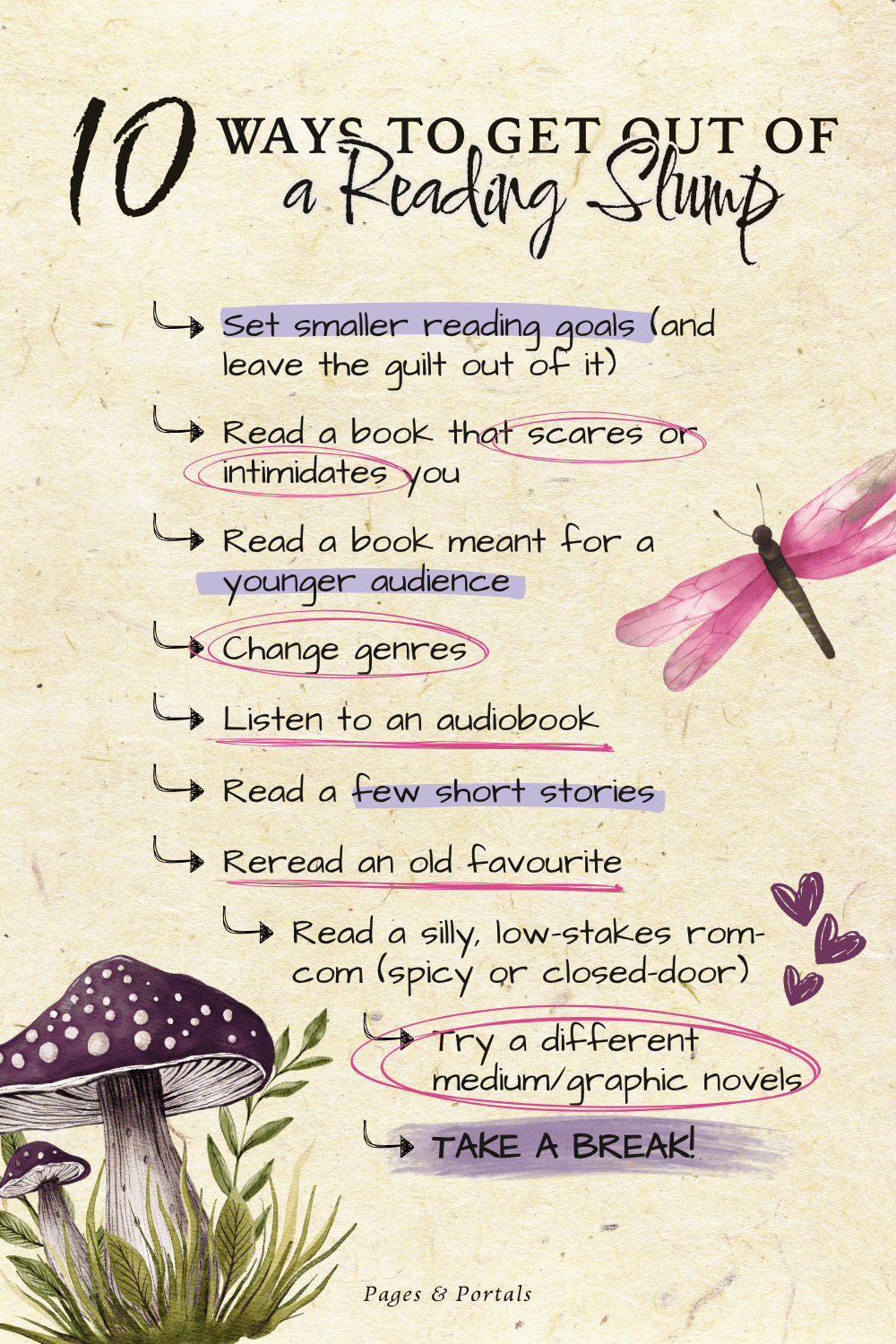
1. Set smaller reading goals (and leave the guilt out of it)
Sometimes we expect too much of ourselves when we pick up a book, whether that is finishing it in record time, making the best aesthetic annotations ever, or reading it to hit that 10 books a month goal. I think that sometimes we all fall victim to what we see online and try to live up to that. And it is those types of pressures that can cause you to lose the joy of reading and put you straight into a slump.
While there is nothing wrong with having reading goals (I have them myself), I do think it is important to be realistic with them because some months you are going to be able to read more than other months. And some months you aren't going to read at all. That's just the way life goes. Try keeping your reading goals flexible, allow them to adjust to whatever happens in your life and leave any guilt out of it. Feeling guilty because I wasn't reading was, ironically, another thing that kept me from reading for a while, and it is just not worth it. So don't feel guilty if you have to adjust your goals, even if that adjustment is to hit pause on all books for a while. If you aren't in the mood to pick up a book, don't. If you aren't in the mood read because you feel like you won't hit that goal you set, think about changing and adjusting that goal to something that feels more attainable whether that is in regards to monthly book counts, the genres of the books you pick, even the intended target ages, or something else. Just make sure to enjoy it.
2. Read a book that scares or intimidates you
This is for a very specific type of slump: the one where you feel like reading but nothing seems interesting enough to grab your attention. Go grab that book that you have been meaning to get to forever, but for some reason you just haven't started on yet. I think every reader has at least one of these books on their TBR. The premise intrigued you (or maybe it was the cover, no judgement) and you want to read it, your gut is telling you that you need to read that book but it's just sitting there, waiting. Maybe you find it somewhat intimidating because of its physical size, maybe you are a little scared of what waits inside of it due to the storyline and its themes, or maybe it's the genre.
Whatever it is for you, is there really a better time to try reading that book than when you are in the type of slump where you feel like you want to read but can't settle on what? You really have nothing to lose because you're already not reading. If you say 'only 10 minutes' and start on this book, one of two things are going to happen: 1) you won't be intrigued thus the book will be put down and you will still be in the exact same place, or 2) you will be intrigued and continue reading and will have started on a book that has intimidated you for years. I think it is worth the try.
(If you are curious, the book that scares me most is The Shadow of the Wind by Carlos Ruiz Zafón. I don't know why I am so scared to start it because I have heard great things; maybe it's because I'm scared that I won't like it and I really want to love it.)
3. Read a book meant for a younger audience
Reading is something that is supposed to be fun, and most of the times it is. Except when we start putting pressure on ourselves to read more. Except when we read so much of one thing, for example adult fiction, that we get bored with it. Each book that falls under a specific target age category, automatically has certain set of characteristic that make up the bones of the story. There are certain beats that that are always there, and this is what we get bored of when we read too much of them. Your brain can get tired of this constant repetition and throw you into a state of disinterest with your current reads.
I almost want to say that this one is easy to break out of because you only need to give your brain something out of the ordinary i.e., read a book meant for somebody younger. There is a whole set of other story characteristics, the storylines are so creative, the characters are so interesting and (if you are into magic and fantasy) the magic systems are usually so much cooler in children's lit. And because they are meant for children, they are easier on the actual language level as well which means that for an adult it would be a slightly quicker read as well.
4. Change genres
It's a simple and small change (as promised) but sometimes crazy effective. If you are in a slump because of genre burnout, then this really is the answer. Constantly reading within the same genre is so comfortable because subconsciously we know what to expect. We find comfort in that fact which is probably why we all have a favourite genre. But sometimes you might need to shake it up because overconsuming the same tropes and the same storylines that are applied to the same type of characters characters will start boring your brain eventually. And then you'll find yourself in a 'genre burnout slump' (I didn't even know there was a name for this until very recently).
If you don't want to take the break your brain is forcing you into then try switching to a completely different genre. Not something that is part of the sub-genre. I know the usual advice is to go and read a thriller but if your favourite genre is thrillers then that little piece of advice will get you nowhere. Look at your favourite genre and figure out what you like about that genre, then look for something that aligns with your likes in a different genre. For example, if you like thrillers you can try a high-stakes fantasy; you'll be exposed to the characteristics of fantasy writing (something new for your brain to process) but still experience that emotional tension that a thriller gives you.
5. Listen to an audiobook
This one is always recommended, I know. But I stand behind audiobooks especially in slumps. See, sometimes the slump comes from not want to partake in the activity of actively reading. That sounds weird and almost like it defeats the purpose of reading, I know, but think about it. Are you tired and disinterested in the activity of reading, meaning sitting down with a book in your hand for an x amount of time, or are you tired of consuming a story overall? If it is the latter, by all means, take a break from reading overall and enjoy another hobby of yours. But if it is the former, get yourself an audiobook.
Just because you don't necessarily want to read by holding a book or eBook in your hand and have your eyes move across the page and be mentally present for every word, doesn't mean you don't crave some sort of story. And that's exactly why audiobooks are perfect for reading slumps in a sense. You can listen to them while you do almost anything, and you're still consuming the story of your chosen book. You are still immersed in reading but you have taken the pressure off just that little bit to give yourself breathing space. Which might be exactly the type of break you need while you navigate the slump and find your way back to holding a book in your hand.
How To Navigate The Major Reading Slumps
The best way to navigate a bigger slump to embrace it, honestly. You just aren't in a season where you feel like reading and that's fine. It might not feel very natural, especially if you're a daily reader but that's where you are right now. And if this stretches into months, or sometimes even years, then forcing yourself to read or feeling guilty that you aren't reading isn't going to help.
Changing your reading habits isn't going to get you through it. In my personal experience, these bigger periods where nothing seems to capture or keep your attention comes from a more integral part of your life outside of books and stories. So there really is only one piece of advice that I can give you when you find yourself in this situation.
6. Take a break
Don't try to force something that doesn't want to happen. If you don't want to read, don't. Go outside, lie in the sun, dance in the rain. Spend some time on other hobbies that you've maybe been neglecting, or even forgotten about. Tend to the garden, and if you don't have a garden now might be the perfect time to start a small one. Learn a new skill like cooking, kickboxing, play a videogame, take up knitting if you want to. Honestly, just give yourself permission to do anything other than reading. Don't bind yourself up in a web of guilt because you're not picking up a book. Krysta from Pages Unbound wrote a great post explaining why reading slumps are actually valuable to us, instead of a hinderance, and she is 100% right. If you have the time, go read it. It was actually that post that caused me to shift my own mindset surrounding reading slumps. Appreciate the slump for the time it now gives you to do something else that you love. Find peace in the knowledge that you will naturally come out of it when the time is right.
Honorary Mentions
I think these are over-recommended but that doesn't suddenly make it bad advice. These four ideas does have merit and although they don't work for everybody or in every situation (no one piece of advice does) they are worth trying…even if it's a last ditch effort :)
try reading a few short stories
That means actual short stories. I’m talking no more that 8000 words a story (a word count that I'm sure makes a few fanfic readers laugh). Short stories are constructed to move quite fast because everything needs to happen in a restricted amount of time. Now usually that makes them quite interesting and maybe even a little weird which might help to keep the attention on the story. For me personally, a potent combination is listening to the story while reading along on a digital or physical copy. Maybe the boost from finishing something super short will inspire you to pick up a longer book or maybe just another short story. Either way, at least you’re reading.
reread an old favourite
This almost borders on cliché advice because it is part of every reading slump list but that is because it does work from time to time. Try thinking outside of the box for this, don't just jump to your normal favourite. Think of a few of your favourite stories and try to recall how you felt when you read them. Sometimes it is all about the emotions connected to the story, and less about the story itself. The act of reading should be enjoyable, it shouldn't feel forced or like an obligation. So pick up an old favourite that brings you happiness, or whatever other emotion you are chasing, and read that again. If you don't want to fully commit to the whole book then flip through it and just read your favourite parts. There are no rules against that. The only rule is to enjoy what you are doing.
read a silly, low-stakes rom-com (spicy or closed-door)
This won't appeal to everybody, I know that, but it's worth mentioning because it has pulled me out of many-a-slump. This specific genre of books are such low stakes reads, it's like my brain knows that she can just read and if she misses something then it won't throw the entire storyline out of whack. Silly and low-stakes does not equal bad, though. It also doesn't equal dark romance, just to be clear. To me, silly low-stakes rom-com novels mean books that are light and comfortable, and easy to read but they still have depth, great themes and some really fun storylines. The reason these types of books work for a slump is because their almost fantasy-like loveliness allows the reader to escape to an altered reality, still grounded enough to sound realistic but without the problems ate the end.
read a graphic novel
This one isn't over-recommended, in fact it is quite the opposite. But if you are constantly reading novels you could be experiencing a little burnout. So why not try a graphic novel? It is a completely different reading experience because of the layout and the structure and the story composition but it is such a good time. And there are so many different genres when it comes to graphic novels, I promise you will find something that interests you. You also get the additional benefit of looking at some amazing art. My introduction to graphic novels was Dream Country from The Sandman Series by Neil Gaiman and I loved it! I fell down a wormhole and never looked back. Now whenever I hit a slump, this is one of the first solutions I gravitate towards.
Comments ()