
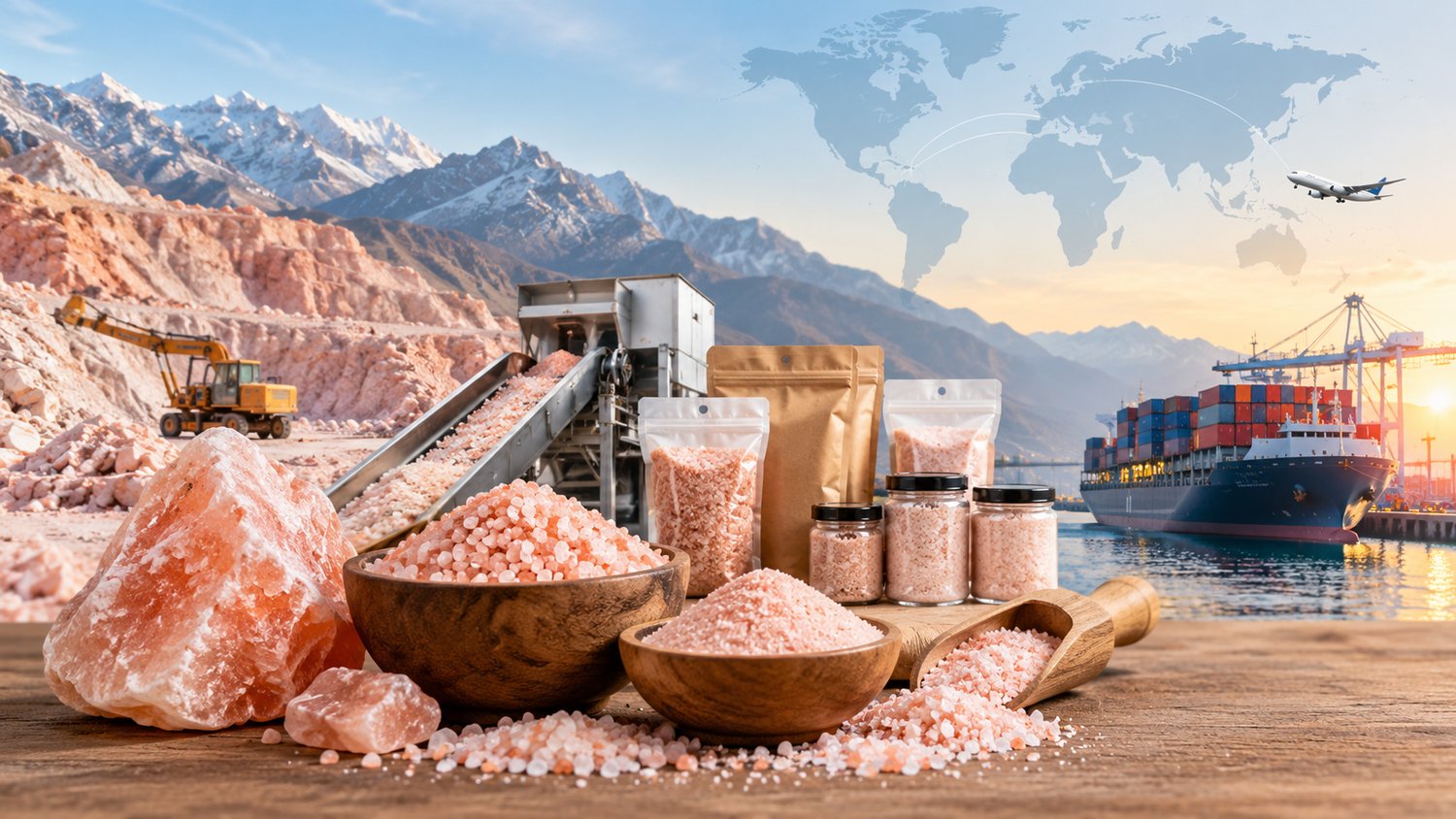
Many international buyers will check the prices from several different suppliers before ordering salt. Price is not the only factor to consider when talking about Himalayan salt exporters in Pakistan. Product grade, grain size, processing methods, certifications, packaging, and production capacity can all affect the suitability of a supplier. Export documentation and communication are also important factors to take into account when buying, particularly when making repeated exports.
A supplier can provide fine salt for food companies, coarse grades for wholesalers, or custom packaging for private label products. The necessities may differ from one market to another.
Therefore, the buyer must begin by identifying their product specifications and target market, and then select an exporter. When comparing suppliers, it is easier to compare the processing capabilities, quality systems, documentation provided, and volume of processing that can be done.
It is not just about getting a low quote, but also about looking for a supplier that can ensure the specifications are maintained and will be able to do so across orders.
What International Buyers Should Look for in a Himalayan Salt Exporter in Pakistan?
It is essential that before a buyer places an order with an exporter, they must evaluate a few practical aspects. This means product specifications, processing methods, certifications, capacity, and capability to fulfill buyers' order requirements for a Best Himalayan salt exporter in Pakistan. Reviewing them all in conjunction provides a better picture for the buyer than checking the price.
Product Quality and Specifications
From the beginning, specifications should be clear about the products. Buyers should be familiar with the origin, grade, grain size, color, and purpose of the salt. There may also be particular requirements for food grade, according to the food product and the market for which it is intended, depending on the food business. Common formats include:
- Fine salt
- Coarse salt
- Salt crystals
- Salt granules
- Specialty formats
A Himalayan Pink Salt exporter in Pakistan ought to be able to give clear data on these formats so that the purchaser can relate the product to their requirements. A food manufacturer might require a specific grain size; another wholesaler or retailer may want a different format. When ordering, it is helpful to verify these details and avoid specification problems later.
Processing and Manufacturing Capability
There are several steps in the process of getting from raw salt to a finished product. Buyers should be aware of the process that the exporter follows, as each step may impact the size, appearance, cleanliness, and overall specifications of the final product. A typical processing process includes:
- Salt extraction: Rock salt is extracted from the mining area and prepared for further handling.
- Sorting and handling: The raw salt is sorted and handled to remove unsuitable material before processing.
- Crushing: Larger pieces of salt are crushed into smaller sizes based on the required product.
- Grinding: Salt can be ground to achieve finer textures and specific grain sizes.
- Screening and grading: The processed salt is screened and separated according to grain size and grade.
- Quality checks: The finished product is checked against the required specifications before packaging.
- Packaging: Salt is packed according to the buyer's order, from bulk packaging to formats prepared for retail or private-label use.
- Storage: Finished products are stored in suitable conditions until they are ready for shipment.
Certifications and Quality Documentation
Certifications can help buyers understand a supplier's quality and food-safety systems, but they should not be treated as automatic proof of reliability. Buyers should check:
- Which certification is available
- Who issued it
- If it is current
- If it covers the relevant product
- If it meets the destination market's requirements
Common documents may include ISO certifications, HACCP, GMP, food-safety certifications, and Halal or Kosher certification where relevant. Product-specific documents may also be needed for certain markets.
Production Capacity and Order Volume
Production capacity is important if buyers require a large quantity or frequent deliveries. The factory facilities, annual capacity, repeat purchase capability, and private label capability of the exporter are useful to verify.
Buyer Requirements: What to Check
- Small Wholesale Order: Check the supplier’s minimum order quantity (MOQ).
- Bulk Order: Confirm available production volume and supply capacity.
- Private Label: Check custom packaging, labeling, and branding capabilities.
- Repeat Orders: Evaluate production consistency and the ability to maintain the same specifications.
- Multiple Products: Check the supplier’s processing capabilities and overall product range.
Why Price Alone Is Not Enough
The price of two exporters for the same type of salt can differ. This distinction may be in the offer's grade, processing, grain size, packaging, documentation, or shipping terms. A lower quotation does not necessarily mean the same product or the same level of service.
Why These Factors Affect the Quotation?
Several factors can influence the final quotation for Himalayan pink salt:
- Salt Grade: Different grades may require different levels of processing, sorting, and quality control.
- Grain Size: Fine, coarse, granule, and crystal formats require different processing and handling.
- Order Quantity: Larger order volumes can affect the price per unit due to production and packaging efficiencies.
- Packaging: Bulk bags, cartons, pouches, jars, and other retail formats have different packaging costs.
- Private Label: Custom packaging, labels, artwork, and branding add additional production requirements.
- Documentation: Required export documents and market-specific compliance requirements can affect the overall cost.
- Shipping & Destination: Freight costs vary based on the shipment size, destination, shipping method, and delivery terms.
How to Evaluate the Best Himalayan Pink Salt Exporter for Your Requirements?
No one exporter can satisfy all buyers. Requirements may vary depending on the product, target market, order size, certifications, packaging, delivery, and documentation. One supplier may be appropriate for one company but not for another.
Therefore, when looking for the best Himalayan pink salt exporter, it's important to consider the supplier's ability to meet your needs rather than just a single aspect.
Build a Buyer-Specific Evaluation Checklist
Before comparing exporters, buyers can make a simple checklist:
- Define the required salt product.
- Set the required grain size and grade.
- Decide the order quantity.
- Identify required certifications.
- Confirm packaging requirements.
- Check private-label options.
- Review export documentation.
- Compare delivery and payment terms.
Using the same checklist for each supplier makes the comparison clearer and helps buyers focus on the requirements that matter to their business.
What Makes Leading Pink Salt Exporters Different?
The facilities, equipment, and products and services that exporters have available will vary. These are the things that can make a difference for international buyers on their bulk, retail, or repeat orders.
Manufacturing Infrastructure:
A buyer can check the exporter's manufacturing setup before placing an order. Key points include:
- Number of manufacturing facilities
- Processing equipment
- Production capacity
- Quality-control systems
- Storage facilities
- Ability to handle different product formats
These details can give buyers a clearer idea of how an exporter manages production and handles different order requirements.
Export and Private-Label Capabilities
Export services can also vary from one supplier to another. Leading pink salt exporters may offer several options for buyers, including:
- Bulk shipments
- Retail-ready products
- Custom packaging
- Private labeling
- International documentation
- Shipment coordination
- Repeat-order handling
For buyers, the useful question is not simply what an exporter sells, but what services and capabilities are available for their specific order.
Example of a Pakistan-Based Exporter
Pakistan Organic Pink Salt® (POP Salts) is a Pakistan-based salt manufacturing and exporting company established in the year 1998. According to the company, they have 24,000+ MT per year manufacturing capacity, four manufacturing factories, and 28+ years of experience.
It's claimed to reach 85+ countries and has 11+ international certifications. The company also caters to bulk, wholesale, and private label orders, offering a choice of products and formats depending on quantity ordered.
These details can be studied together with product specifications, certifications, capacity, packaging, and export documentation for buyers who are comparing suppliers.
Researching the Himalayan Salt Exporter in Pakistan can include checking the supplier's manufacturing facilities, certifications, product range, exported products, etc. prior to contacting a supplier.
Questions to Ask Before Choosing an Exporter
Buyers are advised to ask pertinent questions regarding the product, the manufacturing process, the product certification, packaging, and export arrangements before making an order. It is particularly beneficial when comparing a Himalayan pink salt exporter in Pakistan with other suppliers.
- What are the sources of the salt?
- What grade and grain sizes are there?
- How is it cooked?
- What licenses are offered?
- What is the capacity of the production?
- What packaging material is there?
- Will private label orders be processed?
- What types of export documents are available?
- To which international markets does the exporter sell his products?
- How are repetitions for ordered specifications preserved?
Having clear answers to these questions can help buyers understand what an exporter can offer prior to proceeding in the sales process.
Conclusion
When selecting a Himalayan salt exporter in Pakistan, you must consider factors other than just prices. Customers must consider product quality, processing capacity, certifications, production capacity, and packaging before ordering a product. Ordering can also be facilitated by clear export documentation and good communication.
Price comparison can be useful, but should be based on the same specifications, quantity, package, and shipping conditions. Experience with exporting is also a factor, particularly for repeat and international orders.
It's important to be consistent for long-term supply. The buyer should inquire whether the exporter is able to assure future orders of the same product characteristics, packaging, documentation, and delivery schedules.
Such attributes can enable buyers to determine the suitability of a supplier for their product and supply needs, particularly for the leading pink salt exporters.