
Most certification listings bury the platform version somewhere near the bottom. SAS puts it in the credential's name: SAS Certified Statistical Business Analyst Using SAS 9 - Regression and Modeling. The version is not a footnote attached to the title. It is part of the title.
That is worth a moment before you book anything, because it tells you how to divide your study time. A credential that names its release out loud is drawing a line between two kinds of knowledge: the part tied to a particular version of the software, and the part that would still be true if the software changed underneath it. A00-240 sits mostly on the second side of that line. Candidates who prepare as though it sits on the first — memorising procedure options, rehearsing syntax — tend to be surprised by what the questions actually ask them to do.
The other half of the name says the same thing from the other direction. "Regression and Modeling" is not a SAS feature. It is a body of statistical reasoning that predates SAS 9 and will outlast it. The exam asks you to carry that reasoning through a SAS 9 workflow, which means the platform is the setting rather than the subject. Get that distinction right early and your preparation becomes much easier to plan.
This article walks through what the credential covers, what the exam costs in money and time, how to structure a preparation route around the two SAS courses the exam data names, and what the certification actually changes about the work you get asked to do. Where the underlying data is silent — and it is silent on several things candidates ask about — this says so rather than filling the gap with a guess.
What Is the SAS Certified Statistical Business Analyst Credential?
A00-240 is the exam behind the SAS Certified Statistical Business Analyst Using SAS 9 - Regression and Modeling credential. SAS files it under Advanced Analytics, and that category placement is a better description of the exam than the word "SAS" in the title suggests.
The distinction matters in practice. A programming certification asks whether you can make the software produce a result. This one asks whether the result you produced means what you think it means. Those are different skills, and the second is much harder to fake. You can pass a syntax exam by recognising the shape of correct code. You cannot pass a modelling exam by recognising the shape of correct output, because the output of a badly specified model looks exactly like the output of a good one. Both print coefficients. Both print fit statistics. Only one of them supports the conclusion someone is about to act on.
That is the competence the credential is built to certify: statistical judgment applied through SAS 9, aimed at business questions. The person it describes is not the one who runs the model. It is the one who decides which model to run, notices when its assumptions do not hold, and can explain to a decision-maker why the answer should or should not be trusted.
The two halves of the name map onto two halves of that job. "Statistical Business Analysis" is the framing half — turning a business question into something a model can answer, and turning a model's output back into something a business can act on. "Regression and Modeling" is the technical half — the family of methods used to do it. Neither half stands alone. A candidate who is strong on method and weak on framing builds technically correct models that answer the wrong question, which is a failure mode the exam is well designed to catch.
The "Using SAS 9" clause anchors all of this to a platform release. It is the part of the credential most tied to a moment in time, and the part that transfers least if your organisation moves to something else. The statistics transfer completely. That asymmetry is the single most useful thing to understand about A00-240 before you start studying, because it tells you where to spend the hours that actually change your score.
Exam Overview and Details
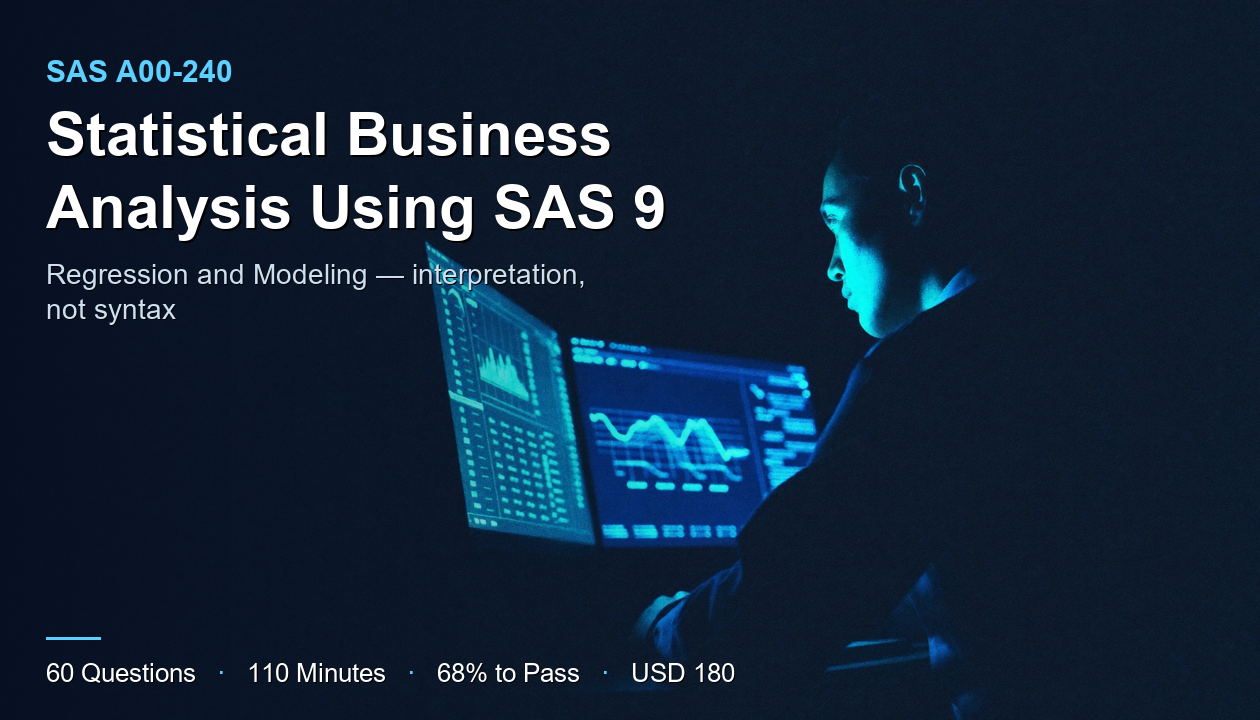
Here is what the exam data records about the attempt itself:
- Exam code: A00-240
- Questions: 60
- Duration: 110 minutes
- Passing score: 68%
- Exam fee: USD 180
- Platform version: SAS 9
- Category: Advanced Analytics
- Scheduling: through Pearson VUE
Those numbers are worth converting into the terms you will actually experience. Sixty questions in 110 minutes is a shade under one minute fifty per question. That is a comfortable pace for a question you understand and a punishing one for a question you are reasoning about from first principles. The exam does not give you room to derive things you should already know.
The 68% threshold deserves more thought than most candidates give it. On 60 questions, it means roughly 41 correct answers, leaving you a margin of about 19. That sounds generous until you consider how the misses cluster. Errors on a statistics exam are rarely scattered at random — they concentrate in whichever concept you half-understand. If your grasp of logistic regression interpretation is shaky, you do not miss one logistic question. You miss most of them, because the same misunderstanding is being tested from several angles. A single soft area can consume the entire margin on its own.
That is the practical case for breadth over polish. Candidates who fail usually do not fail because their strongest topic was not strong enough. They fail because one topic they skipped turned out to carry more questions than they assumed. Bringing every area up to solid is a better use of the last fortnight than bringing one area up to excellent.
The USD 180 fee is the other number worth reasoning about honestly. It is enough that a casual attempt is a poor idea, and not so much that a well-prepared attempt is a gamble. The sensible framing is to treat the fee as the price of a decision you make once — sit when your practice scores have been comfortably clear of 68% for a while, not when they have touched it once.
The exam data behind this article does not record a retake policy, an eligibility rule, or how long the credential stays current. Those are real questions with real answers, but the answers are not in this dataset, and guessing at them would be worse than useless. Check the official SAS credential page for anything in that category before you plan around it.
Key Topics and Syllabus
Before going further: the authority on the official domain list and how much each domain is worth is the A00-240 exam syllabus, alongside SAS's own exam content guide. Work from those for the breakdown. What follows describes the competence the exam is testing, organised by the two SAS courses the exam data names as its study material — which is the most reliable map available without inventing weightings.
Comparing Groups and the Logic of ANOVA
The first SAS course associated with this exam is Statistics 1: Introduction to ANOVA, Regression, and Logistic Regression, and the order of those three words is not accidental. Analysis of variance comes first because it establishes the habit everything else depends on: deciding whether an observed difference is large enough to act on.
The business version of this question is constant. Three store formats posted different average baskets last quarter — is that a real difference or noise? Four campaign variants returned four conversion rates — did one actually win? ANOVA is the machinery for answering that, and the exam cares less about whether you can run the procedure than about whether you know what its answer entitles you to say. A significant overall result tells you the groups are not all alike. It does not tell you which pair differs, and reading it as though it does is one of the most common analytical errors in business reporting.
Expect to be pushed on the assumptions too. ANOVA rests on conditions about independence, variance, and distribution, and the exam is more interested in whether you notice when those conditions fail than in whether you can recite them.
Linear Regression and What a Coefficient Actually Claims
Regression is where most of the exam's conceptual weight sits, and where the gap between running a model and understanding one is widest.
Fitting a linear model in SAS 9 is a small amount of code. Reading it correctly is the skill. A coefficient is a conditional statement — the expected change in the outcome per unit change in that predictor, holding the others fixed — and almost every misinterpretation comes from dropping the second half of that sentence. When predictors move together in the real world, "holding the others fixed" describes a situation that may never occur, and a coefficient that is correct arithmetically can still be nonsense as a business claim.
The diagnostic side carries similar weight. Residual patterns, influential observations, and correlated predictors all change what a model is entitled to say, and they show up in output as things you have to notice rather than things that announce themselves. Be ready for questions that hand you a fitted model and ask what is wrong with it, rather than asking you to build one.
Logistic Regression for Binary Outcomes
Both named SAS courses cover logistic regression, and the second is devoted to it entirely. That repetition is a strong signal about where the exam concentrates.
The reason is that most decisions businesses actually make are binary. Will this customer churn or stay? Will this application default or repay? Will this lead convert? Linear regression is the wrong tool for those questions, and understanding precisely why — that a probability is bounded and a straight line is not — is the conceptual step the exam wants you to have taken properly rather than accepted on faith.
What makes logistic regression harder to interpret is that its coefficients do not live on the scale of the thing you care about. They live on the log-odds scale, and moving between log-odds, odds, and probability is where candidates lose marks. Odds ratios are the usual currency in business reporting, and being fluent in what an odds ratio does and does not mean — particularly that it is not a risk ratio, and that its interpretation depends on the baseline — is directly examinable and directly useful.
Building Predictive Models You Can Defend
The second course, Predictive Modeling Using Logistic Regression, moves from explaining relationships to predicting outcomes, and the standard of evidence changes with it.
An explanatory model has to be defensible about why. A predictive model has to be defensible about whether it will keep working on data it has never seen. That shift brings in variable selection, model comparison, and the honest assessment of performance — which in practice means understanding that a model's fit to the data it was built on is not evidence of anything much, and that the only performance figure worth quoting is the one measured on data held back from training.
Expect the exam to probe the failure mode rather than the success. Overfitting is the central hazard of predictive modelling, and it does not look like failure from the inside; it looks like an excellent model. Recognising it from the evidence available is the competence being tested.
Preparing Data and Reading Assumptions
Running through all of the above is the work that happens before any model is fitted, and it is easy to under-prepare because it feels like housekeeping rather than statistics.
It is not housekeeping. How you handle missing values, whether you transform a skewed predictor, how you encode a categorical variable with many levels, and where you split continuous predictors are all modelling decisions that change the result. The exam treats them as such. This is also where the SAS 9 specifics genuinely matter — the platform has particular conventions for how these operations are expressed, and knowing them is part of the "Using SAS 9" half of the credential.
Preparation Guide
The structure below assumes you have working SAS 9 familiarity and are building the statistical layer on top of it. If the software itself is new to you, add time before any of this.
Start From the Syllabus, Not From a Course Catalogue
The most common preparation mistake is starting with the study material and hoping it covers the exam. Do it the other way around: read the official content guide first, list what it names, and only then decide which resources fill which gaps.
This matters more here than on a typical exam because the topic area is one where you almost certainly know some of it already. Anyone who has done applied analytics has met regression. The risk is that familiarity gets mistaken for exam readiness — you recognise the topic, so you skip it, and the questions turn out to test a level of precision your working knowledge never needed. An explicit inventory against the official list catches that before it costs you an attempt.
Work the Two SAS Courses in Their Intended Order
The exam data names two SAS courses, and they build deliberately:
- Statistics 1: Introduction to ANOVA, Regression, and Logistic Regression — the foundation layer covering all three method families
- Predictive Modeling Using Logistic Regression — the applied layer, going deeper on the method the first course introduces last
Taking the second before the first is a false economy. Predictive Modeling assumes you already understand what a logistic regression coefficient means; it is about what to do with the model, not what the model is. Candidates who jump ahead usually end up going back.
Between the two, leave a gap and use it. The material in Statistics 1 needs to become automatic before the second course's content has anywhere to attach. A week of working problems on your own data does more for retention than moving straight into the next syllabus.
Read Output Until You Can Predict It
This is the highest-value habit available to you, and it costs nothing.
Take a dataset you know well, fit a model, and before you look at the results, write down what you expect: which predictors will matter, what sign each coefficient should carry, roughly how well it should fit. Then look. The gap between your prediction and the output is precisely the gap the exam will find.
Doing this repeatedly builds the thing the exam actually tests — the ability to look at a block of results and immediately notice what is off about it. That is a pattern-recognition skill, and pattern recognition comes from volume, not from reading. A candidate who has interrogated forty model outputs will beat one who has read four chapters about them.
Rehearse Against the Real Clock
Somewhere in the last stretch, stop studying topics and start rehearsing the exam.
Sixty questions in 110 minutes needs to be practised as a whole, in one sitting, because the constraint it imposes is not per-question — it is cumulative. Interpretation questions are mentally expensive, and the cost of the twentieth one is higher than the cost of the second. You need to know how your accuracy behaves at minute ninety, and the only way to find out is to be there.
Use those runs to build a triage habit as well. Some questions you will answer immediately, some need working, and a few will be genuinely uncertain. Sorting them quickly and moving on — rather than spending six minutes on one hard question and rushing four easy ones — is worth several marks by itself, and it is a skill you can only practise under the clock.
Benefits and Career Scope
The most concrete thing this credential does is settle a question that is otherwise expensive to answer: whether someone can be trusted with a model that informs a decision.
That question comes up constantly and is genuinely hard to resolve in an interview or a review cycle. Plenty of people can produce a model. Far fewer can tell you what would have to be true for it to be wrong. A00-240 is evidence for the second, because its subject is interpretation and assumption-checking rather than execution. Certifying against a credential that names Advanced Analytics as its category makes a claim about analytical judgment, not about tool operation.
In day-to-day terms, that tends to change what you get handed rather than what you are called. The work that flows to someone with demonstrated modelling judgment is the work where the answer matters and the method is contestable — the analysis that will be challenged, the model whose assumptions someone will question, the result that has to survive a room. Those are the assignments that build a reputation, and they are usually allocated on the basis of trust that has to be established somehow.
It also has a specific value inside SAS 9 environments. Organisations running SAS 9 for statistical work are typically ones where analysis carries consequences — regulated industries, clinical and financial settings, established analytics functions. In those environments a vendor credential tied to the platform in use is legible in a way that a general qualification is not. It answers the question the hiring manager is actually asking, which is whether you can do this work here.
The honest limit is that a certification demonstrates capability rather than experience, and no credential substitutes for a portfolio of problems you have actually solved. What it does is get your capability taken seriously early enough for the portfolio to start accumulating. The exam data contains no salary information and this article will not invent any — the return is in the kind of work, and that is the part you can plan around.
Practice Test and Preparation Resources
SAS publishes material for this exam directly. The official sample questions are the closest look you get at the vendor's own question style, and there is an SAS e-learning activation associated with the exam as well. Start with these — however good third-party material is, the vendor's own phrasing is the reference standard for how questions are worded.
Their limitation is volume. A short sample tells you what the questions look like; it does not tell you whether you are ready, because readiness is a claim about consistency across the whole syllabus and a handful of questions cannot establish it.
That is the gap a full practice exam fills. AnalyticsExam publishes the SAS Statistical Business Analysis Using SAS 9 - Regression and Modeling (A00-240) Premium Practice Exam at USD 41.30, built to mirror the real attempt's format so that your rehearsal conditions match the day itself. You can try the A00-240 sample questions first to see whether the style suits how you study.
Use practice tests diagnostically rather than as a score to collect. A result is only useful if you go back through every wrong answer and identify which misunderstanding produced it — and, just as importantly, through the right answers you were unsure about, because a lucky guess on a real gap is a failure the score does not show you. Two practice attempts worked through properly are worth more than six taken and totalled.
The signal to book is stability, not a single good result. When your scores sit clear of 68% across several attempts covering different parts of the syllabus, the remaining variance is small enough to sit against. One score that touched the threshold is not that.
Conclusion
A00-240 is a statistics exam conducted through SAS 9, and almost every good decision you make while preparing follows from taking that sentence literally.
It means the platform specifics are worth knowing but are not where the exam concentrates. It means the hours that move your score are the ones spent on interpretation — on what a coefficient claims, on what an odds ratio does not mean, on how you tell an overfitted model from a good one. It means that the part of this credential most tied to a moment in time is the "Using SAS 9" clause, and the part that will still be earning its keep in a decade is everything either side of it.
Work from the official content guide, take the two SAS courses in the order they were designed to be taken, build the habit of predicting output before you read it, and rehearse the full 60 questions against the real clock until 68% stops being a question. The credential is a reasonable target for anyone already doing analytical work who wants that work taken more seriously — and the preparation, done properly, improves the analysis you produce whether or not you ever sit the exam.
FAQs
How many questions does A00-240 have, and how long do I get?
Sixty questions in 110 minutes, which works out to a little under one minute fifty per question. That is enough time to think, but not enough to reconstruct a concept you have not learned properly.
What score do I need to pass?
68%. On 60 questions that is roughly 41 correct, leaving a margin of about 19 — which sounds comfortable but disappears quickly if one topic is weak, because errors on a statistics exam cluster inside whichever concept you half-understand.
What does the exam cost?
USD 180 for the attempt. That is separate from any training or practice material you choose to buy.
Where do I schedule it?
Through Pearson VUE, which handles scheduling for SAS certification exams.
Which SAS version does this exam target?
SAS 9 — it is named in the credential itself, as SAS Certified Statistical Business Analyst Using SAS 9 - Regression and Modeling. Prepare against SAS 9 conventions rather than a different release.
Which SAS courses line up with the exam?
Two are associated with it: Statistics 1: Introduction to ANOVA, Regression, and Logistic Regression, and Predictive Modeling Using Logistic Regression. Take them in that order — the second assumes the first.
Are there official practice materials from SAS?
Yes. SAS publishes a sample-questions PDF for this exam and there is an associated e-learning activation. Both are linked in the resources section above, and both are worth doing before any third-party material, because they show you the vendor's own question phrasing.
Does A00-240 have prerequisites, and how long does the credential last?
The exam data behind this article does not record prerequisites, retake rules, or a validity period, so this article will not state any. Those answers do exist — check the official SAS credential page linked above before planning around them.