
A00-406 costs USD 180 to sit. That is the visible price, and it is the smaller of the two you pay. The larger one is the preparation — the hours spent learning how SAS Viya builds, compares, and selects supervised machine learning models — and the whole point of those hours is to make the USD 180 a one-time expense.
That framing matters because machine learning exams attract a particular kind of optimism. Plenty of candidates already work with models in Python or R, have read about gradient boosting and neural networks, and assume the exam is mostly a matter of learning where SAS put the buttons. Some of them are right. Many discover in the exam room that knowing what a model is and knowing how to build, tune, and defend a pipeline of them in a specific platform are different skills, and that the difference costs exactly one attempt fee to find out.
The 90-minute exam is where you learn whether the preparation worked. It is not a good place to learn what the preparation should have been. At this price, a failed attempt costs USD 180 plus the weeks it takes to rebook, and it tells you far less about your gaps than an honest practice run would have done for a fraction of the money.
So this article keeps asking one question: are you ready enough to spend the fee once? It covers what the credential certifies, exactly what the attempt involves, the competence the named SAS course points at, a preparation route built around catching gaps before the exam does, and a clear signal for when to book.
What Is the SAS Viya Supervised Machine Learning Pipelines Exam?
A00-406 is the exam behind the SAS Certified Specialist - Machine Learning Using SAS Viya credential. SAS files it under Advanced Analytics, and the exam's own title — SAS Viya Supervised Machine Learning Pipelines — is a precise description of what it covers, if you read every word in it.
"Supervised" narrows the field. This is about learning from labelled outcomes: predicting whether a customer churns, whether a transaction is fraudulent, what a claim will cost. Clustering and other unsupervised work sit outside that word. "Machine learning" signals the model families that go beyond classical regression — the flexible, often less interpretable methods that trade transparency for predictive power. And "pipelines" is the word most candidates underweight.
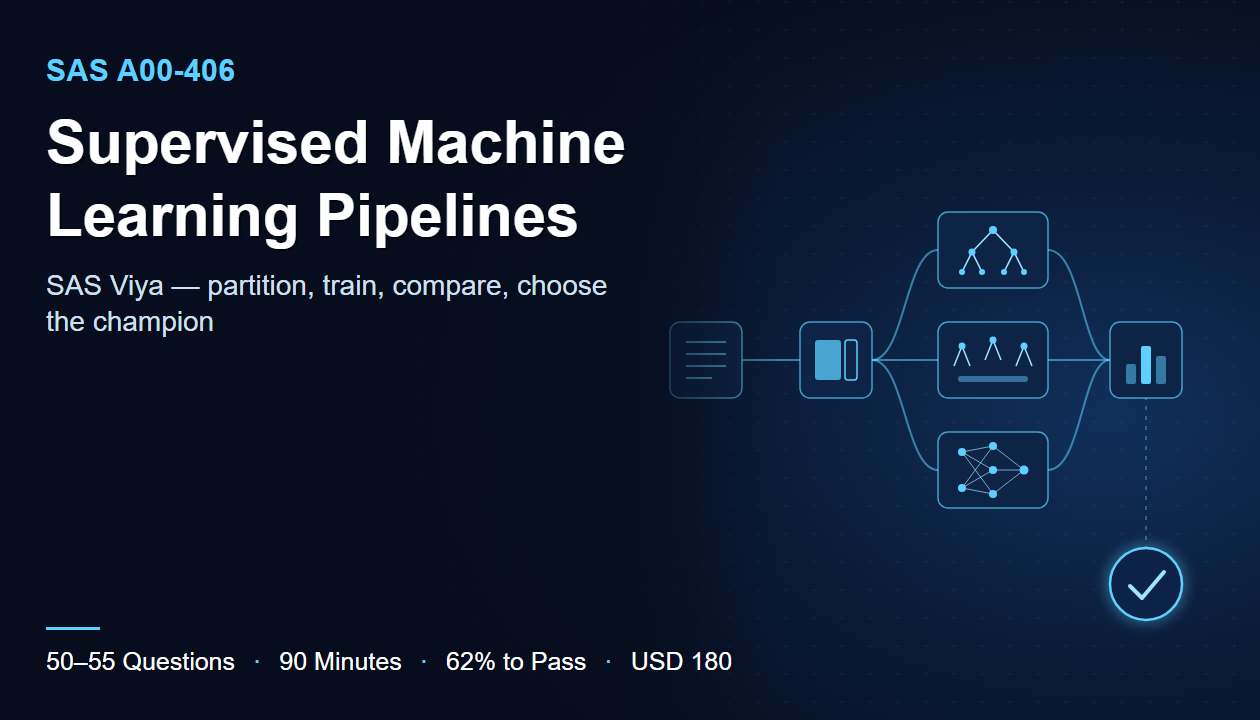
A pipeline is not a model. It is the sequence of steps that turns raw data into a chosen, assessed model: preparing the data, partitioning it so performance can be measured honestly, training several candidates, comparing them on consistent terms, and selecting one. The exam certifies that you can run that whole sequence in SAS Viya, not that you can explain a single algorithm in isolation. That distinction is where most of the gap between expectation and reality lives.
The exam data records the product version as SAS Viya 4.0. That anchors the platform side of the credential. The concepts — partitioning, overfitting, model comparison, assessment — are portable across tools and releases. The way SAS Viya expresses them is not, and it is examinable.
The practitioner this credential describes is the one who can be handed a prediction problem and a dataset and come back with a defensible model, a record of what was compared against what, and an honest estimate of how well it will perform on data it has not seen. If that is the work you do or want to do in a SAS environment, the exam is well aimed at you. If your modelling happens entirely outside SAS, budget more preparation time for the platform half than your machine learning experience might suggest.
Exam Overview and Details
What the exam data records about the attempt:
- Exam code: A00-406
- Questions: 50-55
- Duration: 90 minutes
- Passing score: 62%
- Exam fee: USD 180
- Product version: SAS Viya 4.0
- Category: Advanced Analytics
- Scheduling: through Pearson VUE
The question count is recorded as a range, so work the arithmetic at both ends. With 50 questions, 90 minutes gives you 1 minute 48 seconds each, and 62% means 31 correct with a margin of 19. With 55 questions, you get about 1 minute 38 seconds each, and 62% means 35 correct with a margin of 20. The margin barely moves. The time per question moves more, and it is worth preparing for the tighter end rather than the looser one.
That per-question time deserves attention because of what machine learning questions tend to ask. A question that describes a pipeline, shows you a comparison of several models, and asks which should be selected — or why the apparently best one is a poor choice — takes real reading. Under two minutes is enough to apply understanding you already have. It is not enough to work out from first principles why a model's training performance tells you almost nothing about its future performance.
The margin of roughly 19 or 20 questions is comfortable in principle, but it only protects you against scattered weakness. Machine learning knowledge is rarely scattered. Candidates are usually strong on the model families they use and weak on the ones they have only read about, or strong on algorithms and weak on assessment. A concentrated gap does not cost one question; it costs most of a topic, and that is how a comfortable-looking margin disappears.
Then the USD 180 itself. It is priced so that an unprepared attempt is a genuine waste and a prepared one is plainly worth it. The most expensive outcome is not failing; it is booking because your practice score touched 62% once, failing by a few questions, and paying again for the same lesson a second practice exam would have taught you.
The exam data records no prerequisites, retake policy, or credential validity period. Those answers exist, but they are not in this dataset and this article will not invent them. Check the official SAS credential page before planning around any of them.
Key Topics and Syllabus
The authority on the official objectives and their weightings is the A00-406 exam syllabus, together with SAS's own exam content guide. Use those for the formal breakdown and for exactly which methods are in scope. What follows describes the competence a supervised machine learning pipeline demands, organised around the pipeline itself rather than around invented section names.
Preparing and Partitioning the Data
Every honest model assessment starts before any model is trained, with the decision about how the data will be split.
Partitioning divides the data so that models are trained on one portion and judged on another they never saw during training. It sounds procedural, and it is the single most important safeguard in the whole pipeline. Without it, every performance figure you produce is a measure of how well a model memorised its own training data, which is almost worthless as a prediction of how it will behave in production.
Preparation surrounds that decision. Missing values, rare categories, skewed inputs, and target variables with very unbalanced outcomes all affect what a model learns, and choices made here propagate through every step after. Expect the exam to treat these as modelling decisions with consequences rather than as tidying up.
Training Flexible Model Families
Supervised machine learning pipelines typically train several different kinds of model on the same prepared data, precisely because no single family wins every problem.
Tree-based methods split the data into increasingly specific groups and are prized for handling messy inputs and interactions without much preparation. Ensembles of trees combine many weak learners into a strong one and are frequently the most accurate choice on tabular business data. Neural networks can capture very complex relationships but are hungrier for data and tuning and harder to explain. Which of these the exam covers, and in how much depth, is for the content guide to say — but the reasoning about their strengths and trade-offs is what the questions will lean on.
The competence being tested is less "can you describe a gradient boosting model" and more "given this data and this goal, which family is a sensible candidate, and what would you expect it to do well or badly?"
Tuning Without Fooling Yourself
Flexible models have settings that control how much they are allowed to learn, and tuning those settings is where good pipelines quietly become bad ones.
Every flexible model can be made to fit its training data almost perfectly. That is the problem, not the achievement. Tuning is the search for the setting that generalises best to unseen data, and the trap is tuning against the very data you later use to report performance — at which point the performance figure has been optimised rather than measured. Understanding which portion of the data each decision is allowed to see is the conceptual core of this area.
Expect questions that describe a tuning process and ask what is wrong with how its results were evaluated. The error is usually not in the algorithm. It is in the order of operations.
Comparing Models and Choosing a Champion
The point of training several models is to choose between them, and the choice is where a pipeline earns or loses its credibility.
A fair comparison needs every candidate assessed on the same held-out data with the same measure, and that measure has to match the business problem. Accuracy can be badly misleading when the outcome you care about is rare: a fraud model that predicts "no fraud" every time can score very high accuracy while catching nothing. Choosing the right assessment measure for the question, and reading a model comparison critically rather than simply picking the highest number, is directly examinable and directly useful.
The selected model is often called the champion, and the justification for that choice is part of the deliverable. A champion chosen on the wrong measure, or on data it had already seen, is not a champion at all.
Building and Maintaining the Pipeline Itself
Finally, the pipeline as an object in its own right — the thing you build, adjust, rerun, and hand to someone else.
This is where the SAS Viya 4.0 specifics matter most. How a pipeline is assembled, how its steps connect, how results from different branches are brought together for comparison, and how the finished work is reused are expressed in the platform's own terms, and the exam expects you to know them. General machine learning experience helps least here and hands-on time in SAS Viya helps most, which is exactly why candidates from other ecosystems should budget for it.
Preparation Guide
The route below is built around one aim: find your gaps with cheap tools before the USD 180 attempt finds them for you.
Price Your Gaps Before You Price the Exam
Start with the official content guide and mark every objective honestly: done in SAS Viya, done in another tool, or only read about.
The middle column is the one that surprises people. "Done in another tool" feels like readiness and is often only half of it, because the exam tests the SAS Viya expression of each idea. The third column is outright risk. Between them, those two columns tell you how long preparation will actually take, which is the number you need before deciding when to book.
This costs an hour and is the best value in the entire process. Candidates who fail an attempt can almost always name, afterwards, the area that sank them — and could usually have named it beforehand if they had written the list.
Work Through the Named SAS Course
The exam data names one course: Machine Learning Using SAS Viya. Treat it as the spine of your preparation rather than one resource among many, because it is the material aligned most closely with how SAS thinks about these pipelines.
Do it actively. Rebuild every pipeline it demonstrates yourself rather than watching it built, and after each one, change something — the partition, a model setting, the assessment measure — and predict the effect before you rerun it. The gap between your prediction and the result is exactly the understanding the exam probes.
Build Pipelines That Fail Honestly
Once the course material is familiar, take a dataset of your own and deliberately build pipelines that go wrong.
Evaluate a model on its training data and watch how good it looks. Tune aggressively and see training performance climb while held-out performance stalls or falls. Assess a model on a rare outcome with accuracy and then with a more appropriate measure, and see the ranking of your candidates change. Each exercise builds a reflex for spotting the errors exam questions are constructed around, and none of them can be learned as well by reading.
Defend Every Pipeline Decision in Writing
Pick one pipeline you have built and write a short justification for it, as if a sceptical colleague were about to rely on its results. Why was the data partitioned the way it was? Why were those model families chosen as candidates and not others? Which portion of the data did each tuning decision see? Why was the champion selected on that particular measure, and what would have changed if a different measure had been used?
This exercise is uncomfortable in a useful way. Most of us can build a pipeline that runs long before we can explain every choice in it, and the places where your explanation turns vague are precisely the places the exam will probe. A question that asks why one model should be preferred over another, or what is wrong with how a result was reported, is really asking you to produce this justification under time pressure. Writing it calmly first is much cheaper than discovering in the exam room that you cannot.
It also sharpens the specific vocabulary the exam relies on. Terms such as training, validation, and test data, overfitting, and assessment measures need to be precise rather than approximately right, because answer options are often separated by exactly that precision. If you notice yourself using two of those terms interchangeably while writing, stop and settle the distinction before moving on.
Repeat the exercise for a second pipeline built on a different kind of problem — a rare outcome if the first had balanced classes, or a continuous target if the first predicted a category. The comparison between the two justifications shows you which of your habits are genuine judgment and which are defaults you have never questioned, and at USD 180 an attempt, that is worth knowing before the exam asks.
Rehearse at the Tight End of the Clock
Plan for 55 questions rather than 50. That means practising at about one minute 38 seconds per question, in full-length sittings, so that the pace of the real attempt feels familiar rather than hurried.
Practise triage as part of it: answer what you know, flag what needs working, and move on. On an exam where many questions present a model comparison or a pipeline description to interpret, spending five minutes on one and rushing the next three is an easy way to lose the margin you prepared for.
Benefits and Career Scope
The clearest value of this credential is that it demonstrates something that is hard to verify quickly: that a person can take a prediction problem through a full, defensible modelling process rather than just fit a model.
That distinction matters to anyone who has to trust a model's output. A model that looks accurate is easy to produce. A model whose accuracy was measured honestly, compared fairly against alternatives, and chosen on a measure that matches the business question is much rarer, and its absence usually becomes visible only after decisions have been made on it. A credential built around pipelines — around partitioning, comparison, and selection — speaks directly to that concern.
In SAS Viya environments specifically, the credential is immediately legible. Organisations that have invested in SAS Viya for modelling want people who can use it as intended, and a vendor certification tied to the platform in use answers that question directly in a way that general machine learning experience does not.
In practical terms, the credential tends to change which parts of a modelling project you are trusted with. There is a difference between being asked to train a model someone else specified and being asked which modelling approach to take, how to validate it, and whether its results should be believed. The second kind of work carries more responsibility and more influence, and it goes to people whose judgment has been established somehow.
The honest limit is that certification evidences knowledge rather than the judgment that comes from deploying models and living with their consequences. The exam data contains no salary information, and this article will not invent any. What the credential does reliably is get you considered for the projects that build that judgment.
Practice Test and Preparation Resources
SAS publishes material for this exam directly. The official sample questions are the closest thing to the real exam's phrasing, and they should be the first practice you do. Treat them as calibration: they show you how SAS frames a question about a pipeline, which is often harder than the underlying concept.
Their limitation is scale. A short sample shows you the style; it cannot tell you whether you are ready, because readiness means performing consistently across the whole syllabus, and a handful of questions cannot measure that.
That is where a full-length practice exam earns its place in a cost-conscious plan. AnalyticsExam publishes the SAS Viya Supervised Machine Learning Pipelines (A00-406) Premium Practice Exam at USD 41.30 — less than a quarter of the attempt fee — built to mirror the real exam's format so your rehearsal conditions resemble the day itself. You can work through the A00-406 sample questions first to see whether the style suits how you study.
Use every practice result diagnostically. For each wrong answer, identify the specific misunderstanding behind it. For each right answer you were unsure of, do the same, because a lucky guess over a real gap is a failure the score conceals. Tag mistakes by pipeline stage — preparation, training, tuning, comparison, platform — so a pattern emerges while there is still time to act on it.
The booking signal is consistency. When your results sit clear of 62% across several attempts that covered different parts of the syllabus, with no pipeline stage repeatedly dragging, the remaining risk is small enough to spend USD 180 against. One good score is not that signal; it is one paper that happened to favour your strengths.
Conclusion
A00-406 is a pipeline exam, and the most expensive mistake available is preparing for an algorithm exam instead. Knowing what a neural network or a tree ensemble is will not carry you through questions about partitioning, honest tuning, fair comparison, and champion selection in SAS Viya 4.0.
The economics point the same way the content does. USD 180 is the price of one attempt, and the preparation is what decides whether you pay it once. An hour listing your gaps, a course rebuilt by hand rather than watched, a few pipelines built to fail on purpose, and full-length practice at the tighter end of the clock cost far less than a second attempt — and they produce the understanding the credential is meant to certify.
Book when practice results are consistently clear of the threshold, not when they first reach it. Do that, and the 90 minutes become a confirmation of work already done, which is the only version of this exam worth paying for.
FAQs
How many questions does A00-406 have, and how long do I get?
The exam data records 50-55 questions in 90 minutes. That is about one minute 38 seconds per question at the upper end, so prepare for that pace rather than the looser one.
What score do I need to pass?
62%. That is 31 correct out of 50, or 35 out of 55 — a margin of roughly 19 or 20 questions, which covers scattered mistakes but not a whole pipeline stage you have not practised.
What does the exam cost?
USD 180 per attempt, separate from any training or practice material. The strongest argument for thorough preparation is that a second attempt costs the same again.
Which credential does passing A00-406 earn?
The SAS Certified Specialist - Machine Learning Using SAS Viya credential, filed by SAS under Advanced Analytics.
Which SAS Viya version does the exam target?
The exam data records SAS Viya 4.0. Machine learning concepts carry across tools, but prepare the platform-specific parts against that version.
What training does SAS recommend?
The exam data names one course, Machine Learning Using SAS Viya, linked in the preparation section above. Rebuild its pipelines yourself rather than only watching them.
Are there official practice questions?
Yes. SAS publishes a sample-questions PDF for this exam, linked in the resources section. Do it first, as calibration for how SAS phrases pipeline questions.
Are there prerequisites, and how long does the credential last?
The exam data records neither prerequisites, retake rules, nor a validity period, so this article states none. Take those answers from the official SAS credential page rather than from third-party summaries.