
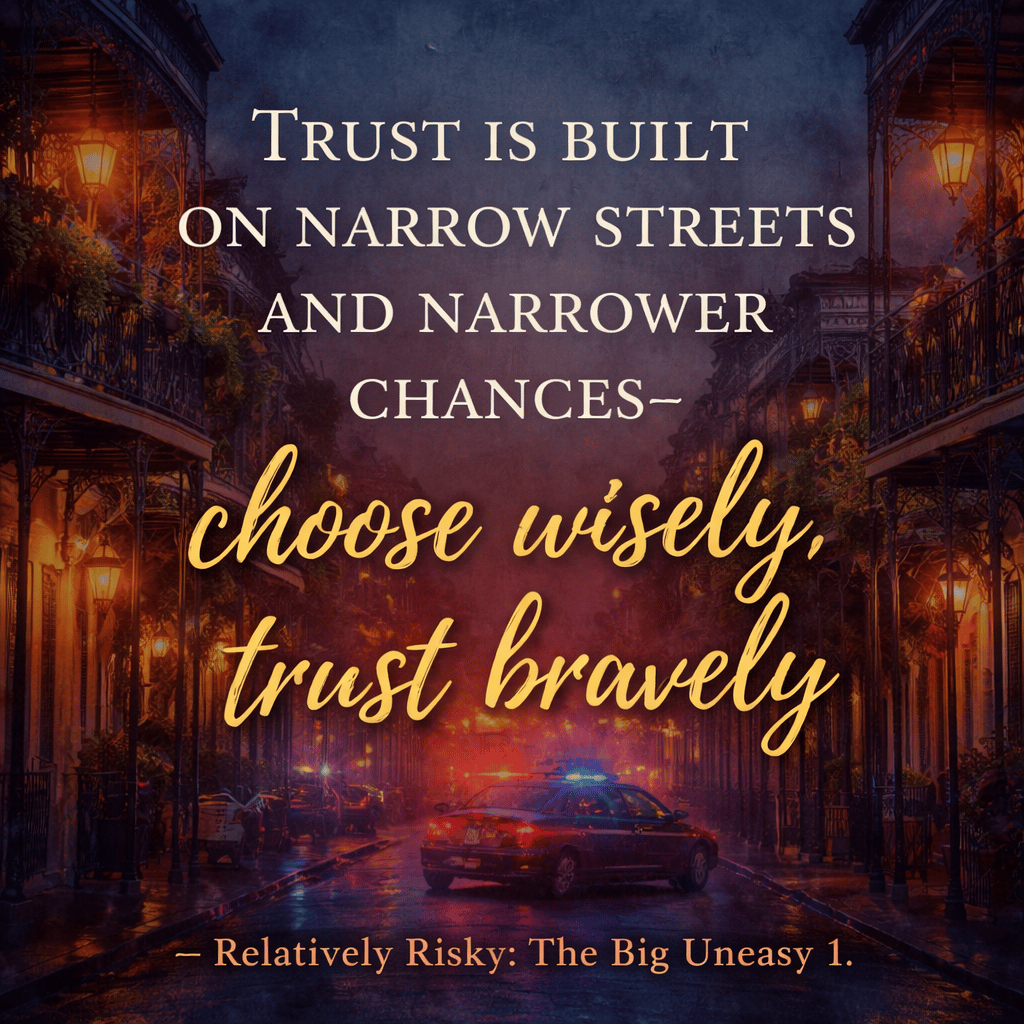
Relatively Risky was born from a love of New Orleans, a fascination with family dynamics, and a desire to blend humor with suspense. Here’s how those ingredients came together.
* * *
Every book begins with a curiosity: a question, an image, a line of dialogue that won’t leave the writer alone. For Relatively Risky, it started with the image of a woman on a bike in the French Quarter, a sketchbook at her side, and an entirely uncooperative world ready to rewrite her plans. From that snapshot, the story of Nell Whitby unfolded — and then Alex Baker, his enormous family, and a secret that refuses to stay buried.
New Orleans is not just a backdrop; it’s a collaborator. The city’s rhythms — the slow pull of Jazz, the intensity of Mardi Gras neighborhoods, the scent of café au lait mixing with street spices — informed tone and plot. Research involved long walks through the Quarter, late-night listening sessions to hear how locals talk, and, yes, plenty of beignet tasting. The aim was to capture authenticity without turning the city into a caricature. The result is a setting that feels lived-in, where the streets themselves can mislead as easily as any suspect.
Balancing humor and danger was another challenge. Mystery thrives on jeopardy, but humor provides readers a breathable space. The voice needed to pivot from laugh-out-loud dialogue to tense stakeouts without losing cohesion. To do that, scenes are written with emotional foils: a high-adrenaline chase followed by an irreverent family dinner, for example. Those contrasts keep the pace energetic and the stakes human.
Character research took a similarly layered approach. Alex’s role as a seasoned detective demanded procedural credibility, so I studied investigative workflows and leaned on consultants to ensure the police perspective felt real. For Nell, her career as a children’s author shapes how she sees the world — with patience, imagination, and an insistence on small joys. Their professions inform their choices, making their conflicts and attractions feel organic.
The family dynamic — particularly Alex’s twelve siblings — began as a storytelling device to add humor and complication, but it evolved into a thematic center. Siblings bring history, shared complicity, and inevitable friction. Giving Alex a large family allowed the novel to explore protection, rivalry, and the messy generosity of belonging.
Finally, there’s the secret at the book’s heart. Crafting a reveal that’s surprising but fair is a writer’s favorite puzzle. Clues were planted to reward attentive readers while false leads kept the suspense robust. The goal was always to make the ending feel inevitable in hindsight — the kind of payoff that prompts a re-read to see how the pieces fit.
Relatively Risky is the product of place, curiosity, and a desire to tell a story that balances laughter with hurt, action with intimacy. If the city hums on the page and the characters feel like people you might recognize at a corner cafe, then the behind-the-scenes work has done its job.