
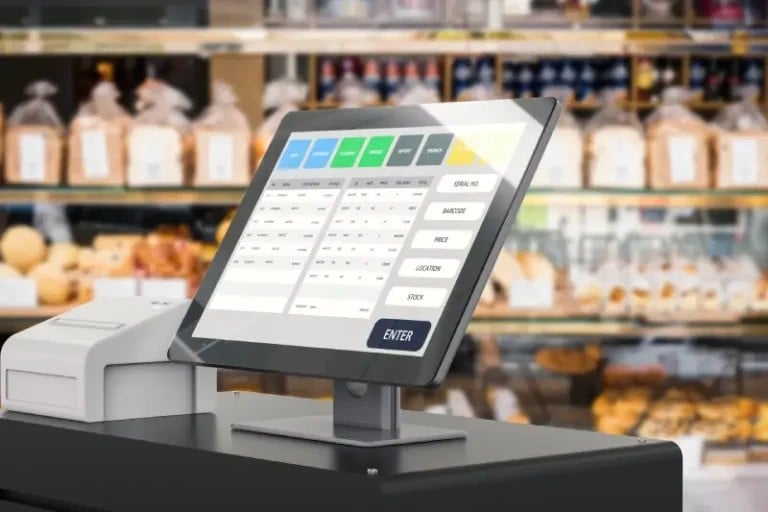
What is restaurant management software in Calgary?
Restaurant management software in Calgary is a digital platform that helps restaurants manage everyday operations from one system. It can combine point-of-sale (POS), order management, payments, inventory, staff management, reporting, and customer data.
For restaurants with busy kitchens, a kitchen POS system can connect front-of-house orders with kitchen staff, helping reduce communication errors, speed up order preparation, and keep service organized.
How does a kitchen POS system work?
A kitchen POS system connects the restaurant's ordering process with the kitchen workflow. When a server, cashier, kiosk, website, or delivery channel enters an order, the information can be sent directly to the appropriate kitchen station or display.
A typical workflow looks like this:
- A customer places an order.
- The POS records the items, modifiers, and payment information.
- The order is sent to the kitchen display or printer.
- Kitchen staff prepare the order based on the ticket.
- Staff update the order status as it moves through preparation.
- The front-of-house team can see when the order is ready.
This reduces the need for handwritten tickets or verbal communication between servers and kitchen staff.
What features should restaurant management software include?
The right features depend on the restaurant's size and operating model, but Calgary restaurants should generally look for software that covers several core areas.
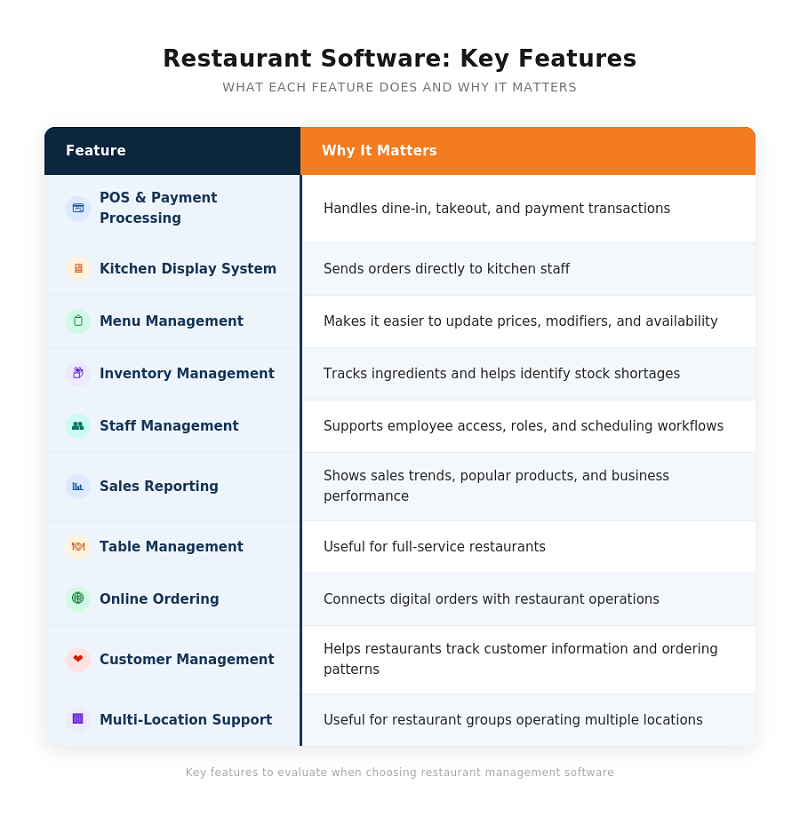
Restaurants should prioritize features that solve their biggest operational problems rather than paying for unnecessary functionality.
How can a POS system improve kitchen efficiency?
A kitchen POS system can improve efficiency by making order information more accurate and accessible.
Instead of a server verbally explaining an order to kitchen staff, the kitchen receives the details electronically. Modifiers such as "no onions," "extra sauce," or specific cooking preferences can be included with the order.
A good system can also help restaurants:
- Reduce order-entry mistakes
- Organize tickets by kitchen station
- Prioritize orders
- Track preparation times
- Improve communication between servers and cooks
- Identify bottlenecks during busy periods
- Keep dine-in, takeout, and delivery orders organized
For high-volume restaurants, even small improvements in order accuracy and preparation time can have a meaningful impact on customer satisfaction.
How much does restaurant management software cost in Calgary?
The cost varies considerably depending on the restaurant's size, features, number of terminals, payment processing, hardware, and whether advanced modules are required.
A practical budgeting framework is:
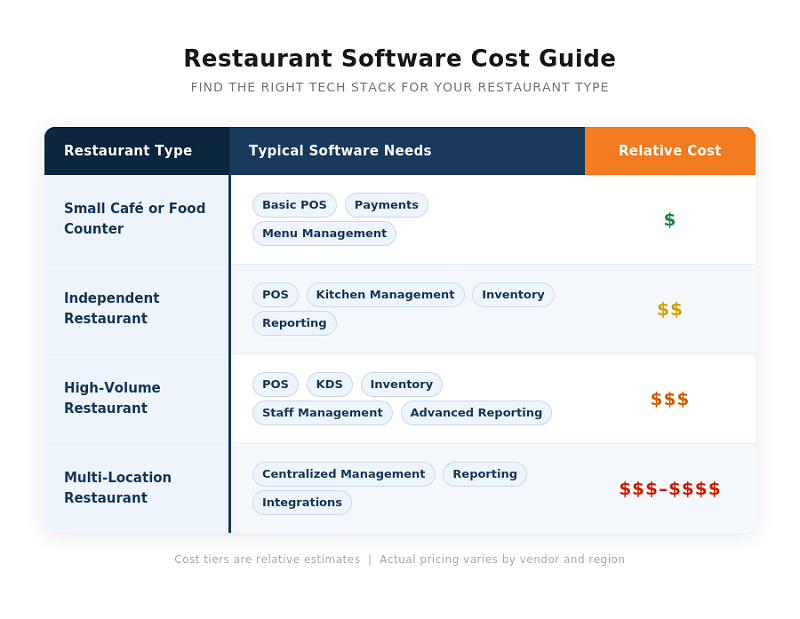
Hardware such as POS terminals, receipt printers, kitchen displays, cash drawers, tablets, and networking equipment can add to the initial investment.
When comparing solutions, look beyond the advertised monthly subscription. Consider software fees + hardware + payment processing + installation + support + integrations to estimate the actual cost of ownership.
What should Calgary restaurants consider when choosing a POS system?
Before choosing restaurant management software, create a checklist based on how the restaurant operates.
- Does it support dine-in, takeout, and delivery?
- Can orders be sent directly to the kitchen?
- Does it support kitchen display screens or kitchen printers?
- Can staff easily modify menu items and prices?
- Does it provide inventory tracking?
- Can managers access sales and performance reports?
- Does it support multiple locations if required?
- Can it integrate with online ordering and other restaurant tools?
- Is staff training straightforward?
- What customer support is included?
- What are the hardware, subscription, and transaction costs?
- Does it work reliably if the internet connection is interrupted?
A system that is easy for employees to use is often more valuable than one with a long list of complicated features.
Is a kitchen POS system useful for small restaurants?
Yes. A kitchen POS system isn't limited to large restaurants. Smaller cafés, takeout businesses, food counters, and independent restaurants can also benefit from centralized order management.
However, smaller businesses should avoid overcomplicating their technology stack. A basic POS with kitchen functionality, payment processing, reporting, and inventory features may be enough.
The goal is to choose software that matches the restaurant's current workflow while leaving room for future growth.
What is the difference between a POS system and restaurant management software?
A POS system primarily handles transactions and order processing. Restaurant management software is broader and may include POS functionality along with inventory, employee management, reporting, customer management, online ordering, and other operational tools.
In simple terms:
POS = processing orders and payments.
Restaurant management software = managing more of the restaurant's overall operation.
For many modern restaurants, these functions are combined into one platform.
Frequently Asked Questions
What is the best restaurant management software in Calgary?
The best solution depends on the restaurant's size, service model, budget, required integrations, and kitchen workflow. Compare features, total costs, ease of use, and support before choosing.
What is a kitchen POS system?
A kitchen POS system connects customer orders with kitchen operations, allowing order details to reach kitchen staff electronically and helping teams manage preparation more efficiently.
Can a POS system manage restaurant inventory?
Many restaurant POS platforms include inventory management or integrate with inventory software. Features can include ingredient tracking, stock levels, product usage, and reporting.
How much does a restaurant POS system cost?
Costs vary based on software subscriptions, hardware, payment processing, integrations, and support. Restaurants should calculate the complete cost rather than comparing monthly software fees alone.
Do small restaurants need restaurant management software?
Small restaurants can benefit from restaurant management software when it reduces manual work, improves order accuracy, simplifies reporting, or helps control inventory. The best option is usually one that provides only the features the business actually needs.