
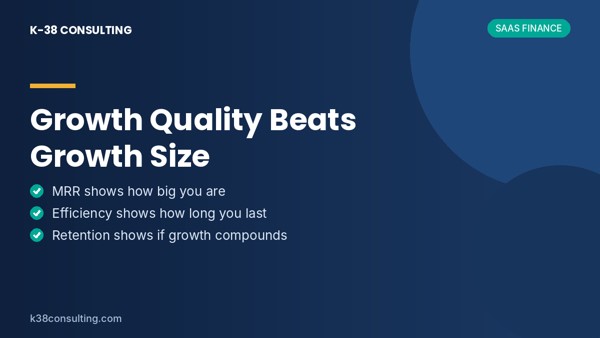
A SaaS company's revenue dashboard may look impressive, with monthly recurring revenue increasing consistently throughout the year. However, a closer look at the company's finances may reveal a different reality. Despite steady revenue growth, the business might have only nine months of cash remaining at its current spending rate.
This situation highlights an important challenge for SaaS founders: growing revenue does not automatically mean building a financially sustainable business. Monthly recurring revenue (MRR) measures the predictable subscription income a company generates, but it does not fully explain customer loyalty, acquisition efficiency, profitability, or cash runway.
To evaluate business sustainability, founders should monitor several complementary metrics. Net revenue retention (NRR) reveals whether existing customers generate more or less revenue over time. Burn multiple measures the cash required to produce additional annual recurring revenue (ARR). Customer acquisition cost (CAC) payback shows how quickly acquisition expenses are recovered, while the Rule of 40 helps assess the balance between growth and profitability.
Understanding these indicators allows SaaS leaders to make informed decisions before financial pressure becomes difficult to manage.
Why MRR Does Not Tell the Whole Story
Monthly recurring revenue represents the subscription income a business expects to receive each month from its active customers. It is one of the most important performance indicators for subscription companies because it helps measure revenue growth and predict future income.
However, relying exclusively on MRR can create a misleading picture of business performance.
Consider two SaaS companies reporting similar monthly revenue growth. The first consistently retains its customers and generates additional income through upgrades. The second acquires new customers but loses a significant percentage of its existing subscribers. Although their MRR figures may appear similar, their underlying business models have very different levels of stability.
MRR also does not reveal how much money a company spends to achieve growth. Heavy investment in marketing, sales, product development, and customer acquisition can increase subscription revenue while reducing available cash.financial modeling services
If a company continues spending aggressively without improving its financial efficiency, it may face serious challenges when fundraising takes longer than expected.
For this reason, SaaS founders need a broader performance framework that evaluates revenue growth alongside customer retention, acquisition costs, cash consumption, and profitability.
Net Revenue Retention: Measuring the Strength of Existing Customers
Net revenue retention, commonly known as NRR, measures how recurring revenue from an existing customer group changes over a specific period. It accounts for expansion revenue, customer downgrades, and revenue lost through cancellations.
An NRR above 100% indicates that revenue from the original customer group has increased despite any contraction or churn. This growth may result from subscription upgrades, additional user seats, or customers purchasing more services.
A strong NRR demonstrates that a company can generate additional revenue from its existing customer base without depending entirely on acquiring new customers.
Conversely, an NRR below 100% means the company is losing more recurring revenue from its existing customers than it gains through expansion. New sales may compensate for these losses temporarily, but persistent retention problems can make growth increasingly expensive.
How to Calculate Net Revenue Retention
Follow these steps to calculate NRR accurately:
- Record the recurring revenue generated by a defined group of existing customers at the beginning of the measurement period.
- Add revenue increases from upgrades, additional seats, and cross-selling.
- Subtract revenue reductions from downgrades and customer cancellations.
- Divide the resulting revenue by the starting revenue and multiply by 100.
NRR formula:
NRR = (Starting Revenue + Expansion Revenue − Contraction Revenue − Churned Revenue) ÷ Starting Revenue × 100
Revenue from newly acquired customers should be excluded from this calculation.
Many investors view NRR above 100% as a positive indicator, although appropriate benchmarks vary according to customer size, pricing structure, product category, and sales model. Enterprise-focused SaaS companies may achieve stronger retention and expansion than businesses serving smaller customers.
Founders should compare their results with companies operating under similar conditions rather than relying on one universal benchmark.
Gross Revenue Retention: Understanding Customer Losses
Net revenue retention is useful, but it does not tell the entire customer retention story. Gross revenue retention (GRR) provides another important perspective by measuring how much existing recurring revenue remains after accounting for cancellations and downgrades, without including expansion revenue.
This distinction matters because expansion from a few large customers can hide losses across the broader customer base.
For example, a company might report strong NRR because several enterprise customers upgraded their subscriptions. At the same time, numerous smaller customers could be cancelling their accounts.
Tracking GRR alongside NRR helps founders determine whether customer relationships are broadly stable or whether revenue growth depends heavily on a limited number of expanding accounts.
When GRR declines, businesses should investigate customer satisfaction, product value, onboarding quality, pricing concerns, and competitive pressure.
Burn Multiple: Evaluating the Cost of Revenue Growth
Burn multiple measures how efficiently a SaaS company converts cash spending into new recurring revenue. It compares net cash burn during a period with the net new annual recurring revenue generated during that same period.
Burn multiple formula:
Burn Multiple = Net Cash Burn ÷ Net New ARR
Suppose a SaaS company burns $600,000 in cash while adding $300,000 in net new ARR. Its burn multiple is 2. This means the company consumes $2 in net cash for every $1 of additional ARR.
A lower burn multiple generally indicates more efficient growth, while a rising figure may suggest that customer acquisition or operating expenses are becoming less productive.
Some investors consider a burn multiple below approximately 2 reasonable for growing companies, although expectations vary with company maturity, growth rate, market conditions, and business model.
One advantage of this metric is that it reflects the company's overall cash efficiency. Engineering, customer support, sales, marketing, and administrative expenses all influence the amount of cash consumed.
Founders should examine burn multiple regularly to identify inefficient spending and determine whether additional investment is generating sufficient recurring revenue.
CAC Payback Period: How Quickly Customer Acquisition Costs Are Recovered
Customer acquisition cost, or CAC, represents the sales and marketing expenses required to acquire a new customer. The CAC payback period measures how many months of gross profit are needed to recover that acquisition investment.
This metric helps SaaS companies understand whether their acquisition strategy supports sustainable growth.
CAC payback formula:
CAC Payback Period = Customer Acquisition Cost ÷ Monthly Gross Profit per Customer
For example, if acquiring a customer costs $1,200 and that customer generates $150 in monthly gross profit, the CAC payback period is eight months.
Gross profit is the appropriate measure because subscription revenue must cover delivery-related expenses, such as hosting and customer support, before it contributes toward recovering acquisition costs.
Shorter payback periods generally allow businesses to recover their investment sooner and reinvest available cash into additional growth.
Many SaaS operators view payback within approximately 12 months as attractive for smaller customers, while enterprise customers may justify longer periods when retention and lifetime value are strong.
However, a steadily increasing payback period can indicate that advertising channels are becoming less effective, sales cycles are lengthening, or acquisition costs are rising faster than customer profitability.
The Rule of 40: Balancing Growth With Profitability
The Rule of 40 is a widely used SaaS benchmark that combines revenue growth with profitability to evaluate overall business performance.
Under this guideline, a software company's revenue growth rate plus its profit margin should equal or exceed 40%.
For example, a company growing revenue by 30% with a 10% profit margin achieves a Rule of 40 score of 40%.
A business experiencing slower growth can still meet the benchmark through stronger profitability. Similarly, a rapidly expanding company may meet the target despite operating at a loss.
Companies commonly use EBITDA margin or free cash flow margin as the profitability component. The chosen method should remain consistent across reporting periods so that management and investors can evaluate changes meaningfully.
The Rule of 40 is generally more informative for established SaaS businesses than for very early-stage startups. Small revenue bases can produce unusually high growth percentages that do not necessarily represent a repeatable business model.
For founders, this metric provides a useful way to assess whether growth investments are producing an appropriate balance between expansion and financial discipline.
Four SaaS Metrics Every Founder Should Monitor
The following indicators answer different questions about the sustainability of a subscription business:
- Net revenue retention: Determines whether existing customers are increasing or decreasing their contribution to recurring revenue.
- Burn multiple: Measures the cash consumed to generate additional ARR.
- CAC payback period: Shows how long it takes to recover customer acquisition expenses through gross profit.
- Rule of 40: Evaluates the relationship between revenue growth and profitability.
Warning signs include persistent NRR below 100%, increasing burn multiple, longer CAC payback periods, and weak growth combined with continued operating losses.
Reviewing these measures together provides a more complete view of financial performance than focusing on MRR alone.
Building a Reliable SaaS Financial Metrics Model
Even the most useful financial metrics become unreliable when the underlying data is inconsistent. Many early-stage SaaS businesses calculate their KPIs using separate spreadsheets, changing definitions or assumptions between reporting periods. Fractional CFO for SaaS companies
These inconsistencies can create confusion during board meetings, financial reviews, and investor due diligence.
Founders can improve reporting quality by following several practices:
- Establish a written definition for every KPI and apply it consistently.
- Reconcile MRR and ARR with billing records and applicable revenue recognition information each month.
- Analyze customer retention by acquisition cohort to identify changes over time.
- Separate recurring subscriptions from one-time charges, professional services, and usage-based overages where appropriate.
- Compare forecasts for churn, expansion, and customer acquisition with historical performance.
- Review cash flow and operating expenses alongside revenue growth.
A driver-based financial model can make these processes more useful. Instead of projecting revenue using a single growth assumption, the model incorporates sales pipeline, conversion rates, pricing, customer churn, and expansion revenue.
This approach helps founders understand how changes in customer behavior or sales spending affect future revenue and cash runway.
A fractional CFO can assist with KPI definitions, financial forecasting, management reporting, and fundraising preparation without requiring the company to employ a full-time CFO.
K-38 Consulting, a Raleigh, North Carolina-based firm led by Dallas Alford IV, CPA, supports SaaS and subscription businesses with financial modeling, KPI development, and strategic planning.
Lessons Subscription CPG Brands Can Learn From SaaS
Although SaaS companies sell software rather than physical products, many of their financial measurement principles also apply to subscription-based consumer packaged goods (CPG) businesses.
Coffee subscriptions, supplement deliveries, pet food subscriptions, and personal care refill services all depend on repeat purchases and customer retention.
Cohort analysis helps these businesses determine whether customers continue purchasing after their first few deliveries or cancel shortly after signing up.
CAC payback is also valuable, but physical-product businesses should calculate customer profitability after accounting for product costs, fulfillment, shipping, and discounts. Revenue alone does not reveal whether an acquired subscriber is profitable.
Inventory management introduces an additional cash flow challenge. Consumer brands must forecast subscription demand carefully enough to maintain adequate stock without tying up excessive capital in unsold inventory.
Companies that combine wholesale distribution with direct-to-consumer subscriptions must also evaluate retailer payment terms, promotional spending, and subscriber economics.
CPG financial strategy consulting can help businesses integrate these operational and financial considerations into a more reliable forecasting process.
Turning Financial Metrics Into Sustainable Growth
MRR remains an essential measure of SaaS performance, but it cannot independently determine whether a business is financially healthy.
Long-term sustainability depends on customer retention, efficient acquisition spending, manageable cash consumption, and a realistic balance between growth and profitability.
By monitoring NRR, GRR, burn multiple, CAC payback, and the Rule of 40, founders can identify problems earlier and make better-informed decisions about hiring, marketing investment, pricing, and fundraising.
Consistent reporting and driver-based forecasting make these indicators more valuable by connecting financial results with the operational decisions that influence them.
The goal is not simply to produce a dashboard showing increasing revenue. It is to build a business where revenue growth translates into stronger customer relationships, improved financial efficiency, and sufficient cash to support future expansion.
Frequently Asked Questions (FAQ)
1. What is a good net revenue retention rate for a SaaS company?
An NRR above 100% indicates that revenue from existing customers has grown after accounting for downgrades and cancellations. This is generally a positive sign because the business can expand without relying entirely on new customer acquisition. Appropriate targets depend on customer size, industry, pricing, and sales strategy.
2. How is burn multiple calculated for a SaaS startup?
Burn multiple is calculated by dividing net cash burn during a period by the net new ARR generated during that period. For example, a business that burns $400,000 and adds $200,000 in net new ARR has a burn multiple of 2. Monitoring this figure helps management evaluate whether additional revenue is being generated efficiently.
3. What does the CAC payback period tell SaaS founders?
CAC payback measures the number of months required to recover customer acquisition costs through the customer's gross profit. A shorter payback period generally improves cash efficiency, while a longer period may indicate increasing acquisition costs or weaker customer economics. The appropriate target depends on retention, customer value, and the sales model.
4. What is the Rule of 40 in SaaS?
The Rule of 40 combines a SaaS company's revenue growth rate with its profit margin. A combined result of 40% or higher meets the benchmark. Investors and management teams use it to assess whether a company is balancing growth with profitability rather than prioritizing expansion at any cost.
5. Why should SaaS companies track gross revenue retention and net revenue retention together?
NRR includes expansion revenue, whereas GRR measures retained revenue before expansion. Tracking both helps businesses distinguish broad customer retention from growth driven by a small number of customers upgrading their subscriptions. This makes it easier to identify churn risks and evaluate the strength of existing customer relationships.
6. How can SaaS companies improve their financial reporting?
Companies can improve reporting by standardizing KPI definitions, reconciling recurring revenue with billing records, tracking customer cohorts, and comparing forecasts with actual performance. A driver-based financial model can further connect sales, pricing, churn, and operating expenses with projected cash flow.
7. When should a SaaS startup consider hiring a fractional CFO?
A startup may benefit from fractional CFO support when preparing for fundraising, developing financial forecasts, improving KPI reporting, or managing a limited cash runway. A fractional CFO provides senior-level financial guidance on a part-time basis, which can be suitable for companies that need strategic expertise without the expense of a full-time executive.
8. Can subscription-based CPG companies use SaaS financial metrics?
Yes. Subscription CPG businesses can adapt customer retention, cohort analysis, and CAC payback to evaluate repeat purchases and customer profitability. However, they must also account for inventory, product costs, shipping, fulfillment, and promotional expenses when assessing financial performance.
9. How often should SaaS founders review their key financial metrics?
Monthly reviews are useful for monitoring recurring revenue, retention, acquisition costs, and cash flow. Quarterly reviews can help management assess broader trends in growth efficiency and profitability. The frequency should reflect the company's reporting capabilities, operating complexity, and financial needs.
10. Which SaaS metric is the most important for business survival?
No single metric can reliably predict survival on its own. NRR reveals customer revenue trends, burn multiple measures cash efficiency, CAC payback evaluates acquisition economics, and the Rule of 40 assesses growth relative to profitability. Together, these measures provide a more comprehensive view of business sustainability.