
The first time I joined an international sudoku competition was in 2018, when I visited Bangkok for the Queen's Cup / Brand's Sudoku Thailand International Open. Back when we used to have national championships in the Philippines, this was the most commonly-attended international competition, possibly because Thailand is nearby and we can visit without a visa.
The last edition of Brand's was held in 2019 due to lack of sponsorship, and I had resigned myself to needing a visa for any future international sudoku events. Then we learned that ASC 2026 would be held in Bangkok, and happily decided to join.
According to the WPF post, this was the largest ASC ever held to date. With four past ASC champions and several past 2nd and 3rd placers, this was a very strong field despite the absence of the top Thai players, who were organizing the event.
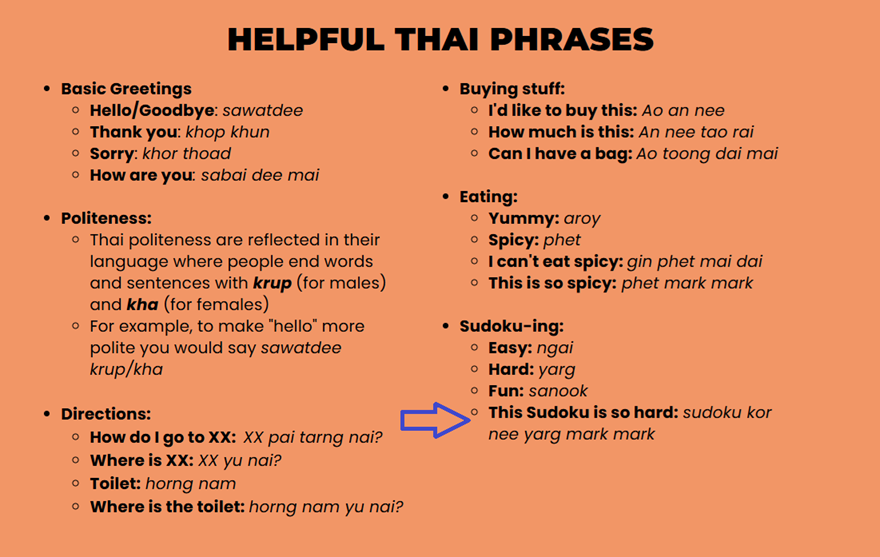
The event website had a "Travel Tips" page, which included some helpful Thai phrases. Note the last phrase, and note that no Thai word for "Finished" (what one says to submit a round early) were included - perhaps this was a foreshadowing of the difficulty level of the contest.
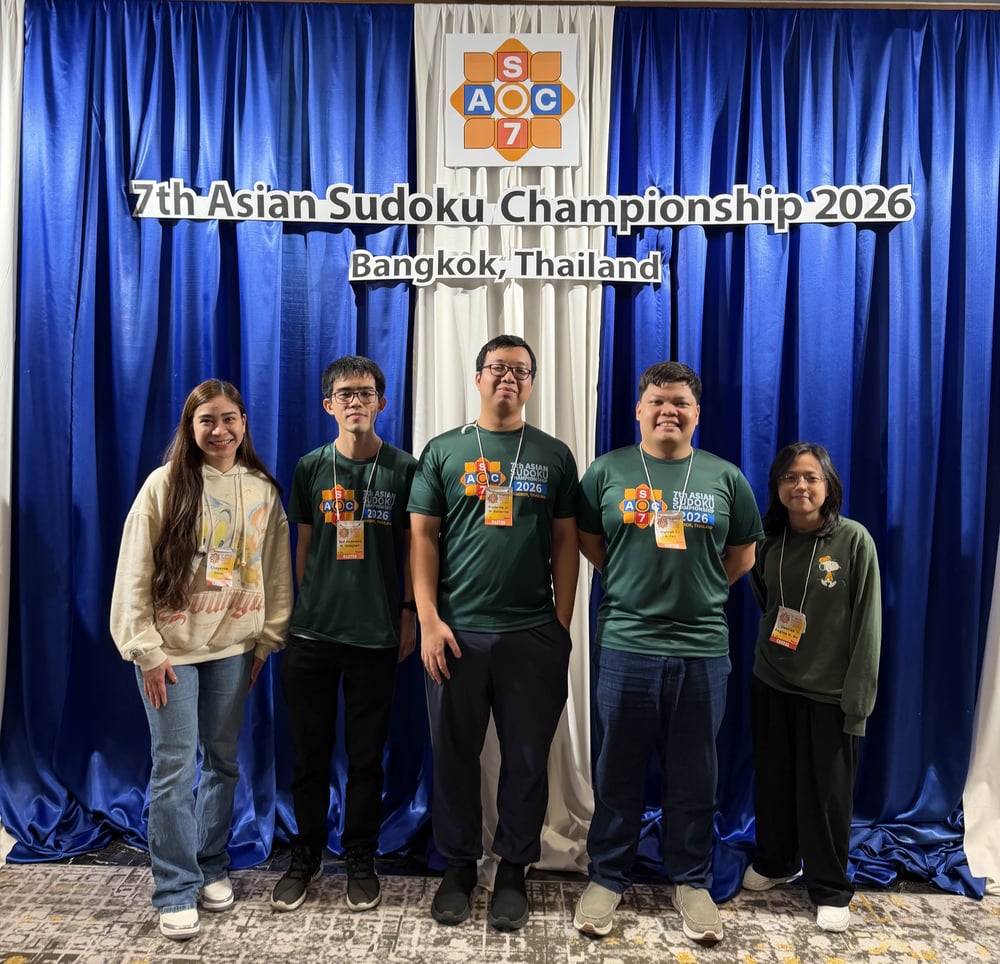
From L to R: Cheyenne Hsieh, Sed Holaysan, Fred Gutierrez Jr., Highryll Tan, Desiree Go. It's funny, but I've met most of them more times outside the Philippines than inside it. Though perhaps that will change if our national championships resume.
Four of us were at the 2024 WSC in Beijing, but we don't all live in the same cities, and we basically haven't seen each other since that year. Our fifth member hadn't met any of us prior to this event, so after some introductions, we spent some time doing a team round for fun. This was the Sudoklear Fusion round from the 2025 MIT Sudoku Open. At dinner, we sat with Tyler Chen (being from the USA, he was one of three unofficial participants of the ASC). He was one of the authors of the MIT Sudoku Open, and revealed to us that the round was written by Can Erturan from Turkey, who was one of the top 10 finalists at the 2024 WSC.
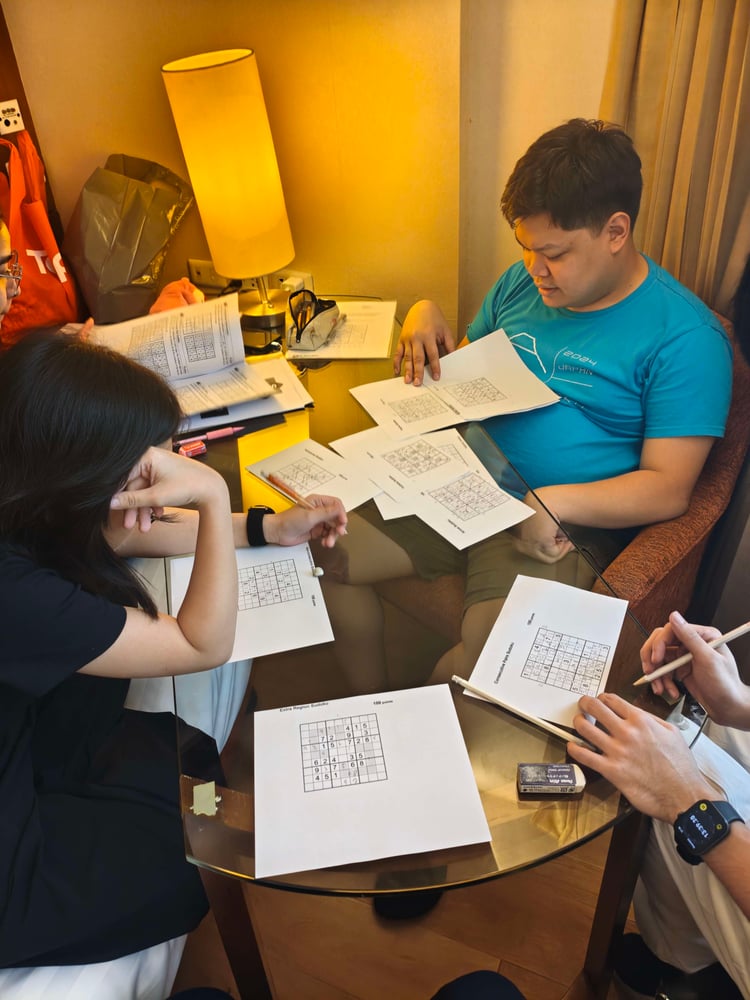
Solving the Sudoklear Fusion round. Photo by Fred.
Upon registration, we were given a Thai Alphabet Sudoku, where instead of the numbers 1-9, it used 9 letters from the Thai Alphabet. We could solve the puzzle to be in the running for a prize. Soon, I was mentally referring to the letters as penguin, open pitcher, door, closed pitcher, closed pitcher with a 6, and penguin on wheels. (Wikipedia's page on Thai script tells me that these are respectively: chicken, egg, water buffalo, elephant, chain, and tree)
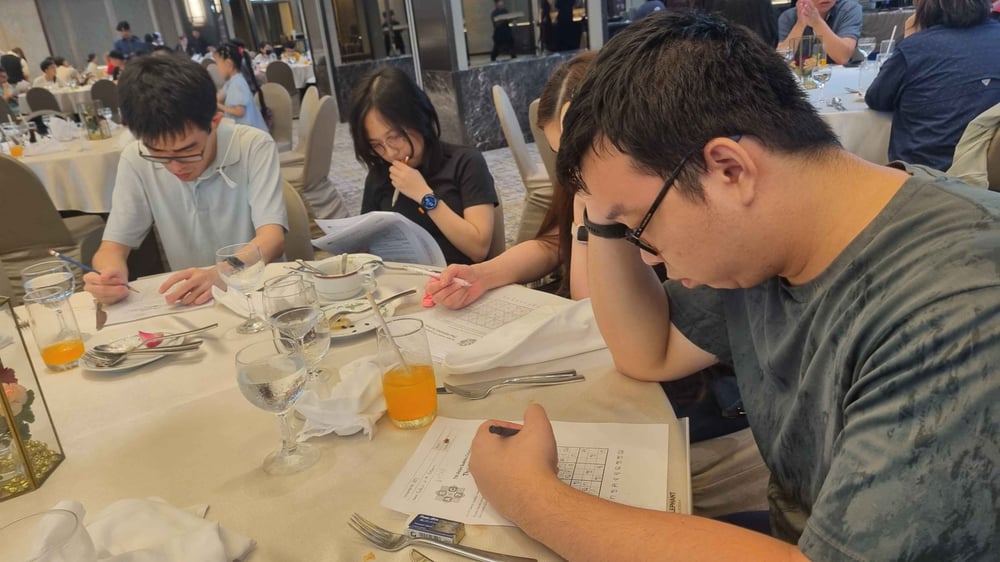
At some point I had two penguins in the same row, and had to restart the whole thing. Photo by High.
In the Philippines, events like this often feature a special number about local culture, often in the form of a song or dance. There was no such thing here, and what we did have was a side event involving even more puzzles. We loved it - I'd say it was a perfect demonstration of the organizers knowing their audience quite well.
The side event was a Just One Cell Sudoku contest where a partial grid would be shown on screen for maybe half a minute, and there would be exactly one cell that could be logically filled in. There was a round for under-15s, and then one for everyone. For the open round, the final playoff involving the top four players was a first-to-3-points affair, and there had been a dozen puzzles prepared, but Kota Morinishi (see the WSC Results Summary if you don't know who he is) won it in just four puzzles.
Individual Rounds
At ASC 2024, I only got 50% of the points in one out of six rounds. At WSC 2024, it was even worse, at one out of nine rounds. So my expectations were not too high going into this.
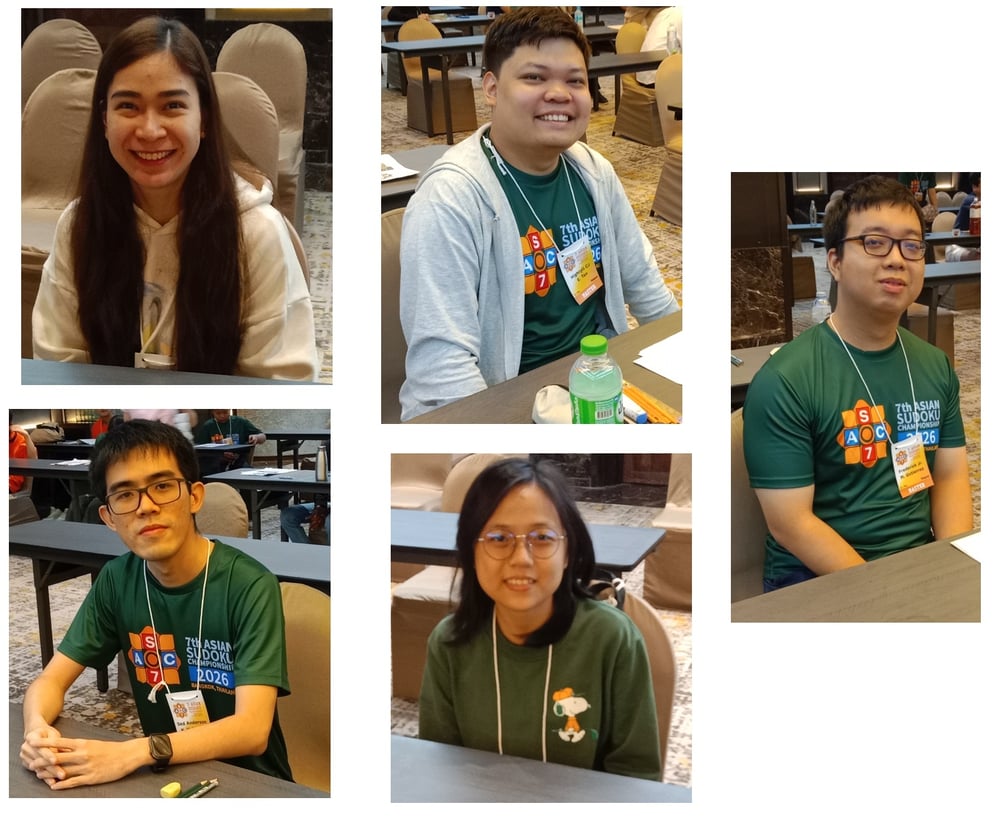
The five of us sitting at our desks... We take these photos at the start of the day, while we've still got energy.
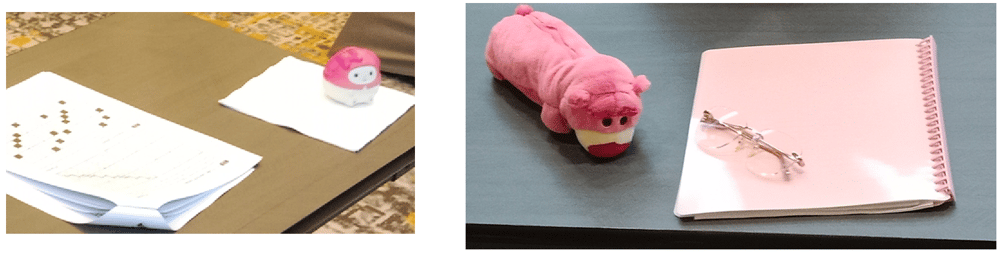
...along with two desk companions. These guys never run out of energy, maybe bringing one along next time will help me do better towards the end of the day.
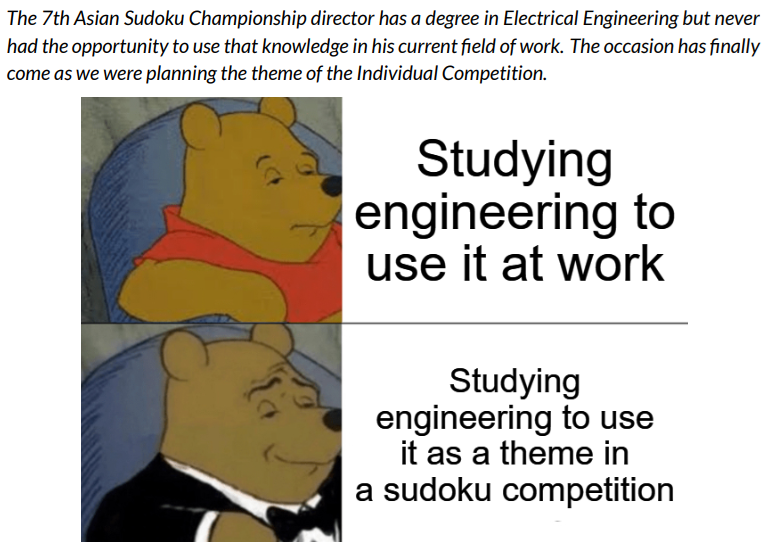
The individual rounds were themed on competition director Sinchai Jaturangkhajit's electrical engineering degree.
Round 1: Direct Current (Classics and Irregular)
At the past three contests I've joined, I've always messed up the first round. This happens either through breaking puzzles and needing to restart, or worse, submitting a wrong grid without realizing it (ex. my 5/400 round at WSC 2024). This time I managed not to make any mistakes, clearing 6/8 classics and 1/2 irregulars for 205/300. I was fairly happy to get above 50%, but rank-wise it left me tied with three others at 17th-20th place, which is hardly impressive.
Round 2: Alternating Current (Well-known Variants)
The highest-pointer of the individual rounds was a Numbered Rooms (150 points), and I went for it right from the opening bell. The logic was really nice, though it unsurprisingly ate up some time. The Renban (55) was tricky for its low point value, and I restarted it once before getting it. I then got Odd/Even (45), Diagonal (35), and Thermo (25). This was where my game plan ended - I had not expected to solve this many puzzles in the round. I managed to get Odd Labyrinth (30), and attempted to rush the 30-point Blackout but got it wrong at the end. Still, 340/450 was by far my best round, and my cumulative score for Rounds 1 and 2 put me in 9th place for the Masters.
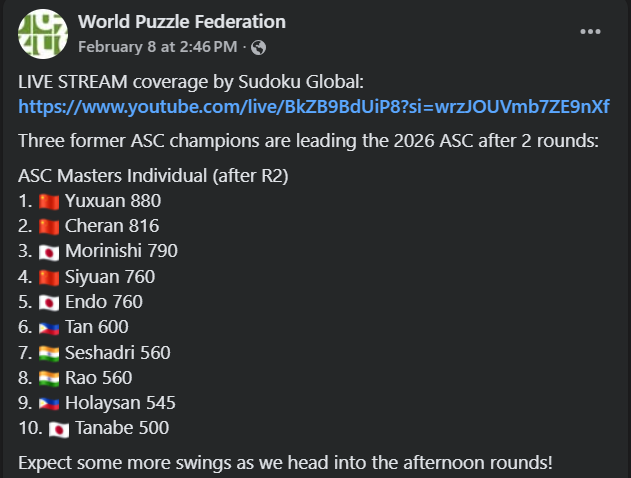
My 15 minutes of fame before it all went downhill. Highryll Tan was doing even better than I was, and was in 6th place at this point.
Round 3: AND (Hybrids where two variants are present in each grid)
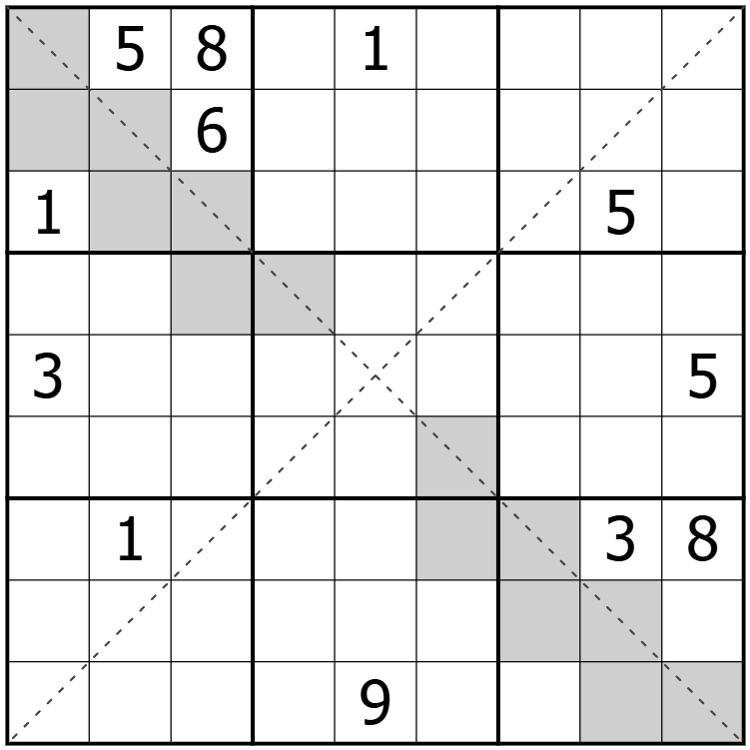
I've never particularly liked hybrids, so I wrote two practice puzzles for this round, and decided to attempt them. The X-Sums + Windoku (90) was a fairly clean solve for me despite being worth more points, while I felt slower on the Diagonal + Consecutive Clone (75). I solved the Palindrome + Rhombus (65) because the Palindrome was in the shape of Thailand on the world map, which was too good to resist. I then attempted the Antiknight + David and Goliath, which was worth 80 points but got it wrong near the end, which left me with 230/450.
Round 4: OR (Ambiguous Variants where clues could have multiple possible meanings)
After having solved the 150-pointer in R2 with minimal trouble, I felt confident enough to dive into Descriptive Pairs, which was 120 points. I did not understand it at all. After a few minutes, I bifurcated to a contradiction, went the other way, then got stuck again. So I switched to Skyscrapers - Left or Right (70), then went back to Descriptive Pairs. Bifurcated, hit a contradiction, went the other way, got stuck. Did the 7 or 11 (45) and returned to Descriptive Pairs - rinse and repeat. Finally I picked up the Antiknight or No Touch or Neither (35), returned to Descriptive Pairs, and still couldn't get it to work in the final minutes of the round. 150/450.
It was lunchtime, and the papers from earlier rounds were already out, but we opted to ignore them for now and eat lunch in peace. Though towards the end of the meal, we couldn't resist looking at the online scoresheets.
High and Fred asked me how this compared to the ASC 2024 Master Division (they had been in the Casual division at that time). I thought the puzzles of 2024 had been harder, but that the variant types for this year were less common - then hurriedly added a caveat that my opinion might change after Round 5, which was the round I was dreading the most.
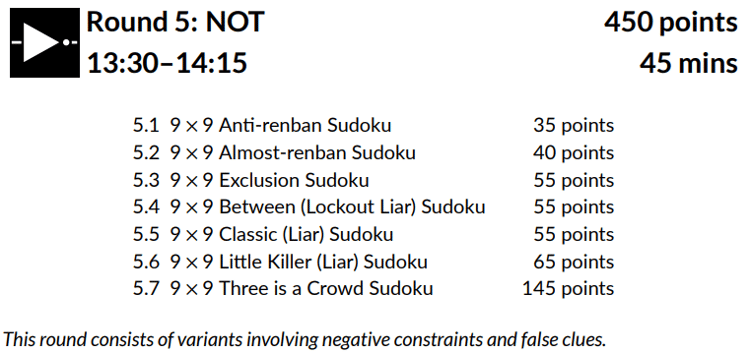
There was not a single variant in this list that I was excited to solve. The last puzzle being worth more than any two other puzzles is also a fairly scary distribution.
Round 5: NOT (Negative constraints and liars)
The smart decision would have probably been to just try to get the low-pointers, given that I didn't like any of the variants. But I have way too much fun going for the high-pointers, and that destroyed me here. I started with the Little Killer - Liar (65) and got it in 8 minutes, so I started on the Three is a Crowd. I broke it after a while, of course. The Classic - Liar wasn't making any sense to me, and I couldn't even get Anti-renban done in the last 5 minutes, and ended with 65/450, yippee. After this round I commented that my round percentages were probably looking a bit like a y = 1/x graph.
Round 6: Circuit Boards (9 interconnected classic sudoku grids where the centers of 3x3 boxes formed another 9x9 sudoku puzzle)
Unfortunately, there were typos in this round and the organizers had to void it to be fair. Not that it would have helped me, I had no idea what I was doing in this round.
Final Score: 990/2100
Final Rank: 16th/36 official (19th/39 overall, including 3 unofficial players from countries outside Asia)
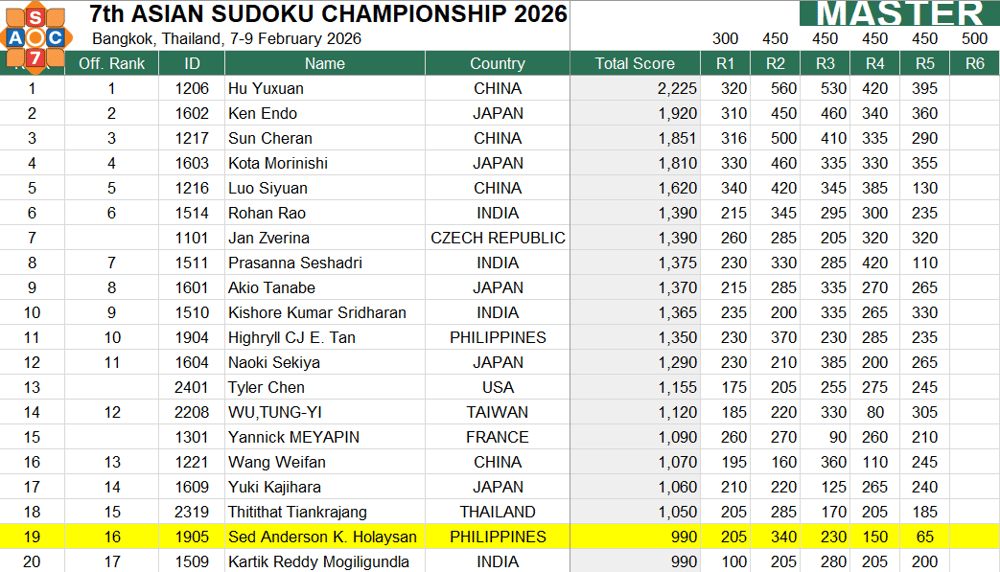
Final results of the individual rounds - Master division. The four past ASC champions? Right there from 1-4.
For the Masters division, Highryll Tan ranked 10th, building on his 2nd place in the Casual division in 2024 (and tying the previous best rank of 10th by Candice Solidarios at the 2019 ASC in Clark).
I ranked 16th, while Fred Gutierrez Jr. was 32nd.
For the Casual division, Desiree Go ranked 11th, just barely missing out on a top 10 finish due to tiebreaks. Cheyenne Hsieh ranked 19th.
Team Rounds
For the team competition, each team can have up to 4 people, so Desiree moved to the Master Division. For countries who don't have enough people to form a team, you can form UN teams (or in this case, Asia teams, as UN is reserved for non-Asian unofficial participants). Cheyenne was playing a sudoku competition for the first time in over a decade, and without too much thought, I messaged the first person who was looking for teammates.
These were Yuka Jo and Yoichi Enta from Japan. I should have done my research, because they turned out to be strong players who ranked 3rd and 10th in the Casual division. The night before, they were joined by a fourth member, Sitanshu Sah from India, who ranked 8th. Yoichi had also joined the 2019 ASC in Clark, and showed us a cap with a Philippine logo that he had gotten back then.
Round 7: Loy Krathong
Named after a Thai festival where people float a decorated basket along a river, this was a one-way relay round where we could not communicate with each other, and we could only pass (float) puzzles forward and not backward. The round was only 30 minutes long, and we estimated that there was no way we would have time to finish all 22 puzzles.
If that sounds defeatist to you, you have to understand that top-level competitions tend to be calibrated for the top teams.
- Japan has two world champions in Kota Morinishi and Ken Endo.
- China has the world #3 (Hu Yuxuan, who won in 2024 and again this year) and world #6 Sun Cheran.
- India has Rohan Rao and Prasanna Seshadri, who have both been in the world top 10.
The 3rd and 4th members of each of those teams are still very strong players, by the way. And anyone who has been to a WSC knows that China and Japan's B-teams are very much capable of beating A-teams of other countries. So it was all but guaranteed that this would be really tough.
So we decided to just distribute the puzzles right at the start, then settle down to solve individually.
When we were dividing up the puzzles, we color-coded them as green for easy (40 points or less), yellow for medium (50-65 points), and red for hard (80-90 points). As for the 150-point Partitioned Sums and the 120-point Windoku - Liar, we just shaded them in black and pretended they didn't exist.
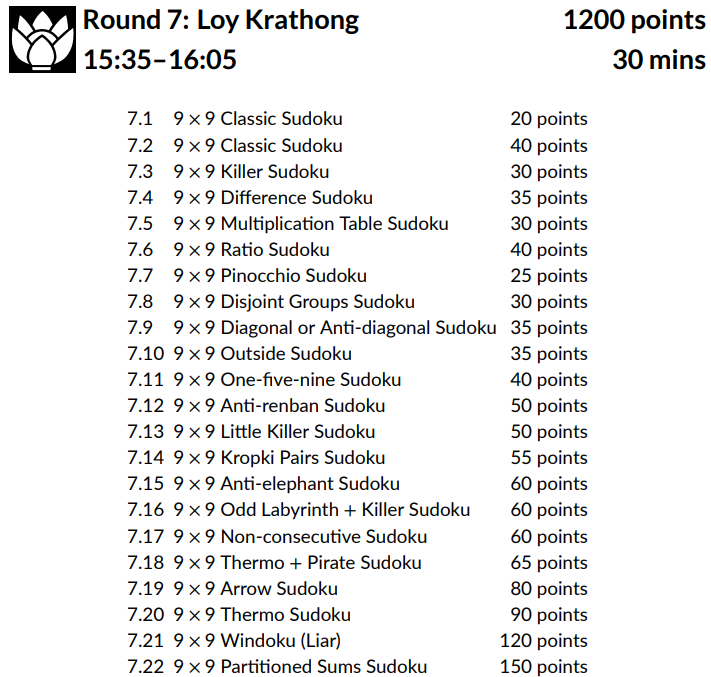
I solved the Arrow (80) but couldn't make any progress on the 50-point Little Killer. I did the Kropki Pairs (55) and decided to go for the 1-5-9 (40) in my last few minutes, managing to finish it in the last 30 seconds of the round.
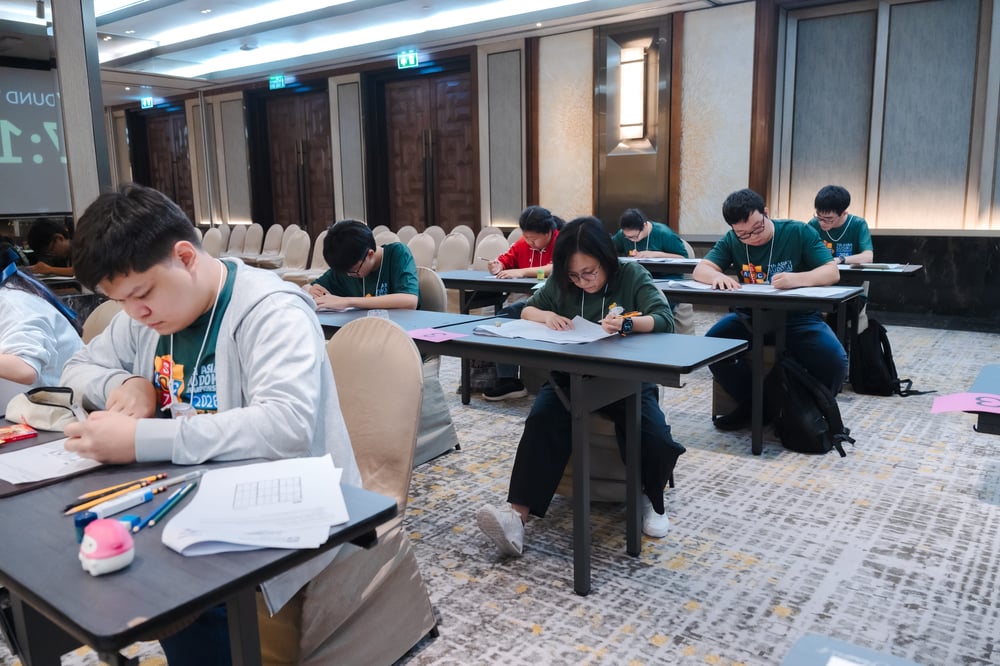
More than enough puzzles to keep us busy for an hour, let alone 30 minutes. Photo by ASC Organizers.
We ended with a score of 425/1200, which had us in 5th place. China-1 had the top score with 740 and Japan-1 was in second place with 630. No team even came close to finishing this round.
Round 8: Elephant Park
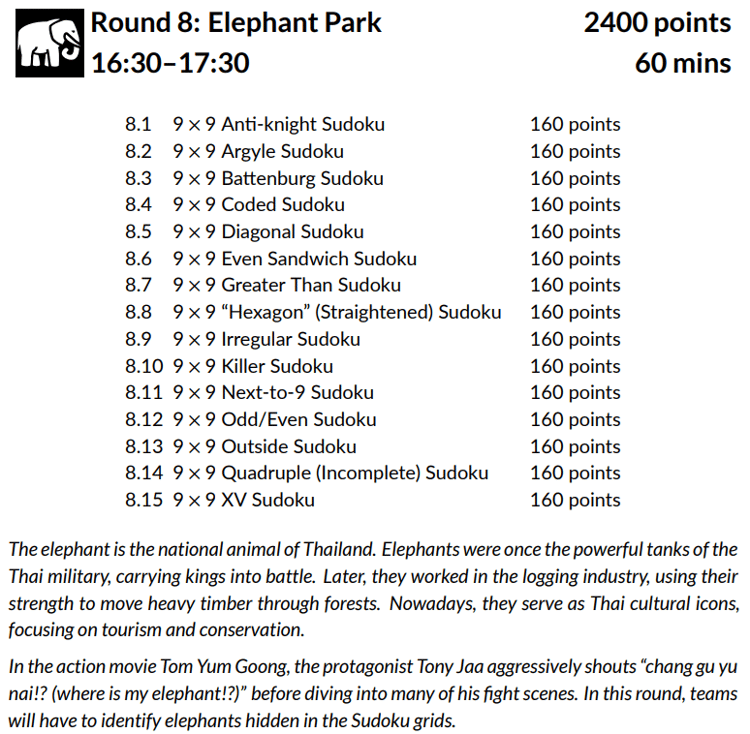
"Chang gu yu nai?" should have been on the list of helpful Thai phrases. After all, who knows when you might lose an elephant?
In this round, there were elephant shapes shaded into 15 grids. Five of these were clones of each other. Then another group of four were clones of each other. Then another group of three, then a group of two, and finally one last puzzle with a unique elephant. This was a 1-hour round and we were looking forward to it.
It turned out the organizers had saved the hardest round for last. Many of the grids just had little to no given numbers, meaning that we would need to figure out the groupings first before we could even make any progress on them. We solved the Argyle for 1/15 puzzles...and that was all we ever got. Eventually the puzzles were spread out in two rows around the table, and we were walking back and forth trying to match partially filled elephants to other grids, but we could never get anything definite (and other times we couldn't even find a potential matching elephant).
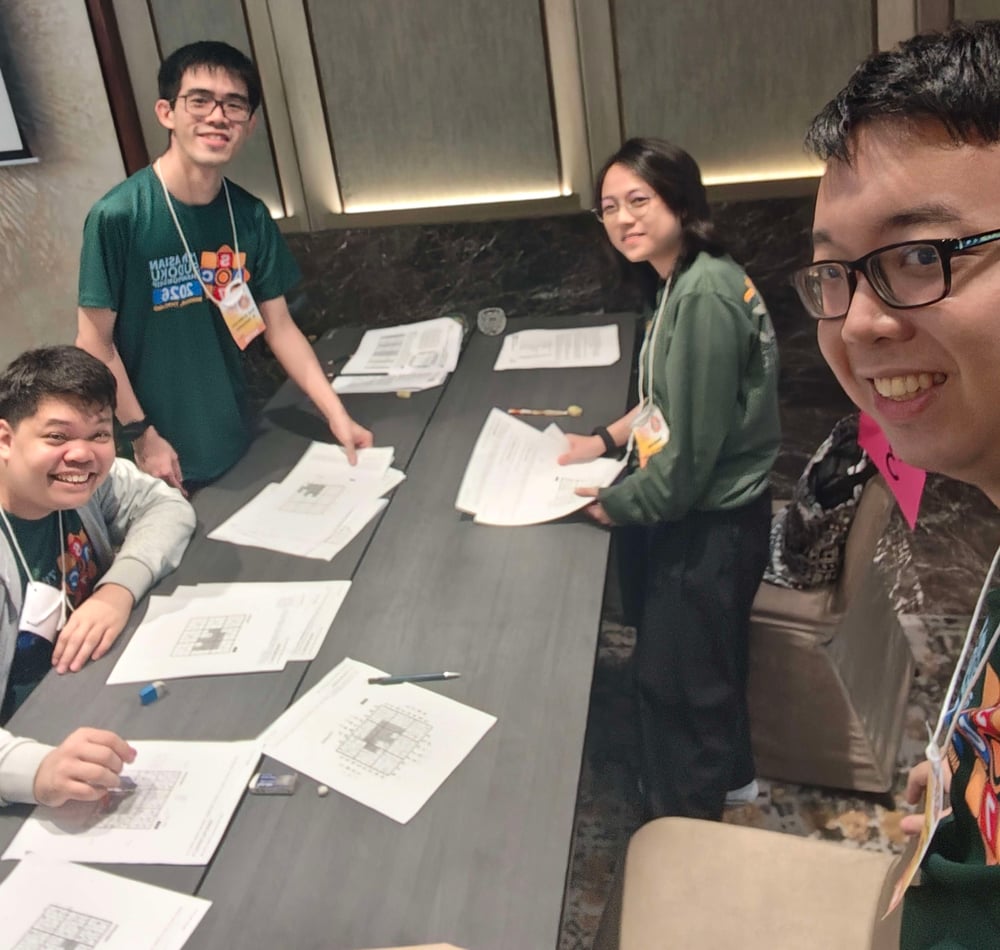
We managed to smile, although our brains were saying "Round 8 kor nee yarg mark mark."
My personal opinion is that Round 8 was too unforgiving. Round 7 was difficult but at least we could make slow progress and pick up points here and there. But having a high "barrier to entry" right at the start just left us confused for most of it - and based on the scoreboard, more than half the teams had the same experience. However, the China - 1 team did solve the entire thing 10 seconds before time expired, so I trust there's some logic to it which I have yet to discover.
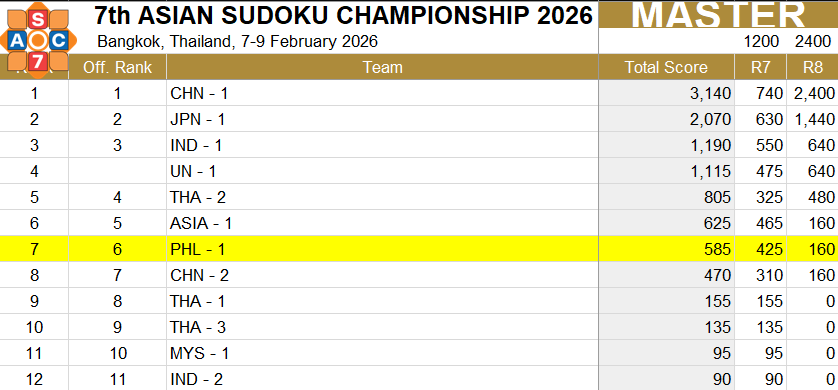
Final results of the team rounds. We ended 6th in the Master division after a brutal hour of staring at elephants.
In the Casual Division, the Asia-A team won third place.
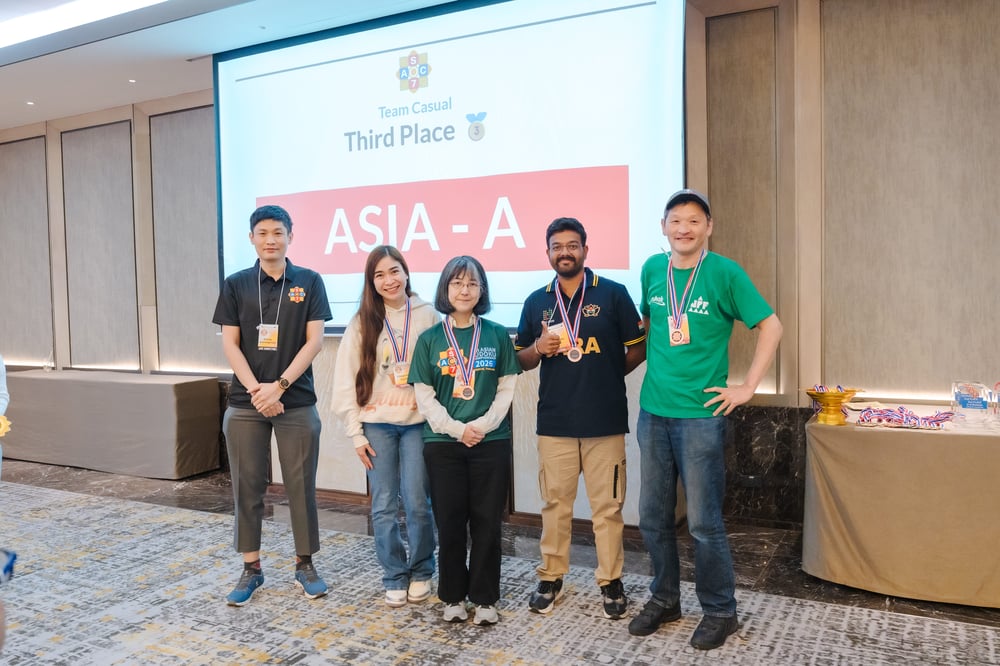
From L to R: Sinchai Jaturangkhajit (tournament director) giving the awards to Asia-A: Cheyenne Hsieh, Yuka Jo, Sitanshu Sah, and Yoichi Enta. Photo by ASC Organizers.
Bonus Puzzles
These are the two puzzles I wrote for Round 3, not really to simulate difficulty but just to experiment with the mix of rulesets involved.
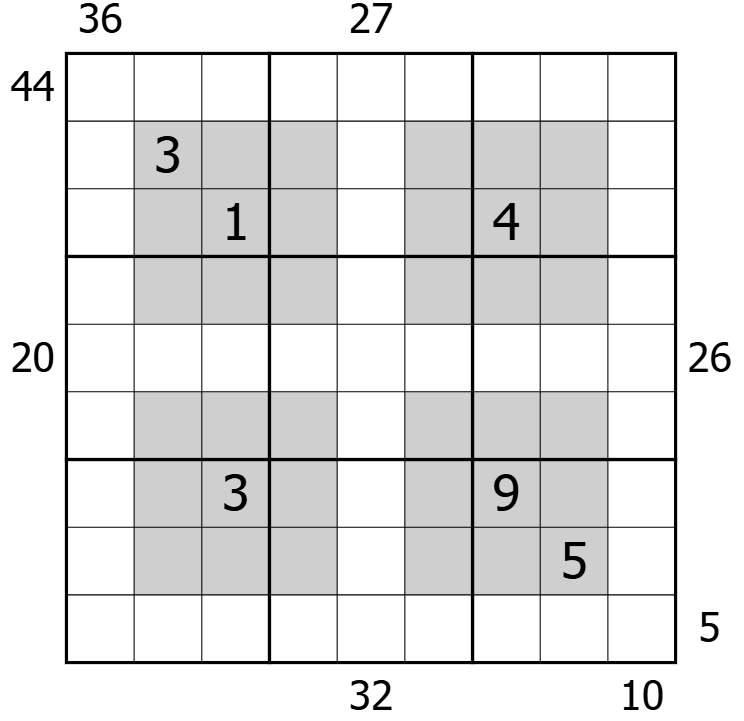
X-Sums + Windoku (3★)
Comments ()