
ASA filament has become an important material in modern 3D printing because of its excellent durability, UV resistance, and ability to withstand challenging environmental conditions. Known as Acrylonitrile Styrene Acrylate, this engineering thermoplastic is widely used by manufacturers, engineers, designers, and 3D printing enthusiasts who need reliable components for indoor and outdoor applications. Its combination of mechanical strength, temperature resistance, and weather stability makes it a valuable alternative to conventional printing materials.
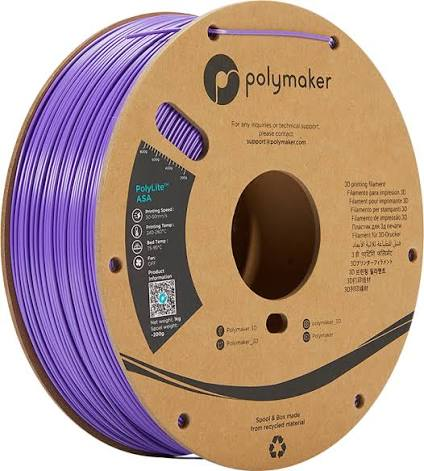
As 3D printing technology continues to advance, users are increasingly looking for materials that offer more than basic appearance and ease of printing. Although PLA and PETG are suitable for many everyday projects, they may not provide the required performance for components exposed to direct sunlight, moisture, and temperature fluctuations. ASA filament addresses these requirements by offering improved outdoor durability and consistent mechanical performance.
From automotive accessories and protective equipment housings to outdoor fixtures and functional prototypes, ASA supports a wide range of manufacturing applications. Understanding its material properties, printing requirements, and practical benefits can help users select the right filament for producing high-quality and long-lasting products.
ASA Filament Properties and Main Benefits
ASA filament is an advanced thermoplastic developed to provide a useful balance of strength, durability, and environmental resistance. It shares several characteristics with ABS plastic but offers significantly better resistance to ultraviolet radiation. This makes it particularly suitable for products that remain exposed to sunlight for extended periods.
One of the most valuable properties of ASA is its UV resistance. Continuous exposure to sunlight can cause many conventional plastics to fade, become brittle, or gradually lose their mechanical strength. ASA is formulated to resist these effects more effectively, helping printed components maintain their original appearance and functionality. This characteristic makes it popular for outdoor equipment, automotive exterior accessories, mounting brackets, and protective covers.
Weather resistance is another important advantage. ASA plastic can withstand exposure to rain, humidity, and changing outdoor temperatures. This makes it suitable for manufacturing products that need to operate in different environmental conditions. Although the performance of a finished component depends on its design and exposure, ASA generally provides better outdoor durability than standard PLA.
Heat resistance also contributes to its popularity in engineering applications. Compared with PLA filament, ASA typically maintains its shape at higher temperatures. This makes it useful for components installed near heat-generating equipment or exposed to warm outdoor environments. Its mechanical strength and impact resistance also make it suitable for producing functional parts that experience regular handling and physical stress.
Another benefit of ASA filament is its professional surface finish. Printed components can have a smooth and attractive appearance, making the material useful for both functional manufacturing and product development. ASA parts can also be sanded, painted, and post-processed to achieve different finishing requirements.
Dimensional stability is equally important when producing accurate components. With suitable printing temperatures and a stable printing environment, ASA can produce detailed parts with consistent dimensions. Its combination of stiffness, strength, and environmental resistance makes it a practical material for specialized 3D printing projects.
ASA Filament Applications and Printing Requirements
ASA filament is widely used across different industries because of its ability to perform in demanding environments. Outdoor product manufacturing is one of its most common applications. Manufacturers use ASA to create garden accessories, outdoor lighting housings, protective enclosures, equipment covers, mounting systems, and custom fixtures.
The automotive industry also benefits from ASA 3D printing. Designers can use this material for selected exterior accessories, interior components, sensor housings, custom brackets, and replacement covers. Its UV resistance and temperature stability make it useful for components that may experience prolonged sunlight exposure. However, safety-critical automotive parts require appropriate engineering validation and testing before use.
ASA is also valuable in electronics manufacturing. Protective electronic enclosures, mounting brackets, cable management components, and equipment housings can benefit from its mechanical strength and environmental durability. These products can be customized according to specific dimensions and installation requirements.
Achieving good results with ASA filament requires appropriate printer settings. The material generally needs higher nozzle temperatures than PLA, with many formulations printing between 240°C and 260°C. The heated bed commonly operates between 90°C and 110°C. However, users should always check the manufacturer's recommended temperature range because different ASA products may have different formulations.
An enclosed 3D printer is strongly recommended for printing ASA. Temperature fluctuations during printing can cause shrinkage, warping, and layer separation. An enclosure helps maintain a stable printing environment and improves the dimensional accuracy of finished components.
Bed adhesion is another important consideration. A clean build surface, accurate first-layer calibration, and compatible adhesion products can help prevent printed parts from lifting during production. For larger models, adding a brim can provide additional contact with the build plate.
Cooling settings should also be managed carefully. Excessive cooling can increase the possibility of warping and reduce layer adhesion. Many users achieve better results with reduced part cooling, although the ideal fan speed depends on the model design and filament formulation.
Proper ventilation is essential when printing ASA. The printing process can release fumes and volatile compounds, so users should operate their printers in a well-ventilated area and consider suitable filtration. Following the manufacturer's safety recommendations helps create a safer workspace.
ASA Filament Compared with Other 3D Printing Materials
Choosing the right 3D printing filament depends on the intended application, mechanical requirements, environmental exposure, and printer capabilities. ASA, PLA, ABS, and PETG each offer different characteristics, making them suitable for different types of projects.
PLA filament is widely used by beginners because it is easy to print, offers good surface quality, and works with many standard 3D printers. However, it generally has lower heat resistance and limited suitability for long-term outdoor exposure. ASA is a stronger choice for products that require better UV resistance and improved temperature performance.
ABS filament is another popular engineering material known for its mechanical strength and heat resistance. ASA shares many of the same characteristics but provides better resistance to ultraviolet radiation. This makes ASA particularly useful for outdoor products and automotive exterior components.
PETG filament offers a combination of strength, flexibility, and relatively easy printing. It is commonly used for protective covers, containers, functional prototypes, and general-purpose components. While PETG can perform well in many outdoor environments, ASA may be preferable when prolonged sunlight exposure and weather resistance are major priorities.
The price of ASA filament varies depending on the manufacturer, spool weight, color, and material quality. Although it can be more expensive than basic PLA, its specialized properties can make it a worthwhile investment for demanding applications. Selecting a reliable filament supplier is important for achieving consistent extrusion, good layer bonding, and dependable printing results.
Conclusion
asa filament is an excellent choice for users who need durable, strong, and weather-resistant 3D printed components. Its outstanding UV resistance, heat stability, mechanical strength, and professional surface finish make it suitable for automotive accessories, outdoor equipment, electronic enclosures, mounting systems, and functional prototypes.
Although ASA requires higher printing temperatures, an enclosed printer, proper bed adhesion, and adequate ventilation, its performance advantages make it a valuable engineering material. Compared with standard PLA and ABS, it offers particular benefits for products exposed to prolonged sunlight and changing weather conditions.