

Color-Changing Chemistry: Test Acids and Bases with Turmeric
⏱ Time: about 15 minutes
🧪 Difficulty: Easy; best for middle school students
🧽 Mess Level: Low (Turmeric can stain plastic and some countertops, so use glass if possible. A quick scrub with baking soda or vinegar removes most marks.)
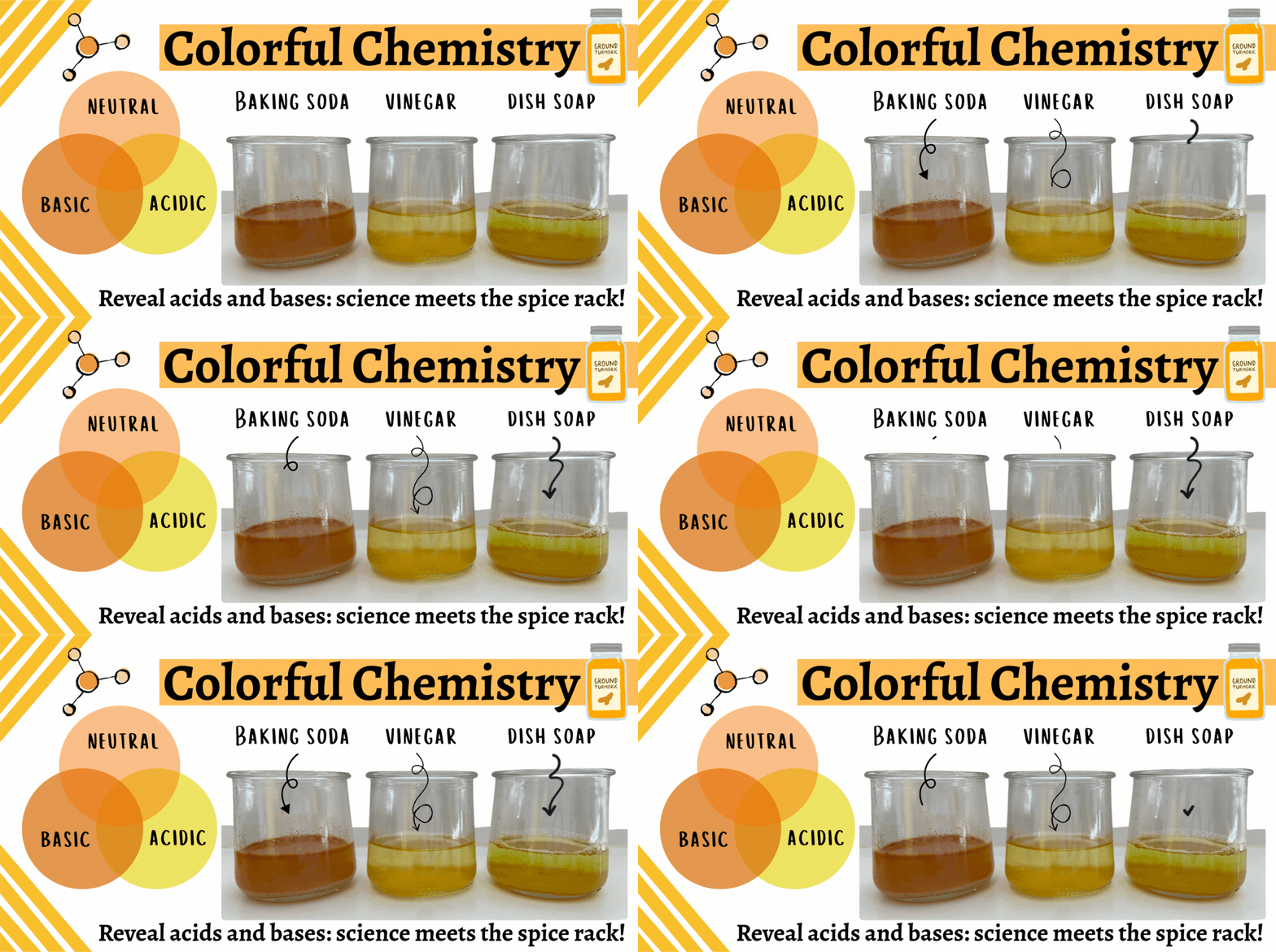
Did you know a common spice in your kitchen can act as a chemistry tool? Turmeric isn’t just for cooking! It’s a natural pH indicator, which means it can tell you whether a liquid is acidic or basic. In an acid, turmeric stays its usual bright yellow. In a base, the color shifts to a reddish-brown. This is a simple experiment that’s perfect for a relaxed lesson in your homeschool, and the results are visually striking and fun to see.
First, let’s understand what we’ll see.
Turmeric contains a compound called curcumin. When turmeric is mixed with an acidic or neutral liquid, the curcumin molecule stays in its regular, yellow form. But in a basic solution, part of the molecule breaks off. That small structural change affects how the molecule bends and absorbs light. This results in a visible color change from yellow to red and gives you a chance to actually see the chemistry in action!
Learning Goals
By the end of this activity, your learners will be able to:
- Understand how turmeric can be used as a natural indicator to distinguish acids from bases.
- Observe and explain color changes as evidence of a chemical reaction.
- Record and organize experimental data.
- Connect the experiment to real-life applications (like cooking, cleaning, and natural dyes).
Materials
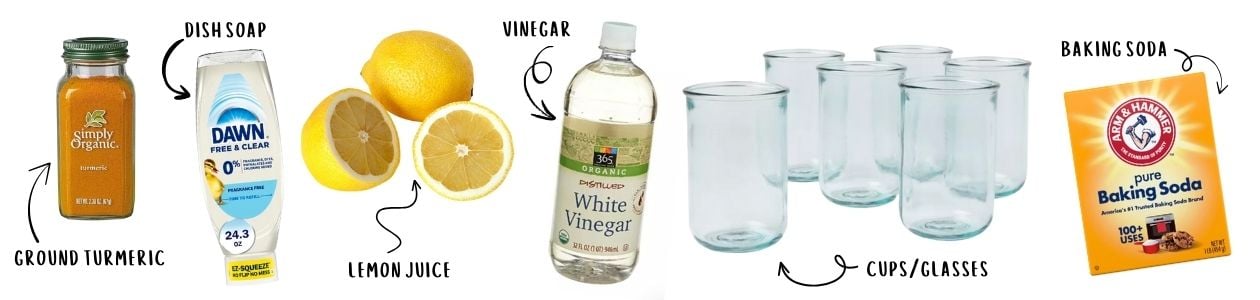
You’ll only need a handful of common household supplies:
- Turmeric powder
- White vinegar (acid)
- Lemon juice (acid)
- Baking soda (base)
- Soap (base)
- Clear cups or jars (one per liquid)
- Spoon (to stir)
- Water (to dissolve turmeric, baking soda, and soap)a
- Notebook or blank piece of paper (for recording observations and amounts)
Setup
- In a clear cup, mix about 1 teaspoon of turmeric powder with 2–3 tablespoons of water to create a turmeric solution.
- In another cup, prepare the baking soda solution by putting about 1 teaspoon of baking soda in ¼ cup of water. Stir to dissolve.
- Prepare the soap solution by mixing 2 teaspoons of liquid dish soap in ¼ cup of water. Stir carefully to mix the soap into the water.
- Pour your other test liquids into individual cups. 2-3 tablespoons of each should be enough for both the vinegar and lemon juice.
- On your paper, write down the amount of each material you used. (How much turmeric did you add? How much baking soda, soap, and water? A good scientist takes precise notes.) Leave space to write down what color changes you will observe.
Experiment
- Add a small amount of the turmeric solution to each cup of test liquid. Stir the turmeric and water first to ensure it is well-mixed before pouring. Watch closely to see if the colors change!
- Observe what happens: acids will leave the turmeric yellow, while bases will shift the color to a reddish-brown. Write down what you see on your data sheet.
- For extra fun, combine a little acid (vinegar) and base (baking soda + water) in the same cup. You will see sudden fizzing! Once it slows down, add some of the turmeric solution and watch the color change as the reaction unfolds. What happens if you now add more vinegar or baking soda?
- Encourage predictions before testing each liquid, and have learners record their predictions and results. Were the results different than expected?
Discussion Questions
- Which liquids caused the turmeric to change color?
- Which liquid resulted in the biggest color change? The slightest color change? Why do you think that is?
- What other household liquids could you test? (e.g., soda, milk, juice)
- Were there any reactions you didn’t expect or were surprised to see?
- If you did this experiment again, would you do anything differently next time?
Ready to keep going? Here are some extension ideas:
- Test other liquids you might have at home, like orange juice, soda, tea, or milk. What do you predict will happen?
- Try a “buffering experiment” by mixing different amounts of vinegar and baking soda to make the solution more acidic (adding extra vinegar) or more basic (adding extra baking soda). Careful! It will fizz.
- See what happens when you now add extra baking soda to the baking soda + turmeric + water solution.
Want more science you can do at home?
For a deeper dive into acids and bases in the kitchen, check out my full Pickle Power Chemistry Unit, packed with easy-to-understand explanations of pH, another quick activity, AND a recipe specific to the lesson. Available in my shop for just $5. Find it here!