

The Indian higher education landscape is currently caught in a powerful tug-of-war following the January 13, 2026, notification of the UGC (Promotion of Equity in Higher Education Institutions) Regulations. What was designed as a "statutory shield" for the marginalized has unexpectedly become a lightning rod for campus unrest. From the gates of Lucknow University to the lawns of Delhi University, the student response has been swift, polarized, and deeply visceral. At The Indian Panorama, we believe this isn't just a policy debate; it is a defining moment for the "social contract" of the modern Indian campus.
The Pulse of the Policy: Why Now?
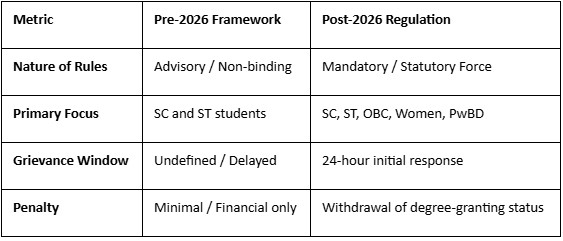
The 2026 Regulations were not born in a vacuum. They emerged from a decade of rising data points: a 118% surge in reported caste discrimination cases between 2017 and 2024, and the tragic loss of students like Rohith Vemula and Payal Tadvi. Unlike the advisory 2012 guidelines, the new rules carry statutory force.
Key Mandates of the 2026 Framework:
- Equal Opportunity Centres (EOCs): Mandatory setups in every college with 24/7 helplines.
- Equity Committees: Tasked with investigating complaints within 24 hours.
- OBC Inclusion: For the first time, Other Backward Classes are explicitly protected alongside SC, ST, and PwBD students.
- Accountability: Heads of Institutions face personal liability and de-recognition for non-compliance.
The Campus Fissure: Two Worlds, One Gate
The "Youth Campus Response" has highlighted a stark divide in perception. On one side, groups like the All India Students' Association (AISA) have hailed the inclusion of OBCs as a "historic victory for social justice." For these students, the regulations are a long-overdue mechanism to dismantle the "invisible barriers" in labs, hostels, and viva-voce rooms.
On the other side, a massive wave of protests—led by the Savarna Sena and general-category student groups—has swept through Uttar Pradesh and Delhi. Their grievance is twofold:
- Exclusionary Definitions: Critics argue that Clause 3(c) defines "caste-based discrimination" solely as acts committed against SC/ST/OBC groups, effectively suggesting that general-category students cannot be victims of similar bias.
- The Misuse Fear: The removal of a 2025 draft provision that penalized "false or malicious complaints" has sparked fears of a "presumption of guilt." Student leaders argue that without safeguards, the 24-hour probe window could turn into a tool for settling academic rivalries.
The Judicial Pause: A Search for Balance
The controversy reached a crescendo on January 29, 2026, when the Supreme Court of India stayed the regulations. The Bench described the rules as prima facie "sweeping" and expressed concerns that they might inadvertently "divide society" rather than integrate it. This stay has provided a much-needed breathing room for the UGC and the Ministry of Education to address the "safeguard gap" while keeping the spirit of social justice alive.
A Path Toward "Harmonious Inclusion"
At The Indian Panorama, we see this not as a "black law" or a "failed move," but as a crucial first draft of a more inclusive future. The intensity of the student response proves that the youth are deeply invested in the fairness of their institutions.
The way forward is not a rollback, but a refinement. By introducing a member from the general community into the Equity Squads—a move already hinted at by Union Education Minister Dharmendra Pradhan—and reinstating penalties for bad-faith complaints, the UGC can transform these rules from a "wedge" into a "bridge."
True equity is not a zero-sum game; it is about ensuring that every student, regardless of their surname, feels they belong to the same library, the same canteen, and the same future. If we can bridge the trust deficit between these student factions today, the campuses of 2026 will become the crucibles of a truly united India tomorrow.