
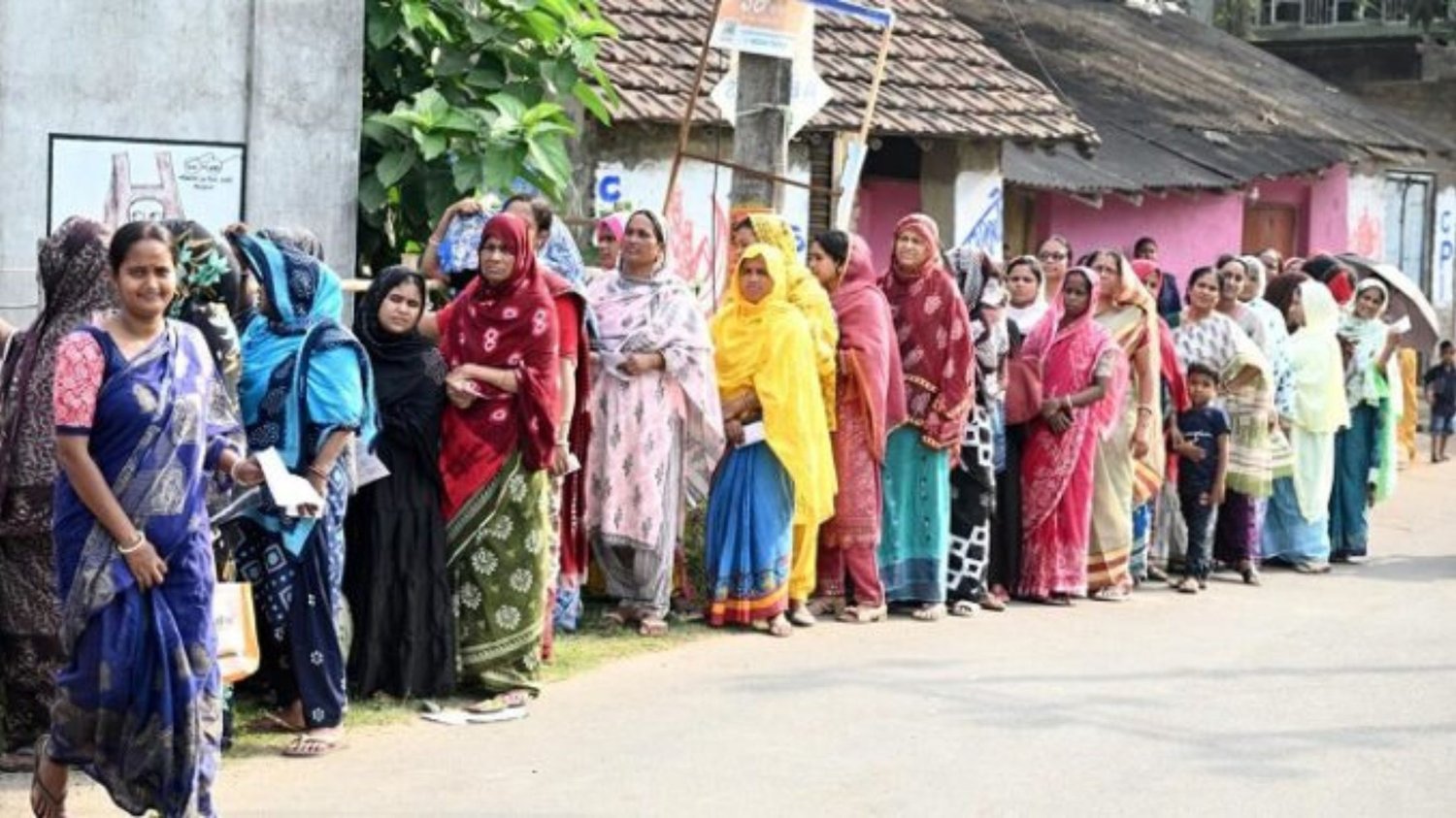
The political cartography of India underwent a drastic shift in May 2026 as the final results of the West Bengal Assembly elections flickered across television screens. For the first time in the history of the Republic, the Bharatiya Janata Party (BJP) has successfully secured a majority in the West Bengal Vidhan Sabha. By capturing more than 200 seats in the 294-member house, the saffron party has not only ended fifteen years of Mamata Banerjee’s Trinamool Congress (TMC) rule but has also fundamentally altered the federal dynamics of the nation. For the Indian diaspora in America, this victory represents or signifies the integration of India’s most culturally distinct eastern frontier into the national political mainstream.
Is the Bhabanipur Miracle a Fluke or a Formula?
The defining image of this election was the fall of the incumbent Chief Minister, Mamata Banerjee, in her own backyard of Bhabanipur. Losing by a margin of 15000 votes to the BJP’s grassroots mobilization, her defeat became the symbolic capstone of a campaign that favored organizational discipline over populist charisma. The BJP’s success was built on a dual-track narrative. On one hand, it capitalized on the anti-incumbency sentiment fueled by allegations of local-level corruption and the controversial handling of the 9 million flagged voters in the border districts. On the other, it presented a vision of Sonar Bangla that focused on the $10.8 billion semiconductor manufacturing fund and the promise of industrializing the long-neglected northern and western belts of the state.
This was not a victory achieved through mere rhetoric. The BJP’s ground game involved a persistent three-year mobilization of over 100,000 Panna Pramukhs who worked at the booth level to counter the TMC’s traditional muscle power. By framing the election as a choice between structural stagnation and national integration, the BJP managed to pull a significant percentage of the urban middle class and the scheduled caste votes, which had previously remained loyal to the Left or the TMC.
How Does the Eastern Breach Impact National Federalism?
The implications of this victory extend far beyond the borders of West Bengal. Historically, the state has functioned as a center of political dissent, often standing in direct opposition to the center in New Delhi. With the BJP now controlling the state apparatus in Kolkata, the friction between the center and the state is expected to transition into a period of cooperative competition.
The 2026 mandate implies that the BJP’s brand of governance is no longer confined to the Hindi heartland. By winning a state with a 30 percent minority population and a strong history of linguistic sub-nationalism, the party has proven that its development-centric Hindutva can find purchase in arguably the most intellectually resistant corner of India. This shift will likely accelerate the implementation of central projects, from the Sagarmala port expansions to the expansion of the National Clean Air Programme in the highly polluted industrial clusters of Durgapur and Asansol.
Will the TMC Survive the Identity Crisis of 2026?
For the Trinamool Congress, the loss is an existential blow. The party, which was built entirely around the persona of Mamata Banerjee, now faces a leadership vacuum and a fragmented cadre. The defection of key leaders like Suvendu Adhikari years prior was the first crack in the dam, but the 2026 results suggest a deeper systemic collapse. The TMC’s reliance on welfare schemes and local patronage proved insufficient against a BJP campaign that successfully tied West Bengal’s economic future to the broader Indian growth story.
As an expert on subcontinental politics, it is clear that the TMC failed to evolve beyond the politics of protest. While the party focused on a narrative of Bengali pride versus the outsiders, the electorate—particularly the youth—focused on the lack of high-end jobs and the migration of talent to Bengaluru and Hyderabad. The BJP’s promise to bring the Digital India revolution to the streets of Kolkata resonated with a generation that is tired of being defined by the slogans of the 1970s.
A Future Defined by Integration and Resilience
The road ahead for the new administration will not be easy. Governing a state as complex and historically charged as West Bengal requires a delicate balance between fulfilling development promises and maintaining social harmony. The BJP must now prove that its governance can be as inclusive as its campaign was aggressive. The focus must immediately shift toward restoring the state's manufacturing glory and cleaning up the urban air quality concerns that have plagued the state's capital.
At The Indian Panorama, we view the 2026 Bengal mandate as a maturing of the Indian democracy. It is a sign that the electorate is increasingly prioritizing economic outcomes and national security over regional isolation. As India remains the fastest-growing major economy, the integration of West Bengal into this growth engine is a win for the entire nation. For the diaspora watching from New York or California, this is a moment of profound reconnection with a state that once led India’s intellectual and economic renaissance. The saffron rising in the east is not just a change of government; it is a redirection of destiny.