
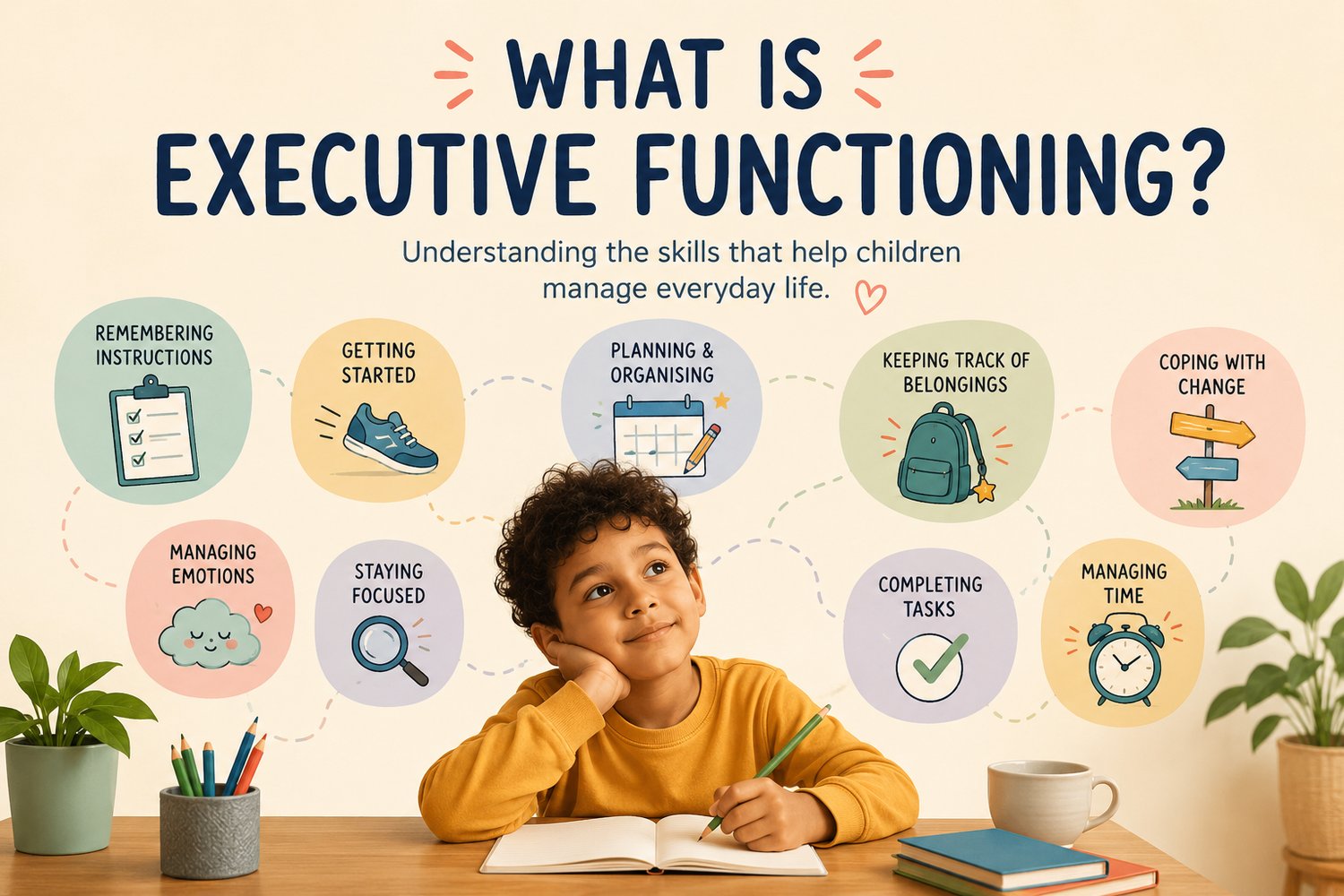
Executive functioning is a collection of skills that help children manage everyday life — from remembering instructions and getting started on a task to managing emotions, organising belongings and coping when plans change. Understanding these skills can help us make sense of some of the things our children find difficult and, importantly, think about what support might help.
You may have heard the term executive functioning and wondered what it actually means.
Executive functioning refers to a set of mental skills and cognitive processes that help us manage our thoughts, feelings and actions. For children, these skills support many of the things they are learning to manage every day.
They help children to plan, focus, remember, organise, manage emotions, get started, keep going and work towards their goals.
These skills develop over time, and every child develops differently.
What skills are involved?
Executive functioning isn't just one skill. It is a collection of different skills that work together.
These include:
- Attention – focusing on what matters and tuning out distractions
- Working memory – holding information in mind while using it
- Inhibitory control – pausing, thinking and managing impulses
- Emotional control – managing feelings and staying calm
- Flexibility – adapting when things change or trying another approach
- Planning and organising – working out what needs to happen and keeping things on track
- Task initiation – getting started without always needing someone else to prompt you
- Monitoring and self-checking – noticing how you're doing and checking your work
- Goal-directed persistence – sticking with something even when it becomes difficult
- Time management – understanding and managing time
- Metacognition – thinking about how we learn and what helps us
- Self-regulation – bringing these skills together to manage ourselves and work towards our goals.
What might this look like in everyday life?
Executive functioning skills are involved in so many ordinary parts of a child's day.
You might notice that your child:
- forgets instructions they've just been given
- struggles to get started on homework or another task
- loses belongings regularly
- needs lots of reminders about familiar routines
- finds it difficult to move from one activity to another
- becomes overwhelmed by big feelings
- finds changes particularly difficult
- acts before thinking
- struggles to organise their things
- gives up when something becomes difficult.
Sometimes, you might also notice that your child can manage something really well on one occasion but struggle with it on another.
This can be confusing.
Understanding executive functioning can give us another way of looking at these differences.
Think of it like an orchestra
One way to understand executive functioning is to imagine an orchestra.
An orchestra has lots of different sections, each with its own part to play. When they work together, everything comes together to create the music.
Our executive functioning skills can work in a similar way.
Attention, working memory, emotional control, flexibility, planning and the other skills all have their own roles, but they also need to work together.
When everything is working well, things can feel more manageable.
But sometimes the orchestra gets overwhelmed.
When there is too much information, stimulation or emotion to manage, the different “sections” can become harder to coordinate. A child may find it more difficult to focus, remember, manage their feelings, make choices or get started.
So, what can I do to help?
The good news is that executive functioning skills develop gradually.
Children don't need to have all of these skills mastered at once. They need opportunities to practise, support while they are learning and encouragement along the way.
A helpful place to start is with one skill.
Think about the area your child is finding most difficult right now.
Then:
Choose one or two strategies to try.
Practise little and often.
Notice and celebrate small steps.
Build confidence before moving on to another skill.
It doesn't have to be perfect.
A small improvement is still progress.
Why does understanding executive functioning matter?
Understanding the skills behind everyday challenges can help us think differently about what our children are experiencing.
Instead of simply asking “Why can't they do this?”, we can start to ask:
“Which skill might they be finding difficult?”
And then:
“What might help?”
That small change in perspective can make it easier to identify the right support.
Executive functioning skills develop through support, repetition, practice and encouragement. Every small opportunity to practise can help children build their skills and confidence over time.
Want to explore executive functioning further?
We've created a free Understanding Executive Functioning resource with simple explanations, practical strategies, visual models and checklists to help you explore these skills and think about where you might like to start.
Understanding Executive Functioning - Payhip
You don't need to tackle everything at once.
Small steps. Big progress. Together.