
Performance-review season has a strange way of making a year of real work feel impossible to describe.
You know you solved problems, helped people, kept important work moving, and learned things. But when the form asks for your “major accomplishments and measurable impact,” your brain offers either a blank page or a pile of vague phrases:
• I helped the team. • I improved communication. • I worked on several projects. • I took on more responsibility.
Those statements may be true, but they do not give the reader enough evidence to understand your contribution. The answer is not to invent a dramatic percentage or ask an AI tool to manufacture one. The answer is to recover the observable facts you already have and explain what changed because of your work.
Here is a practical process you can use even when your notes are messy and your metrics are incomplete.
START WITH EVIDENCE, NOT POLISHED SENTENCES
Do not begin by trying to sound impressive. Begin by collecting raw material.
Look through sources you are permitted to use, such as:
• Your calendar • Completed project lists • Goal documents • Non-confidential work notes • Feedback you received • Status reports • Recognition messages • Training records • Process documents you created or improved
For each item, write down four things:
• What situation or need existed? • What did you personally do? • What changed afterward? • What evidence can you actually support?
This separates your real contribution from the pressure to produce perfect prose immediately.
USE OBSERVABLE CHANGE WHEN A PERFECT METRIC DOES NOT EXIST
Numbers are useful when they are real, but not every valuable contribution comes with a dashboard.
You can often describe impact through an observable change:
• A recurring handoff became clearer.
• A checklist reduced missing information.
• A customer received a faster or more consistent response.
• A staffing gap was covered without losing visibility.
• A risk was identified before it became a larger problem.
• A teammate could complete a task without repeated assistance.
• A decision-maker received the information needed to act.
These are credible results when you can explain what you did and avoid pretending you measured something you did not.
Compare the difference:
Vague: I improved the scheduling process.
Evidence-based: I introduced a request checklist that reduced missing information and made follow-up more consistent. I did not formally measure the time saved, so I am describing the observable process change rather than claiming a percentage.
The second version is stronger because it is specific and honest.
BUILD EACH ACCOMPLISHMENT AS A SHORT, DEFENSIBLE STORY
A useful self-evaluation accomplishment usually contains three parts:
Action + observable result + evidence limit
For example:
I coordinated weekly scheduling during a staffing gap and kept coverage decisions visible to the team. The contribution is supported by the schedules and status updates I maintained; I do not have a formal service-level metric for the period.
You will not always need to state the evidence limit explicitly in the final review. Thinking through it prevents accidental exaggeration and helps you answer follow-up questions confidently.
Aim for two or three contributions that represent your year well. A focused review with clear evidence is usually easier to understand than a long list of duties.
TREAT A GROWTH AREA AS EVIDENCE OF OWNERSHIP
A credible growth section does not require inventing a weakness or writing against yourself.
Choose a real area that matters, then explain:
• What the challenge was • What you learned • What action you have already taken • What behavior, support, or measurement comes next
For example:
I learned that I was waiting too long to escalate ambiguous requests. I have started confirming owners and deadlines earlier, and next cycle I will track unresolved dependencies in the weekly status update.
That answer is candid, constructive, and connected to action. It shows judgment without turning the review into a confession.
WRITE GOALS YOU CAN INFLUENCE
Avoid goals that quietly assume another team, a new budget, a promotion, or a manager's approval.
A credible goal includes:
• The outcome you want • The evidence that will show progress • Your first action • The timing • Any dependency you do not control
For example:
By the end of the second quarter, I will create and pilot a standard intake checklist for recurring requests. I will track adoption and missing-information follow-ups during the pilot. Broader rollout will depend on manager approval and team feedback.
The goal is specific without promising a result that depends entirely on someone else.
CAN AI HELP WRITE A SELF-EVALUATION SAFELY?
It can help organize and polish your own facts, but only if your employer permits the tool and you protect restricted information.
Before using an AI assistant:
• Remove company and customer names. • Remove employee, financial, health, security, legal, and other sensitive details. • Replace identifying information with neutral placeholders. • Never ask the tool to invent accomplishments, feedback, metrics, or outcomes. • Verify every sentence against your own records.
A safer prompt sounds like this:
Organize these sanitized factual notes into themes for an annual self-evaluation. Separate verified facts, useful context, missing evidence, and details that should be generalized. Do not draft claims or invent results.
The tool can help with structure. You remain responsible for truth, confidentiality, and judgment.
A FINAL CHECK BEFORE SUBMITTING
Read your completed draft three times:
• For truth: Can you support every name, date, number, result, and quote? • For clarity: Does the reader understand what you personally did and what changed? • For consequences: Did you accidentally promise a result, resource, deadline, or decision you do not control?
Then ask one final question: does this sound like you on a good professional day, or like generic corporate filler?
WANT A GUIDED VERSION OF THIS PROCESS?
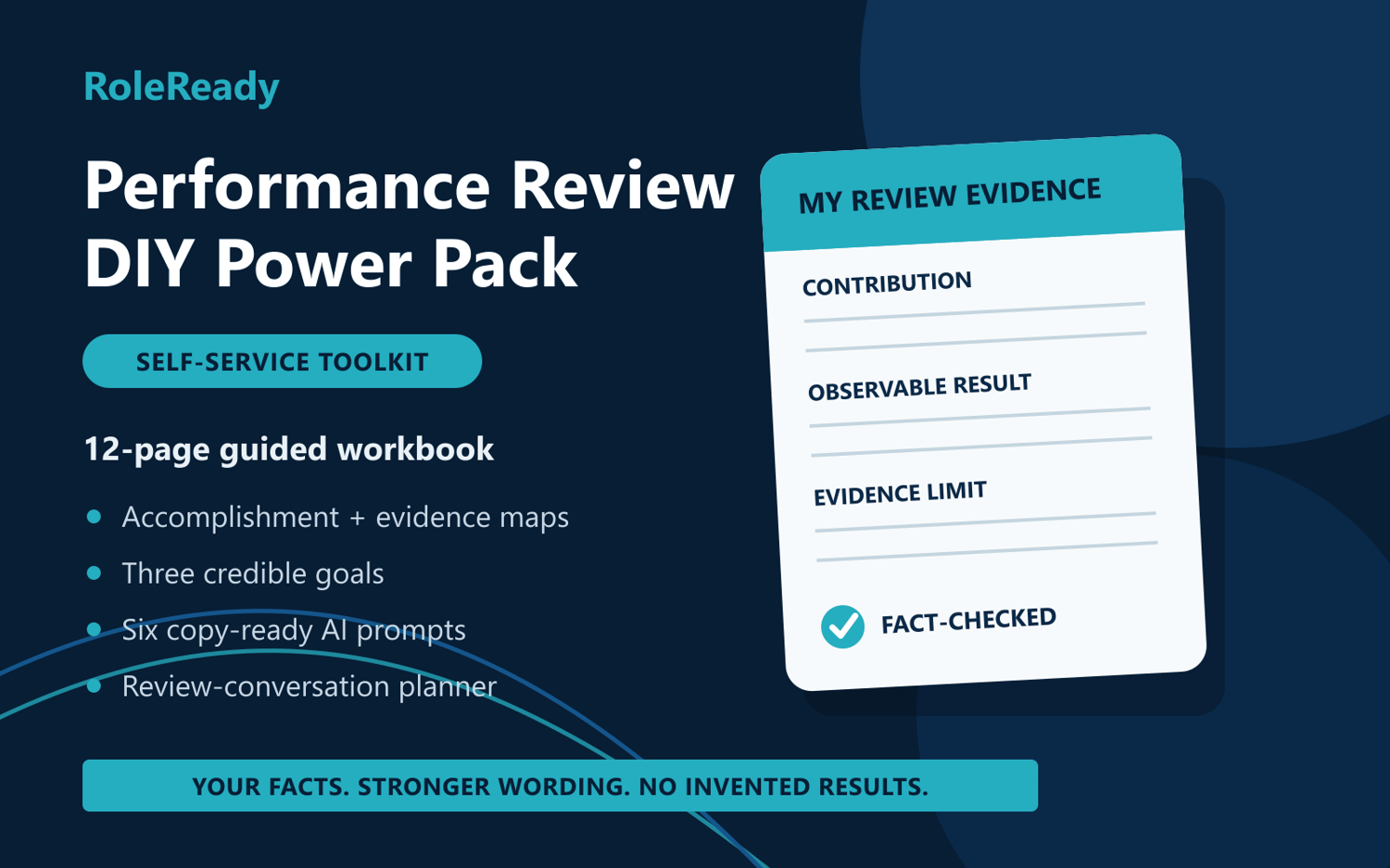
The RoleReady Performance Review DIY Power Pack turns this method into a 12-page guided workbook. It includes accomplishment and evidence maps, a three-goal builder, a review-conversation brief, six privacy-conscious AI prompts, and a final accuracy checklist.Get the 12-page Performance Review DIY Power Pack — $9
For educational writing support only. This article and toolkit are not HR, legal, compensation, workplace-rights, or promotion advice. Your employer controls its review process and decisions.
Taking these accomplishments into a job interview? Read our behavioral interview preparation guide.