
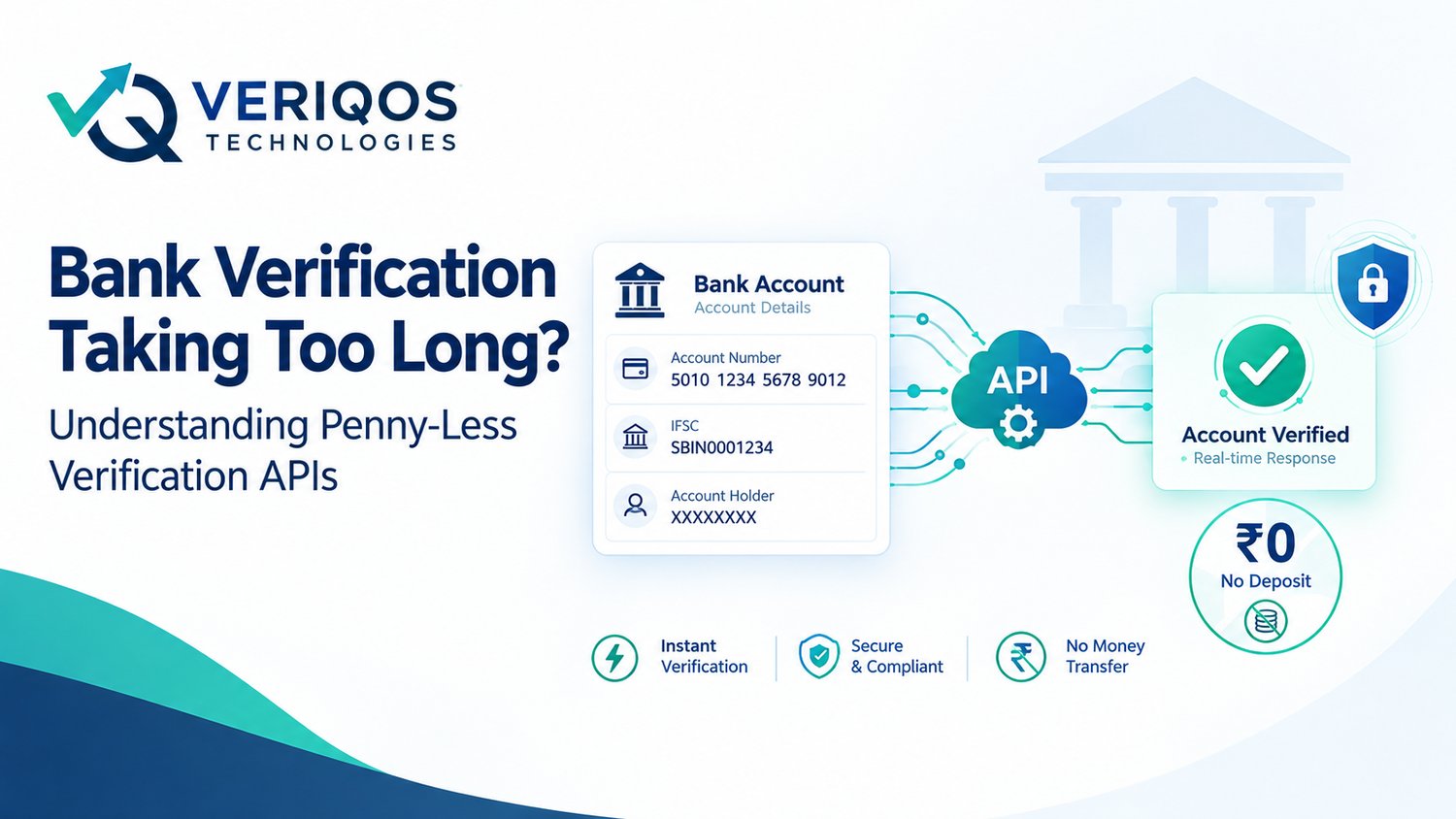
Bank verification can become a bottleneck when a business relies on test deposits, manual checks, or slow verification workflows. A penny-less verification API offers another approach by verifying bank account details without sending or depositing money. Veriqos states that its API uses the account number, IFSC code and account holder name to verify an account and return a result in real time.
For fintechs, lenders, payment platforms, marketplaces and other businesses, the main question is not only whether a bank account can be verified, but how the verification fits into the wider customer or payout workflow. This article explains how penny-less verification works, why bank verification can take longer than expected, what to consider when choosing an API, and where this approach can be useful.
Why can bank account verification take so long?
Bank account verification may involve several steps before a business can confirm that the details provided are valid.
A traditional verification process may involve a small test transaction, waiting for the transaction to reach the account, checking the result and then updating the application or payment system.
This can create delays when a business needs to verify many accounts.
For example, consider a lending platform onboarding a new customer. The platform may need to confirm the customer's bank details before completing part of its process. If verification depends on a transaction and a waiting period, the customer may have to wait before moving forward.
The same issue can appear in:
- Loan processing
- Vendor onboarding
- Employee payouts
- Marketplace payments
- Refund processing
- Customer onboarding
- Subscription payments
The exact verification time depends on the method, provider, banking systems and workflow being used.
What is a penny-less verification API?
A penny-less verification API is an API that allows a business to verify bank account details without sending a small test deposit.
Instead of using a penny-drop transaction, the API receives the required account information and returns a verification response.
According to the Veriqos service page, its penny-less bank account verification API uses the bank account number, IFSC code and account holder name. The API is designed to confirm whether an account is active and perform a name match check.
This makes penny-less verification different from a process where a business first sends money to an account and then waits for the transaction to be confirmed.
How does penny-less bank verification work?
A typical API workflow can be broken down into three stages.
1. Capture the bank details
The business collects the required information, such as the account number, IFSC code and account holder name.
2. Send the details through the API
The application sends the information to the verification API. Veriqos states that its API transmits these details securely over HTTPS.
3. Receive the verification response
The API returns a structured response that can include the verification status, masked account details and matching information. Veriqos states that its API performs account validation and name matching in real time.
This type of workflow allows developers to connect bank verification directly to an existing application instead of creating a separate manual checking process.
How is penny-less verification different from penny drop?
Both methods are used to verify bank account details, but the process is different.
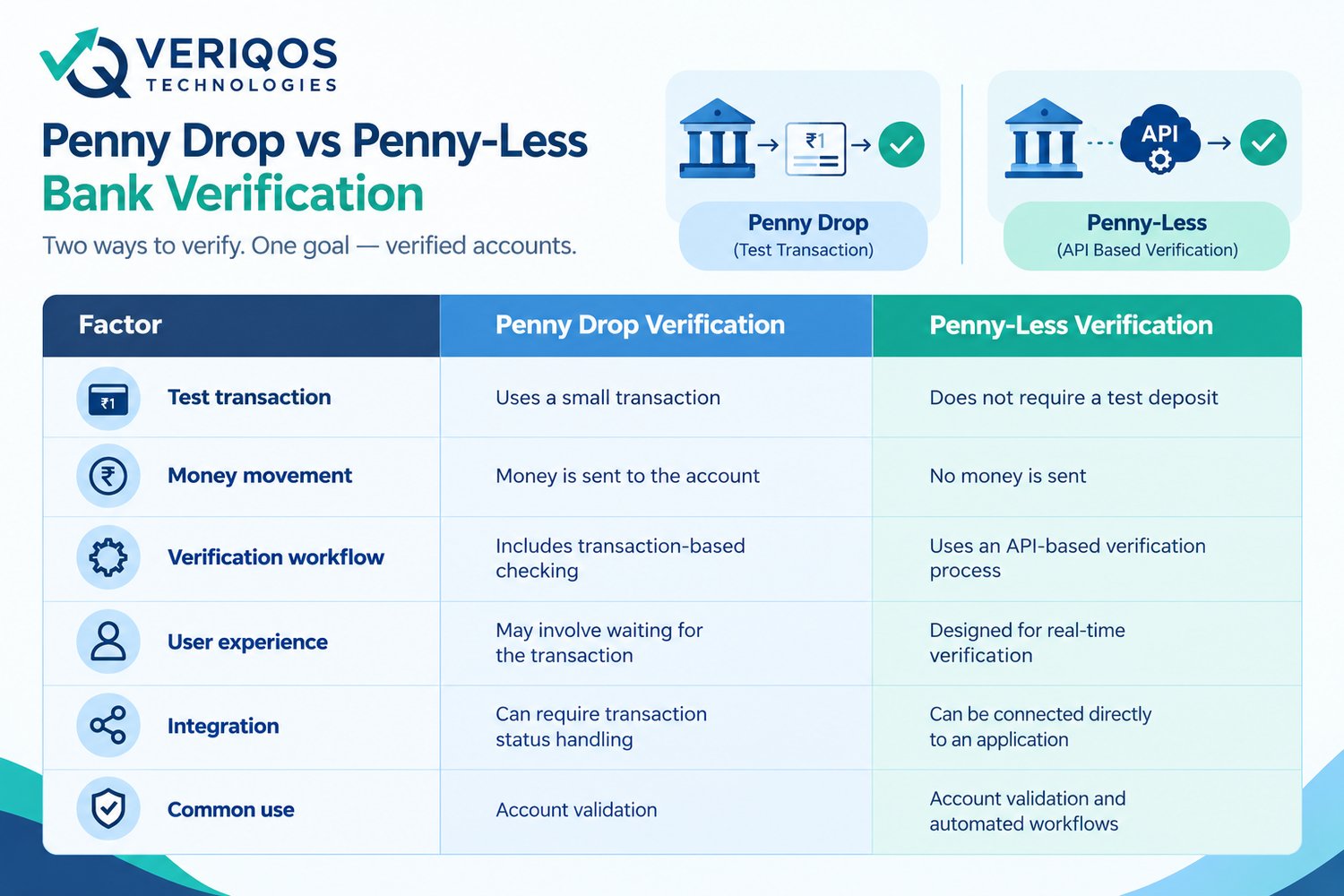
The right method depends on the business process, available verification infrastructure and the type of account checks required.
A penny drop alternative can be useful when a business wants to avoid adding a test transaction to its verification workflow.
When should a business consider penny-less bank account verification?
Penny-less verification can be relevant when account verification needs to happen as part of a larger digital workflow.
For example, a fintech application may need to verify bank details during customer onboarding. A lender may need account information checked before processing a loan. A marketplace may need to verify seller or vendor bank details before making a payout.
In these situations, an API can connect the verification step to the existing application.
Businesses looking to reduce delays in account verification can use a penny-less bank account verification API to build bank verification into their existing workflows.
Which businesses can use a penny-less bank verification API?
The use case is not limited to one industry. Bank verification can be useful anywhere a business needs to confirm account details before a financial action.
Fintech and digital lending
Fintech platforms and digital lenders can use bank verification during onboarding or loan processing.
The verification step can help confirm bank details before they are used in a financial workflow.
Payment and payout platforms
Payment gateways and payout platforms may need to verify beneficiary or merchant account details before releasing funds.
Veriqos lists payment gateways and payout platforms as a use case for its penny-less account validation API.
Marketplaces
Marketplaces may need to verify seller or vendor bank accounts before processing payouts.
Connecting verification to the marketplace workflow can reduce the need for separate manual checks.
SaaS and subscription platforms
Subscription businesses may need to confirm bank details before setting up recurring payments or related processes. Veriqos identifies subscription platforms and SaaS businesses among the use cases for its API.
Insurance and other financial workflows
Insurance platforms and other businesses that handle customer payments may also need reliable account verification as part of their operational workflows.
The exact use case will depend on the business model and the financial process involved.
What should you check before choosing a bank account verification API?
Choosing an API should involve more than looking at whether it can verify an account.
1. What information does the API require?
Check the required inputs before starting integration.
For example, Veriqos states that its penny-less API uses the account number, IFSC code and account holder name.
2. What does the API return?
Developers should understand the response structure before integrating the API.
Look for details such as:
- Verification status
- Name matching information
- Masked account details
- Error messages
- HTTP status codes
Veriqos states that invalid account details or IFSC codes result in clear error messages and HTTP status codes.
3. Can it fit into your existing workflow?
The API should work with the application where verification is actually needed.
For example, a lender may want verification inside its onboarding or loan processing flow rather than sending users to a separate verification system.
4. How is sensitive data handled?
Bank account information is sensitive, so businesses should understand how data is transmitted, protected and returned.
Veriqos states that its API uses HTTPS, encryption, masked bank details in responses, access controls and monitoring. These are claims published by Veriqos and should be assessed alongside a business's own security and compliance requirements.
5. Does the API support your expected volume?
A small internal application and a large fintech platform can have very different verification requirements.
Before integration, check expected request volumes, response handling, error management and available technical support.
Common problems businesses should avoid
A bank verification API can simplify a workflow, but poor implementation can still create problems.
Using verification as a separate manual step
If employees have to copy account details between systems, some of the benefits of API-based verification are lost.
Where appropriate, connect the verification response directly to the relevant application workflow.
Ignoring failed responses
Not every verification request will return a successful result.
Your application should be able to handle invalid inputs, unavailable information, failed matches and other API responses without confusing the user.
Collecting unnecessary information
Only collect information required for the verification process and your legitimate business purpose.
This also helps reduce the amount of sensitive information moving through your systems.
Choosing an API only on speed
Response time matters, but it should not be the only consideration.
Businesses should also look at documentation, security practices, response quality, integration requirements, support and how well the API fits their use case.
How Veriqos approaches penny-less bank verification
Veriqos Technologies provides API-based verification services for businesses that need to connect verification checks with their digital workflows.
Its penny-less bank account verification API is designed to verify bank accounts using account details without sending or depositing money. Veriqos states that the API can perform account validation and account holder name matching in real time.
The service page also lists use cases across fintech and digital lending, payment and payout platforms, SaaS and subscription businesses, and KYC and compliance workflows.
For businesses considering this type of API, the relevant questions are practical ones: what information is required, what response is returned, how the data is handled, and how easily the verification can fit into the existing application.
Frequently Asked Questions
What is a penny-less verification API?
A penny-less verification API is an API used to verify bank account details without sending a small test deposit. The verification takes place through an API-based process rather than a penny-drop transaction.
Does penny-less bank verification require a penny-drop transaction?
No. A penny-less verification process does not require money to be sent or deposited into the account. Veriqos states that its API verifies bank accounts without sending or depositing money.
What details are needed for penny-less bank account verification?
The information required depends on the API. Veriqos states that its penny-less verification API uses the bank account number, IFSC code and account holder name.
Is penny-less verification useful for fintech and lending businesses?
It can be useful where bank account verification is part of onboarding, lending, payout or other financial workflows. The exact suitability depends on the business process and verification requirements.
Can a bank verification API be integrated into an existing application?
Yes. API-based verification can be connected to websites, mobile applications and other digital workflows. Veriqos describes its API as suitable for integration into websites, mobile apps and payment workflows.
Is penny-less verification the same as bank account validation?
Not necessarily. "Bank account validation" describes the purpose of checking account details, while "penny-less verification" describes a method that does not rely on sending a test deposit. The exact checks and response depend on the API provider.
Summary
Slow bank verification can create unnecessary delays when a business needs to confirm account details during onboarding, lending, payouts or payments.
A penny-less verification API provides an alternative to transaction-based verification by allowing businesses to verify bank account details without sending a test deposit. The approach can be particularly useful when verification needs to become part of an automated digital workflow.
Before choosing a provider, businesses should check the required inputs, response data, integration process, security controls, error handling, support and expected verification volume.
For businesses that want to evaluate an API-based approach, Veriqos Technologies provides a penny-less bank account verification API designed for real-time account validation and name matching.
If you are planning to add bank verification to an existing product, contact the Veriqos Technologies team to discuss your use case.