

Sculpture, often associated with hard labour and meticulous stone carving, is yet another art discipline that was, historically, male dominated. So, when the Cockpit Studios Arts Society Award went into the hands of Jasmine Bradbury, it gave us a reason to look back at the female history of art and invite Jasmine to share a few insights on her unique career.
By Angela Johnson, Lead Features Contributor
From Michelangelo to Modern Times or What Has Changed in Sculpture
Men have long dominated the official history of visual arts. Even if you are not an art enthusiast, names like Michelangelo, Andy Warhol, Leonardo da Vinci or Banksy come to mind, all male. Does this mean there were no great female artists? Absolutely not.
It was when we reached the sixteenth century Italian Renaissance that we found Properzia de Rossi, one of the earliest recognised female sculptors. While workshops and art schools existed much earlier, the first school for female sculptors, led by neoclassical pioneers Harriet Hosmer, Anne Whitney and Edmonia Lewis, emerged in Rome in the late nineteenth century.
This shift marked the transition of women from workshop assistants to independent, recognised sculptors, carving the path for twentieth century artists like Barbara Hepworth and Niki de Saint Phalle. And although gender-related stereotypes persist in the contemporary art world, women continue to break them successfully. Jasmine shared her perspective on the matter.
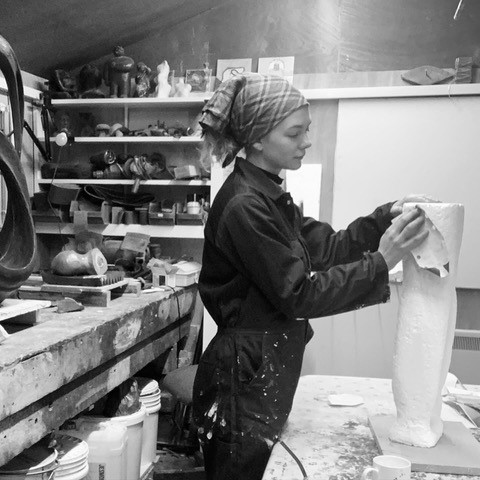
When people see me, a woman, working in foundries, they are often surprised because elements of the bronze casting world are very male dominated, and I have had challenges in establishing myself as a capable technician in the early stages. Many of the processes of casting bronze are heavy, messy and labour intensive, but this is something I love about the job and there are smart ways to enable myself to ensure I am capable of the work.
Sculpting Her Vision or The Artistic Pursuit of Jasmine Bradbury
Jasmine Bradbury graduated with a Fine Arts degree from Norwich University of the Arts in 2015 and gained extensive experience in bronze casting and mould-making while working at various foundries across the UK. For the past few years, she has been working independently. She opened her own mould-making and casting business, which allowed her to continue developing her artistic practice.
I started my own business in mould making and casting, and this made me believe I have confidence in what I make. Also, being accepted into my first foundry job was a big step in proving a woman could do a job that was advertised for a man.
Today, Jasmine is a young British sculptor recognised for her abstract, soft, organic forms, often moulded in a material as cold and sturdy as bronze. These contradictions in form and material reflect an inner dialogue, responses and interpretations of the internal self.
The fascination Jasmine holds with the unconscious mind is inspired by Carl Jung’s Collective Unconscious Theory, more specifically, his concept of the Shadow Self, based on which she explores the relationship and tension between the light and dark aspects of the self.
Empowering Artists or The Cockpit Arts Society Bursary
Unfortunately, the arts do not have a reputation for being a highly profitable field, which is why the role of societies and foundations like Cockpit is crucial. Founded in 1986, Cockpit has become a well-known name in the art world, and its support, whether financial or technical, enables artists to continue producing art.
The Cockpit Arts Society Bursary is focused on traditional craft skills, and their Cockpit Studios Arts Society Award went into the sculpting hands of Jasmine Bradbury, granting her a subsidised studio space for a year within the creative community at Cockpit along with dedicated business support.
Empowering Women or Advocating for Equality in the Arts
We asked Jasmine what changes she would like to see in her trade, and her response is a valuable reminder of the importance of empowerment and inclusivity.
More women feeling that they can and have the ability to learn or do bronze casting, an acceptance in workplaces and more female workwear. There are more opportunities available to women in the casting world now than when I first started out, but I am passionate about making it even more accessible and known that this is a job for both women and men.
The only way of overcoming stereotypes is to actively challenge them and work on creating an environment where talent and dedication are valued beyond gender. The work and achievements of Jasmine exemplify this, inspiring a new generation of female sculptors to pursue their passions.
Up Next

Off the Grid: The Reality of Going SOLAR