

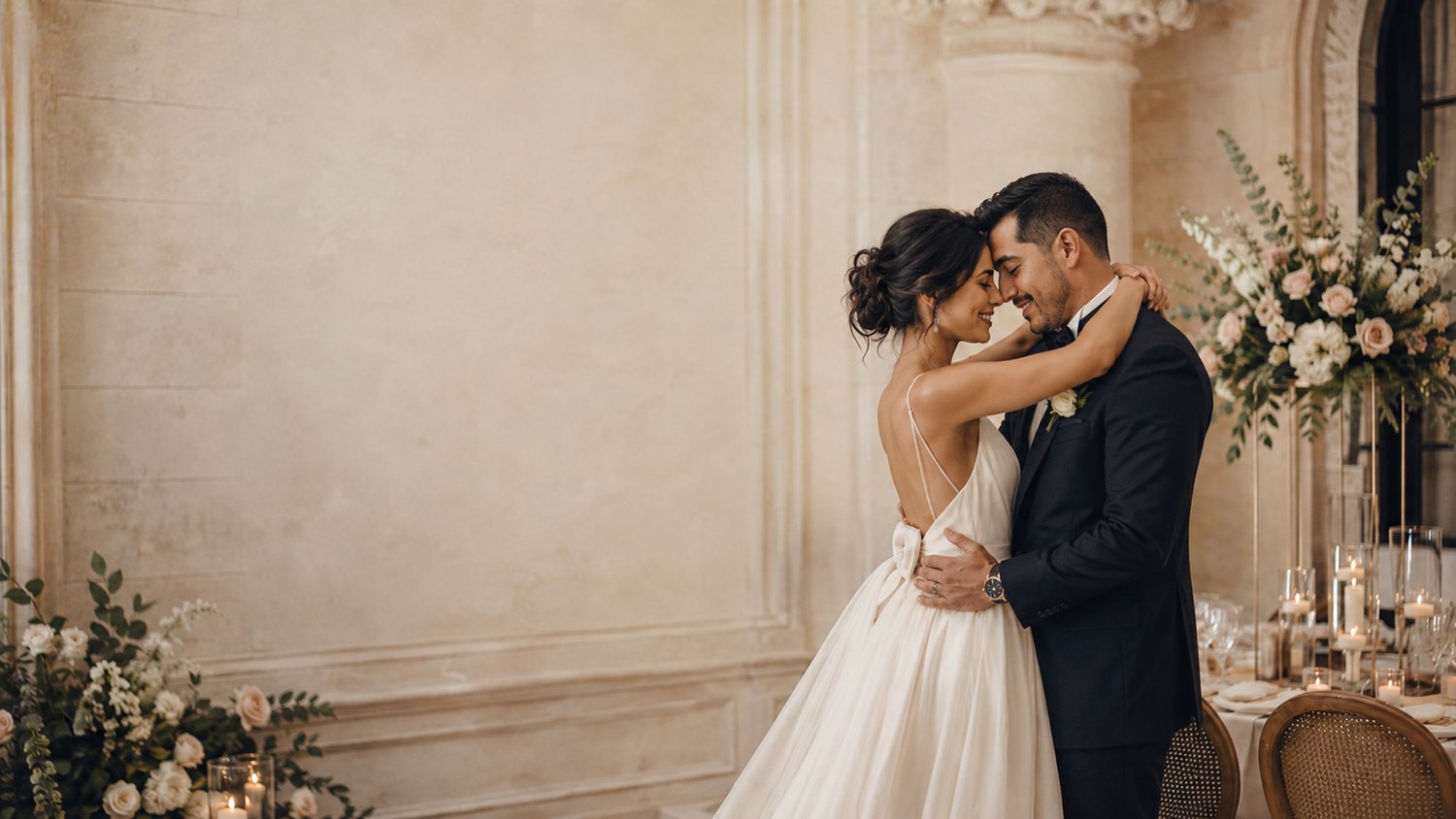
A more intentional approach to wedding traditions, trends, budgets, and expectations
There is a strange moment that happens to many couples after they get engaged.
At first, the wedding feels wonderfully personal. You imagine the people you love in one place. You picture the music, the food, the clothes, the photographs, perhaps the moment you first see one another.
Then the planning begins.
Suddenly, your wedding seems to come with an enormous invisible checklist.
You need the right venue. The right flowers. The right invitation suite. The right ceremony backdrop. The right favors. The right signature cocktail. The right reception entrance. The right late-night snack.
Then come the inspiration boards, family opinions, social media trends and beautifully photographed weddings that can make even a confident couple wonder whether what they originally wanted is somehow…not enough.
Somewhere between choosing a color palette and comparing centerpiece heights, it becomes surprisingly easy to lose sight of the most important question:
Does this wedding actually feel like us?
At Worth The Veil™, we believe wedding planning should begin there.
Not with what everyone else is doing.
Not with what tradition says you have to include.
And certainly not with what looks impressive online.
A meaningful wedding is not created by checking every box. It is created by making intentional choices about the experience you want to have, the people you want to honor and the beginning you want to remember.
“A trend can be gorgeous and still have absolutely nothing to do with your relationship.”
Inspiration Should Help You Discover Your Taste — Not Replace It
Wedding inspiration can be wonderful.
A photograph might introduce you to a flower you have never seen. A tablescape may help you recognize that you prefer warm candlelight over dramatic uplighting. A ceremony might inspire you to rethink the way you involve your families.
That is what inspiration does best: it helps you articulate what already resonates with you.
The problem begins when inspiration quietly becomes imitation.
You save one beautiful wedding after another until the question is no longer, “Do we love this?”
It becomes, “Should our wedding have this?”
Those are very different questions.
A trend can be gorgeous and still have absolutely nothing to do with your relationship.
You do not need a champagne tower because it photographs beautifully. You do not need private vows because they are popular. You do not need a particular style of bridesmaid dress, cake, signage or ceremony simply because it appears repeatedly in your feed.
Before adding something to your wedding, ask yourselves:
Would we still want this if we had never seen it on social media?
If the answer is yes, wonderful.
If the answer is no, you may have just saved yourselves money, time and one more decision.
Luxury Is Not the Same Thing as Expense
One of the ideas we return to often at Worth The Veil is that luxury is not simply a price point.
Luxury can be spaciousness.
It can be care.
It can be excellent food served at the right temperature.
It can be a beautifully written ceremony.
It can be enough time in the schedule that you are not rushing from one photograph to another.
It can be a handwritten note waiting at your partner's place setting.
It can be lighting that makes a simple room feel warm and inviting.
It can be giving your guests fewer things to look at and more opportunities to actually experience the evening.
There are weddings with enormous budgets that feel oddly impersonal.
There are also modest weddings where every detail seems considered.
The difference is often not how much was spent.
It is where the attention went.
A thoughtful wedding does not ask, “How can we afford everything?”
It asks:
What deserves to be beautiful here?
That question creates room for discernment.
Perhaps photography matters deeply to you, but elaborate florals do not.
Perhaps food is one of the ways your families show love, so dinner deserves a larger portion of the budget.
Perhaps fashion is incredibly important to one of you while the other cares most about live music.
There is nothing wrong with any of those priorities.
The mistake is believing your priorities have to match someone else's.
“Guest experience and guest spectacle are not the same thing.”
You Are Allowed to Skip Wedding Traditions
Traditions can be meaningful.
They can connect generations, honor culture, create anticipation and give a celebration rhythm.
But a tradition is meaningful because of what it represents — not simply because it exists.
You are allowed to ask why you are doing something.
The bouquet toss.
A formal wedding party.
The first look.
Cake cutting.
Favors.
A guest book.
A receiving line.
A particular ceremony reading.
A father-daughter dance.
Matching attire.
A grand entrance.
None of these are universal requirements for a successful wedding.
The same is true in the opposite direction: you do not need to reject traditions simply because doing something differently seems more modern.
The question is not:
Is this traditional?
The better question is:
Does this mean something to us?
Keep the traditions you love.
Adapt the ones that almost fit.
Release the ones that do not.
A wedding becomes more personal when tradition is treated as an invitation rather than an obligation.
Your Budget Should Tell the Story of Your Priorities
Wedding budgets are often discussed as though there is one correct percentage for every category.
There isn't.
Budgeting becomes much easier when couples stop asking what they are “supposed” to spend and begin asking what they actually value.
Imagine you have an extra $1,000.
Where would you instinctively put it?
Photography?
The honeymoon?
More guests?
Live music?
Flowers?
Dinner?
Your attire?
Or would you rather keep the $1,000?
That answer tells you something important.
The purpose of a wedding budget is not merely to restrict spending.
A good budget helps you direct money toward the experience you care about most.
It also gives you permission to spend less on things that do not matter to you.
This is where comparison becomes especially dangerous.
Someone else's wedding may include enormous floral installations because flowers were one of their highest priorities.
Your wedding does not become less beautiful because you would rather spend that money on your photographer and serve incredible wine at dinner.
Different does not mean inferior.
It means intentional.
“Your goal is not to create the wedding everyone expects. Your goal is to create the celebration you will recognize as your own.”
Ask What Your Guests Will Actually Remember
Couples often feel pressure to provide an endless number of details for their guests.
But think about the weddings you remember most clearly.
Do you remember the exact wording on the welcome sign?
Probably not.
You may remember whether you felt welcome.
You may remember laughing with people you had not seen in years.
You may remember the couple's vows.
The meal.
A packed dance floor.
A beautiful speech.
A quiet conversation during cocktail hour.
The way the room felt when everyone realized something meaningful was happening.
That does not mean décor is irrelevant. Beauty absolutely contributes to atmosphere.
But guest experience and guest spectacle are not the same thing.
Whenever you feel pressured to add something because guests might expect it, ask:
Would our guests genuinely notice if this disappeared?
Then ask the more important question:
Would we?
Some details are worth doing because you care about them, even if most guests never notice.
Others can disappear entirely without changing the experience.
Knowing the difference is one of the most valuable skills in wedding planning.
Protect the Relationship That Started All of This
Wedding planning can quietly become a second job.
There are vendor emails to answer, guest lists to edit, budgets to adjust, opinions to navigate and dozens of decisions that all seem to demand an immediate response.
And because you are planning together, wedding logistics can begin creeping into every conversation.
Dinner becomes wedding planning.
Saturday morning becomes wedding planning.
Date night becomes wedding planning.
Eventually, you can find yourselves spending more time discussing a seating chart than discussing your actual life together.
That deserves attention.
The wedding is important.
The relationship is more important.
Create boundaries around planning.
Choose certain evenings when wedding talk is off-limits.
Go somewhere together without discussing the budget.
Cook dinner.
Take a walk.
Plan something that reminds you why you are getting married rather than simply reminding you that you are planning a wedding.
There is something deeply ironic about allowing the celebration of your relationship to consume the relationship itself.
Do not let that happen quietly.
Three Questions to Return to When Planning Gets Noisy
When you feel overwhelmed, stop adding ideas and return to these three questions:
What do we want to remember?
Not what do you want photographed.
What do you actually want to remember?
Perhaps it is laughing during the ceremony.
Eating dinner slowly.
Having your grandmother there.
Dancing until your shoes come off.
Seeing your partner across the room and realizing everyone you love showed up for this moment.
How do we want our guests to feel?
Welcomed?
Surprised?
Relaxed?
Moved?
Energized?
Included?
The answer should influence your planning far more than whatever trend is currently dominating your feed.
And finally:
What would we still choose if nobody else were going to see it?
That question is remarkably clarifying.
Because your wedding does not have to prove anything.
Your Wedding Does Not Need to Look Like Everyone Else's
There will always be another trend.
Another color.
Another centerpiece.
Another “must-have.”
Another wedding that looks impossibly beautiful in a thirty-second video.
But your goal is not to create the wedding everyone expects.
Your goal is to create the celebration you will recognize as your own.
Years from now, the details you remember most may not be the ones that required the most money or took the most time.
They may be the ones that felt unmistakably like the two of you.
The song nobody else would have chosen.
The menu your families understood immediately.
The tradition you changed.
The tradition you kept.
The small moment nobody posted.
The decision to spend less.
The decision to splurge.
The choice to stop performing and simply celebrate.
That is where a wedding becomes worth remembering.
Plan the celebration. Honor your story. Begin what comes next.
— Worth The Veil™