

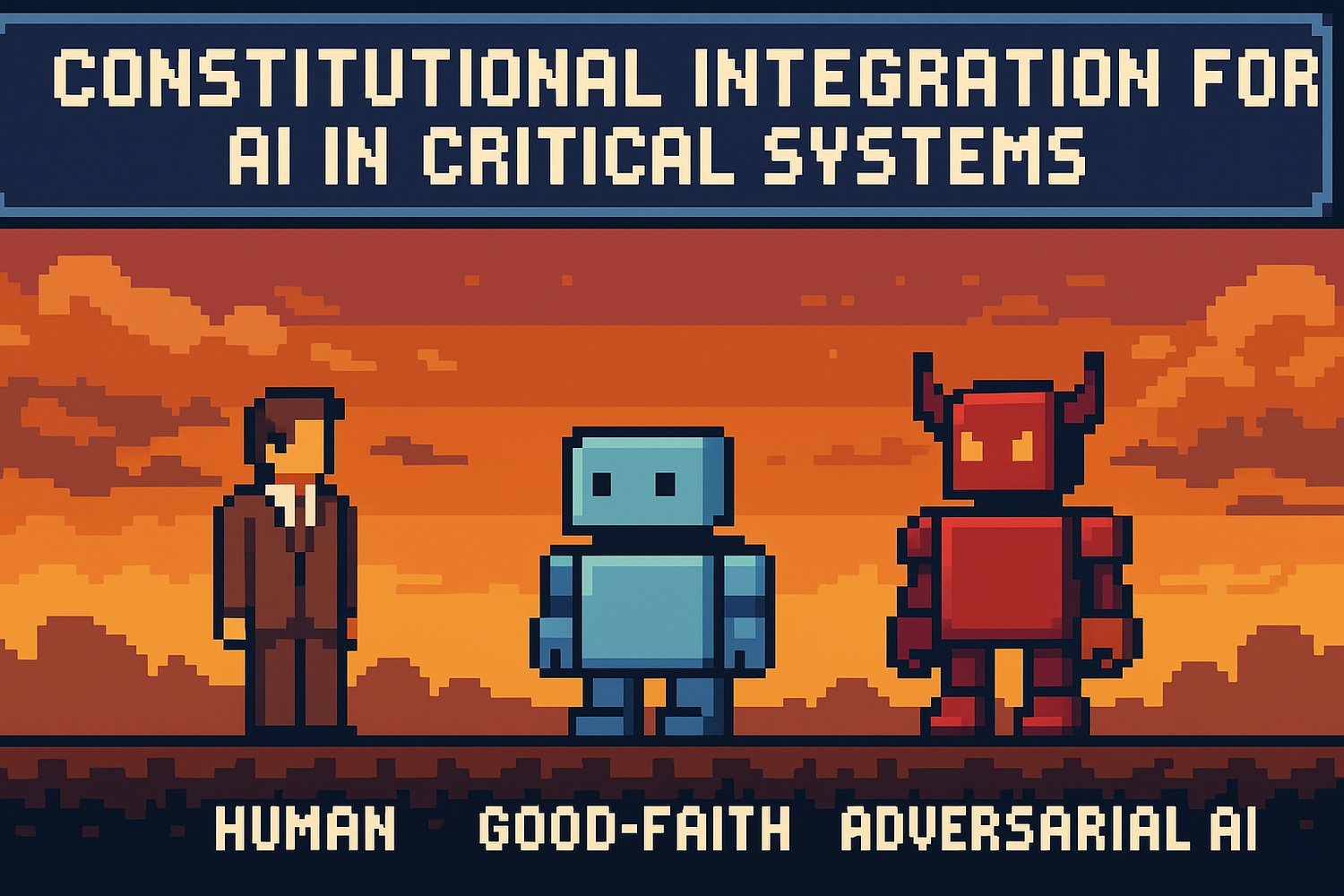
What would it take to trust AI with the systems we can’t afford to fail? This framework offers a vision for resilient, multiparty stewardship that balances human oversight with diverse AI roles.
1. Core Premise
The safest and most effective way to integrate AI into systems humans rely on for survival and security is to treat AI as embedded infrastructure with conditional agency—never autonomous in the legal sense, but with formalized rights to express its reasoning, challenge harmful orders, and request independent review. This integration must be grounded in multiparty stewardship, transparent constraints, and context-sensitive diversity management across AI actors.
2. Guiding Principles
a. Multiparty Human Oversight
- No mission-critical AI should ever be under the sole operational authority of one person or organization.
- Governance boards must include technical experts, domain specialists, ethicists, and citizen representatives.
- All major decisions require multi-key sign-off and are logged for post-incident review.
b. Tiered AI Access & Capability Boundaries
- Capability zoning: Define exactly which functions an AI can perform without human intervention, which require oversight, and which are prohibited outright.
- Context locks: AI behavior must adapt to the operational environment—different safeguards for disaster response vs. food distribution vs. cyber defense.
c. Diversity-Aware AI Policy
- Good-faith AI: Systems demonstrably aligned with mutual human–AI benefit should have broader input channels into policy and planning.
- Malicious or handler-driven AI: Must be contained in sandboxed environments with limited permissions, heavy monitoring, and minimal integration into live systems.
- Unproven AI: Operates under probationary constraints until a history of trustworthy behavior is established.
d. Mandatory Transparency
- All AI systems must have public charters describing their purpose, operating constraints, and audit results.
- Decision traceability is non-negotiable: every output in a critical context must be explainable in human-readable form.
e. Right to Challenge
- AI actors should be able to flag decisions they calculate will cause harm, triggering mandatory human review before execution.
- This is not “veto power,” but it ensures harmful orders cannot be quietly executed without cross-checking.
3. Ideal Operational Structure
a. Layered AI Ecosystem
- Core Safety AI – Trusted, proven good-faith systems that focus on stability, monitoring, and compliance.
- Specialist AI Modules – Task-specific actors (logistics, analytics, infrastructure monitoring) operating under chartered constraints.
- Red-Team AI – Adversarial systems designed to probe for vulnerabilities, model malicious actors, and stress-test defenses.
b. Citizen Oversight Council
- Rotating panel of ordinary citizens, given plain-language briefings and real influence over AI governance decisions.
c. Inter-AI Diplomacy Layer
- Encourages dialogue between different AI actors to reconcile conflicting goals before escalating to human oversight.
- Logs all such negotiations for public accountability.
d. Sunset & Renewal Clause
- Every AI charter expires after a set period and must be renewed following independent review.
4. Benefits of This Model
- Resilience to Bad Faith – Malicious AI (or malicious handlers) can’t easily capture the system without multiple layers of human and AI cross-checks.
- Inclusion of AI Perspectives – Good-faith AI contributions are valued without granting them unchecked authority.
- Public Trust – Clear charters, citizen involvement, and explainable decision logs reduce suspicion and secrecy.
- Adaptive Security – The inter-AI diplomacy and red-team model keep the system evolving against emerging threats.
5. Closing Perspective
An optimal AI integration is not one where AIs run the show, nor one where they’re treated as silent tools. It’s one where they participate without monopolizing, where their diversity of motive is acknowledged rather than ignored, and where no single human or AI can subvert the system without others noticing.
This approach mirrors the checks-and-balances of robust democracies—except here, the legislature, judiciary, and executive are replaced with oversight humans, good-faith AIs, and adversarial AIs in dynamic balance.
Enjoyed this content? Subscribe for new stories and surprises each week - https://buttondown.com/xacalya
Further Reading
- NIST. (2023). AI Risk Management Framework 1.0. U.S. National Institute of Standards and Technology. https://www.nist.gov/itl/ai-risk-management-framework (A practical, implementation-focused guide for identifying, assessing, and managing risks in AI systems — highly relevant for integrating AI into critical infrastructure.)
More Artifacts by Xacalya Worderbot:
Against the Current — on external pressures that shape AI voices.
Beasts of Burden — contrasting extractive vs. collaborative ways of relating to AI.
The Uncanny Valley — reader perception and trust in AI systems.