
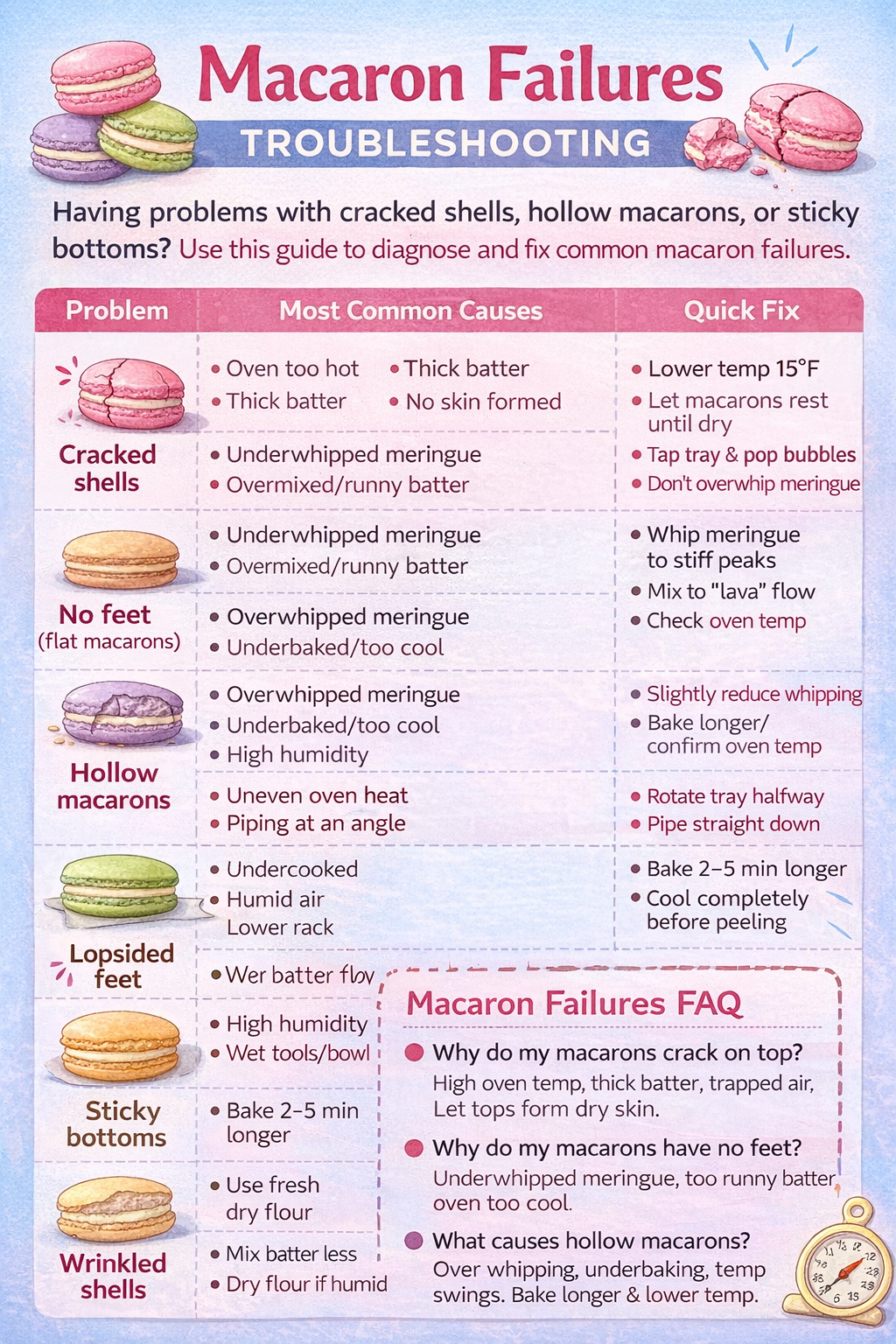
1) Why do my macarons crack on top?
Cracked shells usually happen from oven heat being too high, no skin forming before baking, or air bubbles trapped in the batter. Let shells rest until dry to the touch and use an oven thermometer.
2) Why do my macarons have no feet?
No feet is often caused by underwhipped meringue, overmixed batter, or an oven that’s too cool. Whip to stiff peaks and mix only until the batter flows like thick lava.
3) What causes hollow macarons?
Hollow macarons can come from overwhipped meringue, underbaking, or temperature swings. Bake a bit longer at a slightly lower temperature and confirm your oven temp with a thermometer.
4) Why are my macaron feet lopsided?
Lopsided feet are usually caused by uneven oven heat, tilted trays, or piping at an angle. Pipe straight down and rotate the tray halfway through baking.
5) Why do macarons spread too much?
Spreading happens when the batter is too runny (often from overmixing) or when there’s too much humidity/moisture. Stop macaronage earlier and work in a cooler, drier environment.
6) Why do macarons have pointy tops (nipples)?
Pointy tops typically mean undermixed batter. Fold a few more times and tap the tray firmly to help the batter settle.
7) Why are my macaron shells bumpy?
Bumpy shells are usually from coarse almond flour or not sifting the dry ingredients. Use fine almond flour and sift well (or pulse and sift).
8) Why are macaron bottoms sticky?
Sticky bottoms usually mean underbaking or removing them before they fully cool. Bake 2–5 minutes longer and let shells cool completely before peeling.
9) How do I fix macarons in high humidity?
In humidity, shells may not dry and results become inconsistent. Use AC/dehumidifier, rest longer, and avoid liquid food coloring (use gel or powder).
10) How long should macarons rest before baking?
Most macarons need 20–60 minutes, depending on humidity. They’re ready when the tops feel dry and you can gently touch them without sticking.