

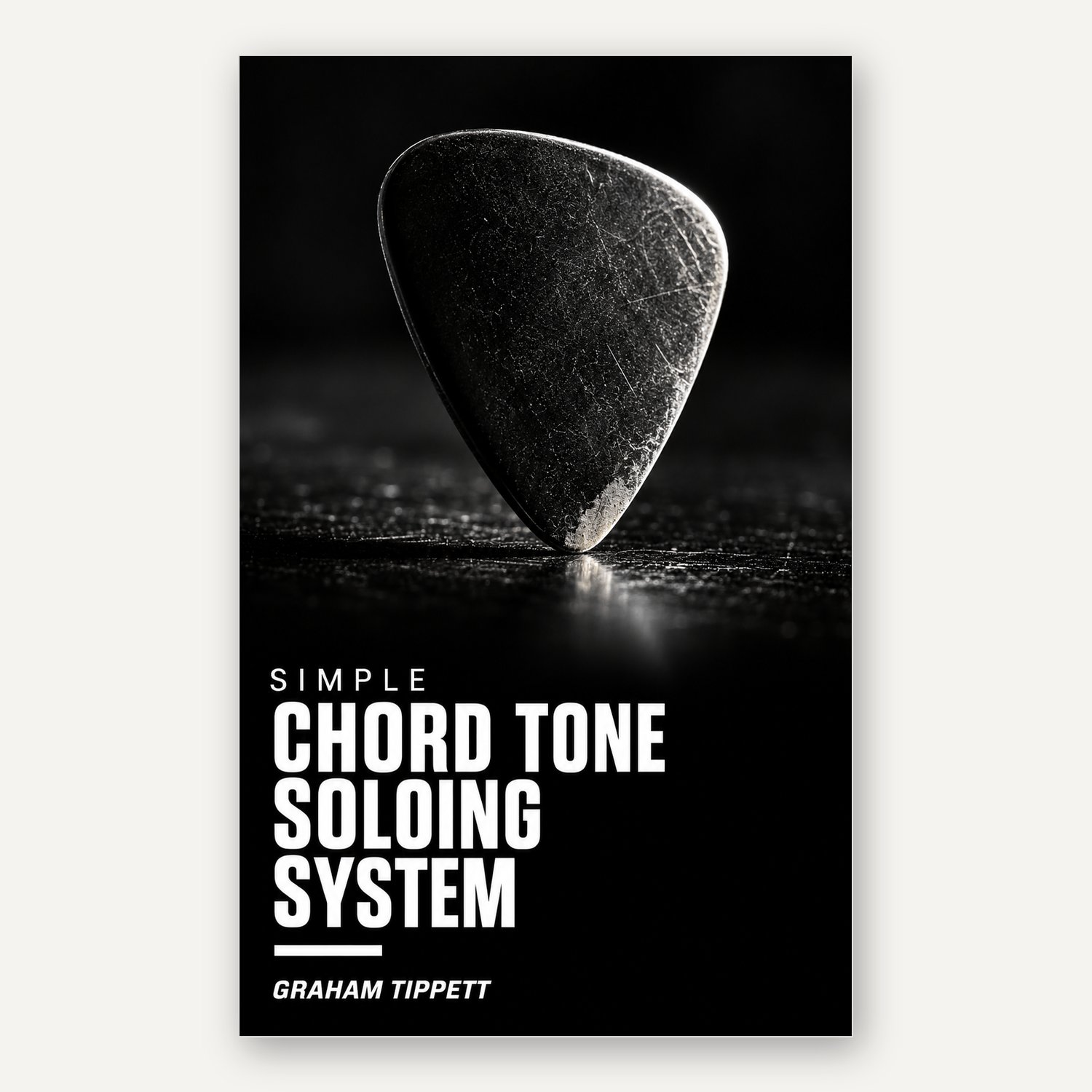
Simple Chord Tone Soloing System
On Sale
$0.00
Pay what you want:
$
Most advice on playing over changes comes down to memorising which scale goes with which chord. That works until the chords start moving, at which point you're working out a scale pattern while the tune carries on without you.
This book takes the other road. There are no scale patterns in it and no arpeggio patterns either. Instead you learn to decode any chord into its intervals, find the two that actually define it — the 3rd and the 7th — and land on them. Four short sequences, learned on a single string, cover about 90% of the chords you'll meet.
The part most books leave out is what those two intervals do next. They connect. In a ii-V-I the 7th of each chord drops a half step to become the 3rd of the next, and the 3rd is held over to become the next chord's 7th. Put those two lines on adjacent strings and a chord change becomes one finger moving one fret, instead of a leap to somewhere else on the neck.
Inside: locating 3rds and 7ths anywhere without patterns, decoding any chord from a maj7#5 to a 13, approaching target notes from a fret away, why the 11 fights with the 3 on a dominant chord, four worked phrases in tab with every note labelled for what it's doing, and five practice progressions that tell you what each one is for.
You'll want a way to loop a chord while you hunt for notes against it — a pedal if you have one, or a phone app, or the voice recorder you already own.
Free. If the interval-finding turns out to be the slow part, that's what Melodic Soloing in 10 Days is for. If you want the argument taken as far as it goes — chords and arpeggios built from intervals, no fretboard diagrams at all — that's No Shapes.
This book takes the other road. There are no scale patterns in it and no arpeggio patterns either. Instead you learn to decode any chord into its intervals, find the two that actually define it — the 3rd and the 7th — and land on them. Four short sequences, learned on a single string, cover about 90% of the chords you'll meet.
The part most books leave out is what those two intervals do next. They connect. In a ii-V-I the 7th of each chord drops a half step to become the 3rd of the next, and the 3rd is held over to become the next chord's 7th. Put those two lines on adjacent strings and a chord change becomes one finger moving one fret, instead of a leap to somewhere else on the neck.
Inside: locating 3rds and 7ths anywhere without patterns, decoding any chord from a maj7#5 to a 13, approaching target notes from a fret away, why the 11 fights with the 3 on a dominant chord, four worked phrases in tab with every note labelled for what it's doing, and five practice progressions that tell you what each one is for.
You'll want a way to loop a chord while you hunt for notes against it — a pedal if you have one, or a phone app, or the voice recorder you already own.
Free. If the interval-finding turns out to be the slow part, that's what Melodic Soloing in 10 Days is for. If you want the argument taken as far as it goes — chords and arpeggios built from intervals, no fretboard diagrams at all — that's No Shapes.