
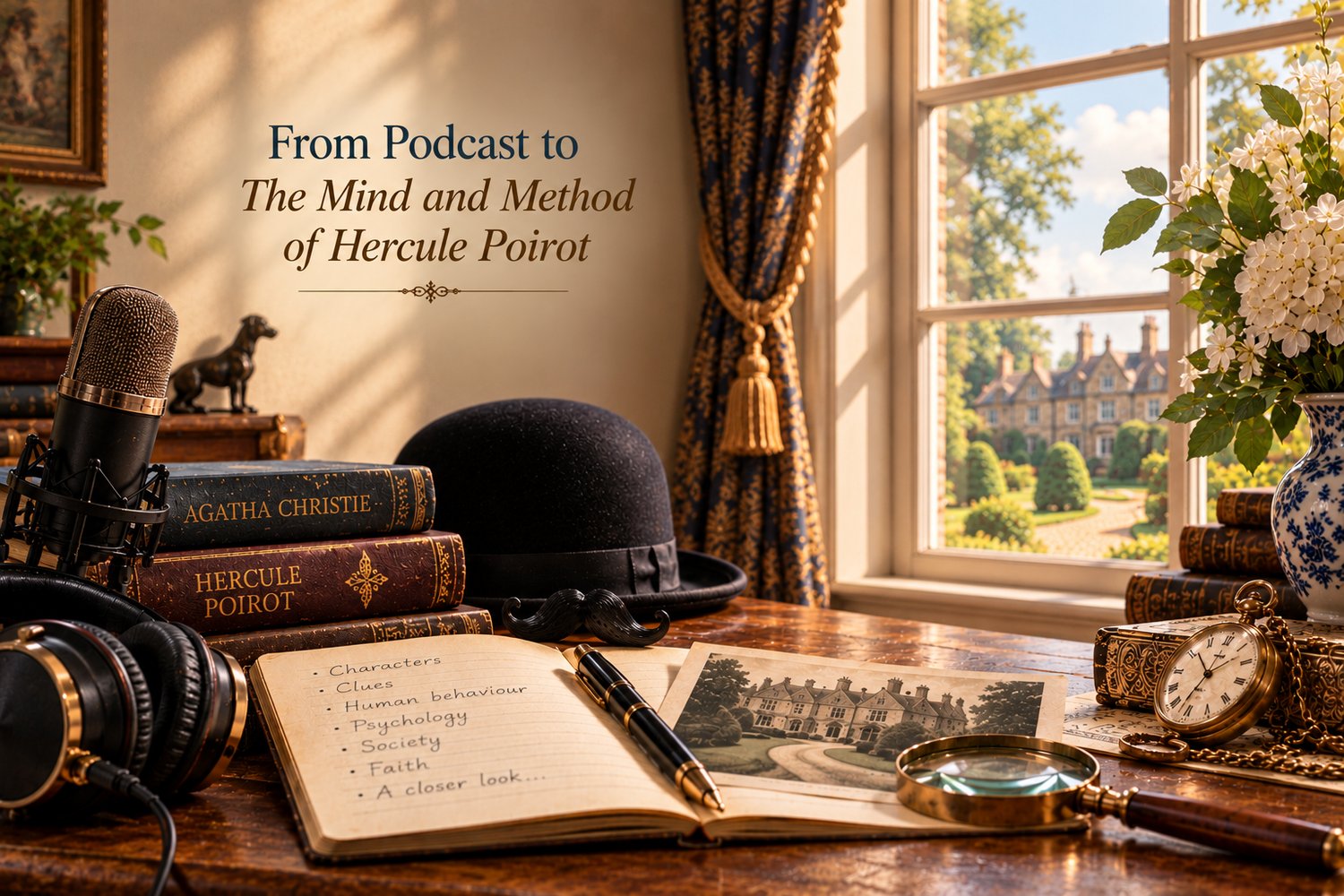
For the past 12 months I have been exploring Agatha Christie’s most famous detective through my podcast, The Curious Mind of Hercule Poirot. What began with an interest in Poirot himself gradually became something much broader.
The podcast has given me the opportunity to think about neurodiversity, psychology, relationships, society, faith, communication and human behaviour through the world Christie created. Again and again, I have found that a detective story can provide a surprisingly rich starting point for thinking about people.
But eventually I found myself wanting to do something different. I wanted to slow down. Instead of taking a particular theme and exploring it across different Christie stories, what would happen if I stayed with one novel for much longer?
That question led to The Mind and Method of Hercule Poirot.
A Different Kind of Exploration
The podcast and The Mind and Method are closely related, but they are not the same thing. A podcast episode might begin with an idea: perhaps conversation, grief, faith, social expectations or the way people interpret one another. Christie’s stories then provide examples that help us explore that idea.
The Mind and Method reverses the process. Here, the novel comes first. I take one Poirot novel and spend time with its particular world: the characters Christie creates, their relationships, the clues she provides, the things people conceal, the assumptions they make and the methods Poirot uses to uncover the truth.
The first book could really only be The Mysterious Affair at Styles. It is where Christie first introduced Hercule Poirot to her readers and where we first encounter many of the qualities that will come to define him.
But I didn't want simply to retell the story. Christie had already done that rather well!
Beyond Plot Summary
There is certainly a place for summaries of classic novels. But if you already know The Mysterious Affair at Styles, you don't necessarily need someone to tell you what happens again. And if you don't know the novel, Christie's original is waiting for you.
What interested me was everything that becomes visible when we stop asking only, What happens next? We can begin asking different questions. Why does this character behave in this particular way? Why are we inclined to believe one person and distrust another? How does Christie make a particular explanation seem convincing? What is Poirot noticing that Hastings overlooks? How do relationships within the household affect the investigation? And what does the mystery reveal about the way people think, judge, deceive and misunderstand one another?
Those questions take us beyond the mechanics of solving the crime and into the world of human behaviour. That is the territory I find particularly fascinating.
Bringing Different Interests Together
My own background inevitably shapes the questions I ask. I'm a social worker, with graduate study in forensic mental health, autism studies and theology. None of that means I want to turn an Agatha Christie novel into a psychology textbook—and I certainly don't want The Mind and Method to sound like an academic lecture.Quite the opposite.
Stories work because they allow us to encounter ideas through people. We see jealousy rather than merely defining it. We encounter loyalty, prejudice, fear, love, resentment and deception in the decisions characters make. We watch people misunderstand one another. We see the consequences of assumptions. And then Poirot enters the situation and asks us, in effect, to look again.
My professional and academic interests help inform the questions I bring to the novels, but the story remains at the centre. That is important to me.
Poirot's Method Is About More Than Clues
One of the things that continues to interest me about Poirot is that his method is both logical and deeply concerned with people. Of course he notices physical evidence, but he also listens. He watches. He compares what people say with what they do. He considers what they know and what they could not have known. He notices when someone's behaviour doesn't quite fit the explanation being offered. And he is remarkably interested in motive.
The famous little grey cells are not simply being used to arrange clues into the correct order. Poirot is attempting to understand the human decisions behind those clues. That gives us much more to explore than simply whether he identifies the murderer correctly.
Why Audio?
There was another decision to make when The Mind and Method began to take shape. Should this be a traditional book? I considered it. But audio felt much more natural.
After a year of creating The Curious Mind of Hercule Poirot, I have become accustomed to exploring these ideas in a form designed to be heard rather than studied. I want someone to be able to listen while driving, walking, cooking or simply sitting with a cup of tea.
There are no exams at the end. You don't need specialist knowledge. And you certainly don't need a degree in Christie! The aim is simply to spend some thoughtful time with a wonderful story.
Research Should Serve the Story
I do research these books carefully. Historical context matters. Christie's own life and experiences matter. Psychological and social ideas can help us understand particular aspects of a story. But research should illuminate the novel rather than overwhelm it.
I want The Mind and Method of Hercule Poirot to have substance. I want the observations to be informed and thoughtful. But above all, I want it to be accessible and enjoyable.
Returning to Styles
So The Mind and Method of Hercule Poirot begins where Christie's readers began: at Styles Court. Not at the beginning of Poirot's life—he already has a past, a career and a reputation when Hastings encounters him there. Rather, this is our beginning with Poirot.
We meet the Belgian refugee with the remarkable moustache and the equally remarkable confidence in his own abilities. We watch Hastings trying to keep up. We encounter a household in which almost everyone has something going on beneath the surface. And we see Christie beginning a relationship between detective and reader that would continue for more than half a century.
My hope is that The Mind and Method gives fellow Christie enthusiasts another reason to return to these novels. Not to replace reading them. Not simply to explain them. But to stand beside them for a little longer and ask: What else is there to notice?
Because with Agatha Christie, there is usually something!
If this has encouraged you to look at Styles a little differently, continue the exploration with The Mind and Method of Hercule Poirot: The Mysterious Affair at Styles. Listen to the audiobook here.