
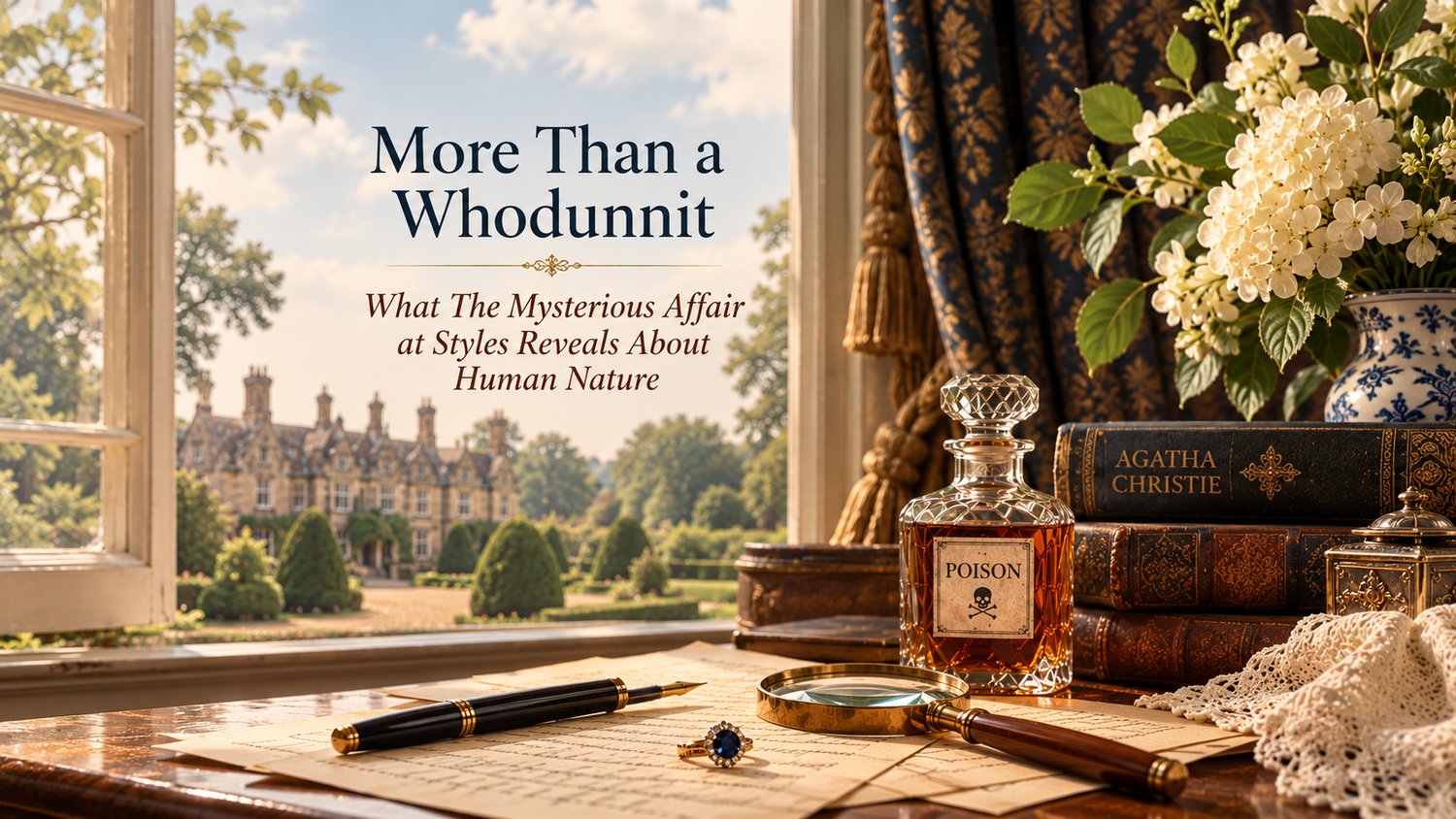
At first glance, The Mysterious Affair at Styles is exactly what we expect from a classic detective novel. A wealthy woman dies under suspicious circumstances. A country house is filled with possible suspects. There are arguments, secrets, medicines, documents, financial interests and conflicting accounts of what happened. Hercule Poirot arrives, examines the evidence and sets about discovering the truth.
But Agatha Christie gives us more than a puzzle to solve. Beneath the question of who killed Emily Inglethorp lies another fascinating question: 'Why do people behave as they do?'
That question is one of the reasons I continue to find Christie so interesting. Her novels may revolve around murder, but they are populated by recognisable human beings. They love, resent, protect, deceive, misunderstand, judge and make assumptions about one another. And Styles, Christie's first published novel, already demonstrates how important human behaviour will be to her mysteries.
We See What We Expect to See
One of the most interesting things about the household at Styles Court is how quickly people form conclusions about one another. Alfred Inglethorp is an obvious example. He is younger than his wealthy wife. Other members of the household dislike or distrust him. His appearance and manner do little to help him. When Emily dies, suspicion seems almost naturally to move in his direction.
But why? Some of that suspicion is based on evidence. Some is based on behaviour. Some comes from what other people say about him. And some comes from expectation. Once we decide what sort of person someone is, everything they do can begin to look like confirmation.
This is not merely a useful device for a detective story. It is something human beings do remarkably easily. We form an impression and then interpret new information through it.
Poirot is far less willing to do that. He may have opinions about people, but he repeatedly returns to the evidence. If a theory does not fit the facts, the theory must change. That sounds simple. In practice, it can be surprisingly difficult.
Families Are Complicated
Styles Court is not simply the location of the crime. It is a household with a history. Money matters. Marriage matters. Dependency matters. Old loyalties and new relationships matter.
Emily Inglethorp occupies a particularly powerful position because several people around her depend upon her in one way or another. Affection and financial dependence therefore exist alongside each other. That creates ambiguity. Can someone genuinely love another person while also worrying about what they might inherit? Of course. Can someone resent being financially dependent upon a person they also care about? Again, of course.
Human relationships rarely fit neatly into a single category, and Christie understands this. Her characters do not have to be entirely loving or entirely selfish, completely loyal or completely resentful. They can experience conflicting emotions at the same time. Those complexities make excellent material for a mystery because motive becomes much harder to interpret.
Anger Does Not Necessarily Mean Guilt
Evelyn Howard is one of the most striking personalities in Styles. She is outspoken, forceful and deeply suspicious of Alfred Inglethorp. She does not hide her feelings.
That makes her interesting because we are often tempted to interpret strong emotion as revealing some deeper truth. An angry person appears suspicious. A calm person appears innocent. Someone who cries appears genuinely distressed. Someone who doesn't cry appears cold. But none of those conclusions is necessarily reliable. People respond differently to conflict, fear and grief.
Christie repeatedly plays with the difference between what behaviour looks like and what it actually means. Poirot therefore cannot simply ask, “Who is behaving suspiciously?” He has to ask why the person is behaving that way. That is a much more sophisticated question.
People Have More Than One Secret
Another particularly clever feature of detective fiction is that suspicious behaviour does not necessarily point towards the central crime. Someone may lie because they are the murderer, but they might also lie because they are embarrassed. They may be protecting someone. They may be concealing a relationship. They may fear scandal. They may have done something wrong that has absolutely nothing to do with the murder.
This creates one of the great pleasures of a Christie novel: almost everyone can appear suspicious without everyone being guilty of the same thing. It also reflects something quite true about human behaviour. When we don't understand why somebody has acted strangely, we tend to fill in the missing explanation ourselves. And our explanation may be completely wrong.
Poirot is interested in those gaps. He wants to know not only whether someone is lying, but what the lie is protecting.
Intelligence Is Not the Same as Good Judgement
Captain Hastings gives us another window into human nature. Hastings is not foolish. He notices things. He thinks about the evidence. He develops theories. The problem is that he can become attached to those theories. He is also influenced by appearances and personal impressions.
That makes him an excellent companion for the reader because most of us do exactly the same thing. We notice a clue and immediately decide what it means. We like a character and become reluctant to suspect them. We dislike another and find their behaviour increasingly incriminating. We construct a story, then begin fitting the evidence into it.
Poirot tries to reverse that process. The evidence should shape the story. The story should not determine the evidence.
Deception Requires Understanding Other People
The murderer in a Christie novel doesn't operate in isolation. Successful deception depends upon anticipating how other people will interpret what they see. A misleading clue works only if somebody is likely to be misled by it. A false impression succeeds because it fits something people are already prepared to believe.
That makes deception itself a psychological act. The person creating the deception must, in some sense, understand the minds of the people being deceived. The detective must do the opposite. Poirot has to recognise where someone has attempted to manipulate perception and reconstruct what actually happened.
This is one reason his interest in human nature is inseparable from his interest in evidence. The physical and psychological clues belong to the same puzzle.
The Little Grey Cells Are About People Too
Poirot's famous emphasis on the “little grey cells” can sometimes make him sound as though detection is purely an intellectual exercise. But his reasoning is rarely detached from human behaviour.
He notices contradictions between what people say and what the evidence suggests. He considers what someone knew. He asks what they expected another person to do. He thinks about motive, personality, relationships and opportunity.
In other words, Poirot does not merely reconstruct events. He reconstructs decisions. Someone chose to do something. Someone chose to conceal something. Someone anticipated a particular reaction. Someone made a mistake. Understanding the crime therefore means understanding the human beings behind it.
Why Styles Is Still Worth Exploring
More than a century after its publication, very few of us live in households resembling Styles Court. Yet the human behaviour within it remains surprisingly familiar. We still make assumptions. We still judge by appearances. We still misunderstand other people's motives. We still keep secrets for reasons that make perfect sense to us and look deeply suspicious to someone else.
We still become attached to our own explanations. And we still sometimes notice the facts that support what we already believe while overlooking those that challenge us.
That is why I think The Mysterious Affair at Styles remains more than simply a clever whodunnit.
The murder gives Christie her puzzle. But human nature makes the puzzle possible.
If this has encouraged you to look at Styles a little differently, continue the exploration with The Mind and Method of Hercule Poirot: The Mysterious Affair at Styles. Listen to the audiobook here.