
I told you in Part 1 that we were doing this for real.
So here we go.
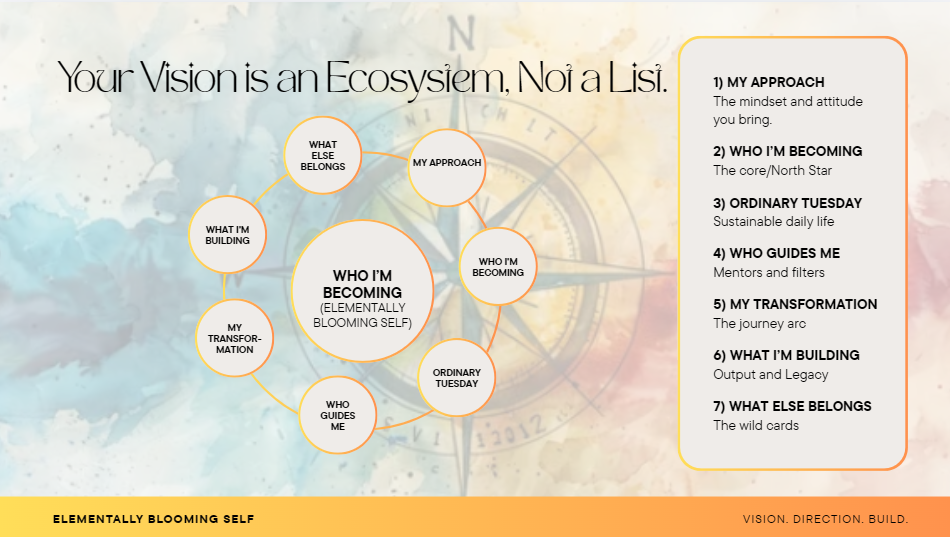
Before I opened Canva, I sat with a notebook and a framework that moves through seven sections. Let's walk through each one, you don't need to follow it exactly, but the questions it asked me are where it all made sense and do-able.
Section 1: My Approach
Not what I want to achieve, but what I need to move through the process of building it.
I spend a lot of time thinking about goals and almost no time thinking about how to make it all make sense. The question is: when things get difficult, what is my backup, my way to keep going? Do I push harder? Step back? Shut down?
For me, I go back to creating. I make something with my hands. That is not avoiding the work. That's how I think. Knowing that changed what went on the board.
Section 2: Who I’m Becoming
This is the Elementally Blooming Self I mentioned in Part 1. The framework suggests you look at what you already take in before you try to put vision together. What you save on Instagram. Your YouTube history. Your Pinterest. The books on hand. These patterns reveal who you are becoming before your mind catches up.
I made note. What kept showing up was craft education, people who build things by hand, and how to create a workable rhythm instead of grinding. I knew this already, but seeing it laid out was useful.
Section 3: My Ordinary Tuesday
Most vision boards can look like highlight reels. Award ceremonies, launches, big moments. But that is not where we live in the highlights. You live in an ordinary Tuesdays. So the question is not what I want to achieve; it is what I want a regular day to actually feel like.
This is where two personal areas hit for me: health and creative growth. Not as goals for the future. As part of my day. What does my body feel like on an ordinary Tuesday in the life I want? What am I learning? What am I making? I had been looking at these as things I would get to eventually. This section made me realize they need to be built into the ordinary, not saved for when things calm down.
Things do not calm down. You build the ordinary you want.
Section 4: Who Guides Me and Where I Push Back
This one asks you to find mentors or who do you look up to and seek guidance from. Most importantly, though, is where you differ from them. The difference matters as much as the guidance. Where your views differ from someone else’s is information about you and your values.
I found this to be useful for Bloom Elemental specifically. There are artists I learn from in the handcraft world and small-business world whose approaches differ from mine. Finding where I push back helped me get clearer on what I actually stand for.
Sections 5, 6, and 7: Transformation, What I’m Building, and the Overflow
Section 5 is your journey. Where you started and where you are going. For me, that is a long and winding road that eventually became Bloom Elemental, and it is still going.
Section 6 is the business. The feeling you want people to have. The transformation you make. The community, the legacy. For Bloom Elemental, I want: workshops, markets, and a brand that lasts.
Section 7 is the overflow. The things that kept calling to you and did not fit anywhere else. This is just as important as everything we have done so far. Mine had things on it I didn’t initially understand, and yet they were some of the most honest parts of the board.
Then I Opened Canva
I built three zones. Business and where Bloom Elemental is going. Health and how I want to feel in my body day to day. Creativity and growth, and what I am still reaching for as a maker. Clean edges, no clutter.
When it was done, it looked like mine. Not a template. Not someone else’s vision with my name on it. Mine.
Your turn: work through those seven questions in a notebook before you touch any design tool. The thinking is the hard part. Canva is just where you put it.
Part 3 is about what happens next.