
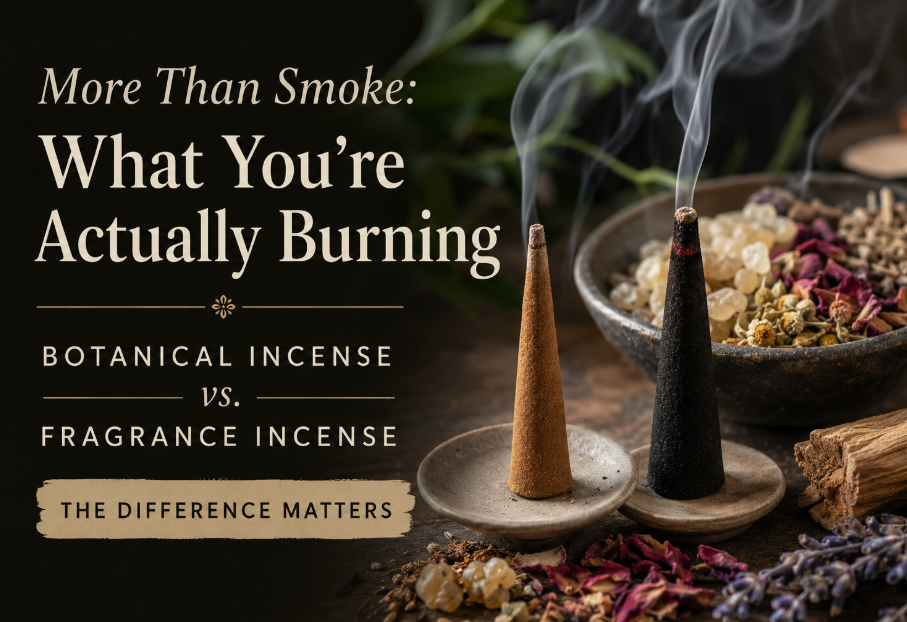
Walk into any gift shop and you'll find shelves of incense promising everything from Ocean Breeze to Dragon's Blood Vanilla. Light one and the room fills fast. Smells fine. But what are you actually burning?
Turns out, that question has two very different answers.
One stick is a bamboo splint coated in charcoal powder and dipped in synthetic fragrance oil. The other is nothing but powdered woods, herbs, flowers, resins, and a natural binder, shaped by hand and dried slowly.
Both make smoke. Both scent a room. That's where the similarities end.
Humans have burned aromatic plants for thousands of years. The Egyptians burned frankincense and myrrh in their temples. In India, incense wove itself into Ayurveda and daily devotion. China marked meditation and even told time with incense clocks. Japan refined it into Kodo, the Way of Incense, where scent is contemplated, not just smelled.
Across every one of these cultures, the purpose was the same. Incense was never about hiding odors. It created atmosphere. It marked sacred moments. It invited presence.
That's the lineage botanical incense comes from. Not the air freshener aisle.
Traditional recipes are simple. Aromatic woods like sandalwood and cedar. Dried flowers like lavender and rose. Herbs, tree resins like frankincense and copal, a plant binder like makko bark, and water.
The fragrance comes from the plants themselves. Not from perfume sprayed on at the end.
Commercial fragrance incense flips that. Bamboo splints, charcoal powder, sawdust, synthetic binders, then a dip in concentrated fragrance oil. If the goal is making a room smell like vanilla, it works. It's a scented candle in stick form. That's fine.
It's just not the same craft.
Notice the smoke.
Fragrance incense smells nearly identical unlit and burning, because most of the scent is added perfume. Botanical incense keeps changing. A sandalwood base opens warm and creamy. Lavender arrives soft instead of sharp. Frankincense rises near the end instead of shouting from the start.
The aroma evolves because the plants themselves are changing with heat. It feels less like scenting a room and more like sitting beside a slowly burning garden.
People assume more essential oil means better incense. Usually the opposite is true.
Essential oils are concentrated extracts, and combustion destroys much of their complexity. Experienced makers use them sparingly, if at all. They brighten a note or restore aroma lost in drying. They don't carry the blend.
Our studio rule: if a formula needs a heavy pour of oil to smell like anything, the formula isn't finished.
Want botanical incense? The ingredient list tells the story. Look for materials you recognize. Sandalwood. Lavender. Frankincense. Makko.
Be cautious when the list just says "fragrance" or "aroma." Those words usually mean added oil, not plants.
Neither approach is wrong. They serve different purposes. You just deserve to know which one you're buying.
The real difference isn't on the label at all.
Commercial incense asks: how can this room smell better?
Botanical incense asks: how do I want this moment to feel?
Lighting a hand-rolled cone marks a transition. A meditation begins. The journal opens. The tea is poured. Nothing mystical has to happen. The smoke simply reminds you to slow down long enough to notice where you are.
That's what incense has been doing for thousands of years. We're just keeping the practice honest.
Our handmade botanical incense line. Powdered botanicals, aromatic woods, natural resins, makko binder, water. Rolled by hand, air-dried, no synthetic fragrance, no charcoal fillers.