
Imagine a massive, cold-steel robotic arm slicing through the air of a high-tech factory with silent, surgical precision—stopping on a microscopic dime. At that exact same fraction of a second, in an unimaginably small void, a single electron traces a flawless, multi-lobed probability cloud around an atomic nucleus, never drifting, never collapsing.
Though separated by trillions of orders of magnitude, these two realms are governed by the exact same invisible architect: the absolute, unwavering law of the 90-degree angle.
The Gut Sense: Nature’s "Un-Mixer"
At its core, orthogonality isn't just a dry equation on a derivation sheet; it is the universe’s ultimate boundary keeper. It acts as a mathematical "un-mixer" of reality.
Think of it as a silent agreement between dimensions. If you push forward along one axis, the universe promises you will not accidentally drift sideways. If a robot arm extends outward, it shouldn't trigger an unintended, parasitic twist. This complete geometric independence is what allows us to untangle the chaotic, multi-dimensional physical world into clean, isolated streams of action.
Why the Robot’s Brain Doesn't Melt
For an industrial robot, calculating motion in a three-dimensional curve is a mathematical nightmare. If the coordinate axes weren’t perfectly perpendicular at every point, every tiny movement would trigger a cascade of complex, overlapping calculations—like trying to walk forward while your legs are tied to a diagonal pulley.
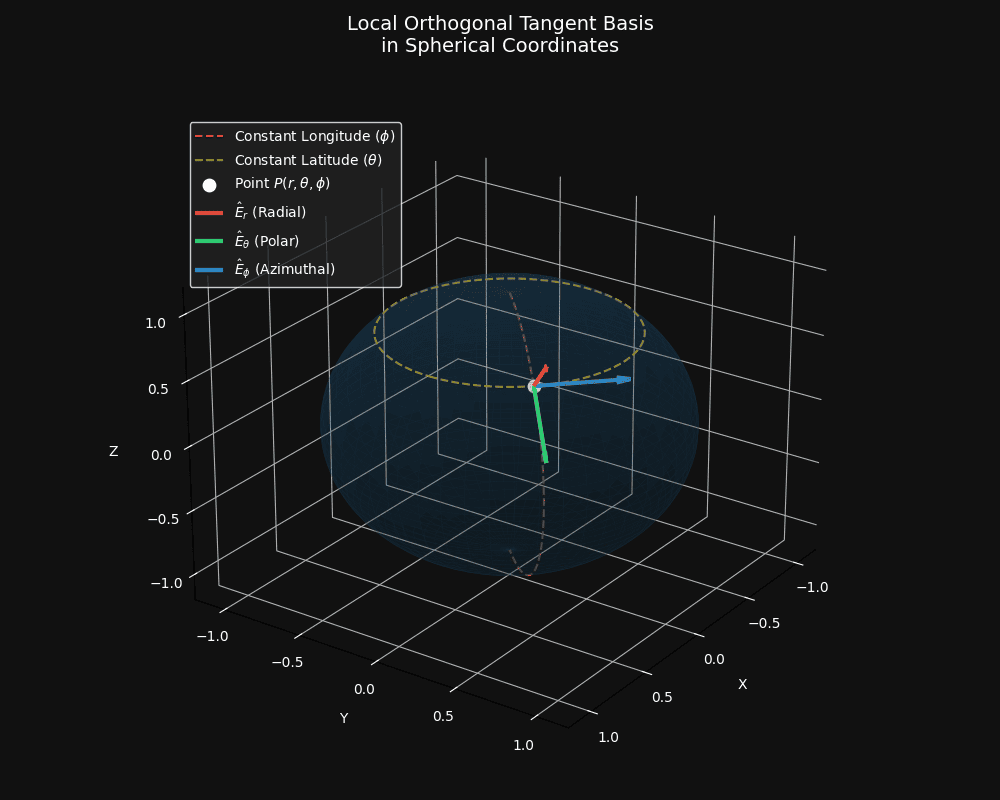
By verifying that the tangent vector bases are orthogonal, we effectively "diagonalize" the math. It thins out the complex robot kinematics equations, turning a tangled web of coordinates into a clean, predictable map. The robot's control system can run in real-time because the math has been stripped of unnecessary noise.
Why the Atom Doesn't Collapse
If we zoom down to the hydrogen atom, this same 90-degree rule acts as a physical shield. The electron's quantum wavefunction is a complex wave of probability. Without an orthogonal spherical coordinate system, the mathematical operator governing its energy—the Laplacian—would be riddled with messy "cross-derivative" terms.
Because of the perfect perpendicularity of the spherical basis, those cross-terms drop to zero. This allows physicists to perform a mathematical miracle called separation of variables. The wavefunction cleanly factorizes into:
- Independent radial shells (determining how far the electron is from the center)
- Independent angular lobes (determining the shape of the cloud)
This clean separation is the entire reason we have the distinct, stable electron orbitals that form the basis of all modern chemistry.
The Takeaway
Whether we are looking at the geometric engine of orthogonal systems driving heavy machinery or the quantum equations mapping out the universe's smallest building blocks, orthogonality is the quiet force that makes the complex simple. It is the geometric anchor that ensures our physical commands are predictable, and our atomic structures are beautifully stable.