



Verification of Orthogonal Tangent Vector Bases in Cylindrical and Spherical Coordinates
Deliverables ( Update: Jul 16,2026 )
─── Mathematics & Core Theory ───
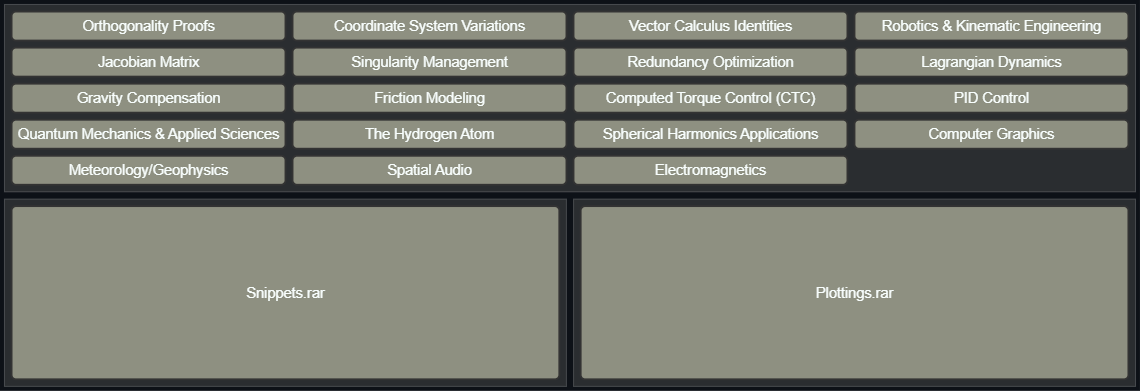
🔹 Orthogonality Proofs
🔹 Coordinate System Variations
🔹 Vector Calculus Identities
─── Robotics & Kinematic Engineering ───
🔹 Jacobian Matrix
🔹 Singularity Management
🔹 Redundancy Optimization
🔹 Lagrangian Dynamics
🔹 Gravity Compensation
🔹 Friction Modeling
🔹 Computed Torque Control (CTC)
🔹 PID Control
─── Quantum Mechanics & Applied Sciences ───
🔹 The Hydrogen Atom
🔹 Spherical Harmonics Applications
🔹 Computer Graphics
🔹 Meteorology/Geophysics
🔹 Spatial Audio
🔹 Electromagnetics
─── Code Snippets ───
📦 Snippets.rar └── 44 Snippets.py
📦 Snippets.rar └── 5 Scripts
📦 Snippets.rar └── 1 Snippet.html
─── Visualizations ───
📦 Plottings.rar └── 43 Plottings.png
📦 Plottings.rar └── 3 Animated Results.mp4
📦 Plottings.rar └── 4 Plottings.gif
Summary
The Analytics.md explores how the foundational verification of independent, perpendicular directions within coordinate systems serves as a critical bridge between abstract mathematics and high-stakes applications in engineering and physics. By confirming that these directional building blocks do not interfere with one another, the framework enables significant simplifications in the math used to drive industrial robots and solve complex atomic equations. In the field of robotics, this property ensures that a command to extend an arm results in pure linear motion without triggering unintended rotations, allowing for fast, predictable real-time control while safely managing heavy payloads or technical boundaries where movement would otherwise become unstable. Similarly, in quantum mechanics, this separation of dimensions allows researchers to untangle the variables of an atom’s structure, leading directly to the discovery of the distinct numbers that define chemical properties and electronic shells. Beyond these core areas, the principles extend to modern technological frontiers such as spatial audio for virtual reality, advanced light rendering in computer graphics, and global climate simulations, where isolating different physical or data components is essential for both efficiency and accuracy.
Presentation
Verification of Orthogonal Tangent Vector Bases in Cylindrical and Spherical Coordinates
Gut feeling
The Perpendicular Pillar: The Invisible Architecture of Orthogonality
The 90-Degree Promise: How a Silent Geometric Law Anchors Our World
Composition
The Precision of Orthogonal Basis Vectors in Modern Science
Foundations and Applications of the Orthogonality Principle
Foundations of Non-Cartesian Curvilinear Mapping
A Structural Blueprint for Curvilinear Coordinate Systems
The Mechanics of Orthogonal Basis Dynamics
The P40 Demos: Principles of Quantum Orthogonality
The Logic and Landscape of Orthogonal Systems
Precision Control via Differential Inverse Kinematics
Mathematical Architectures for Redundant Robotic Control
Orthogonal Basis Dynamics and System Decoupling
Warped Grids and Curvilinear Geometry
Harmonizing Complexity Through Orthogonal Spherical Functions
Orthogonal Parametrization and Vector Identity Stability
Orthogonality and Hyperbolic Metrics across Geometric Frameworks