
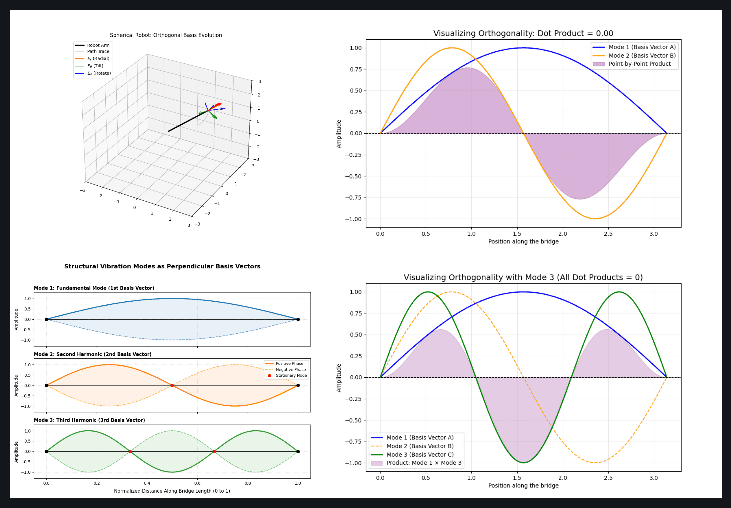
The documents detail the foundational verification and diverse applications of orthogonal tangent basis vectors, focusing on how the mathematical proof that the dot product of distinct vectors equals zero serves as a "gatekeeper" for advanced engineering and physics. In robotics, this orthogonality is used to simplify the Jacobian matrix, creating a sparse or diagonal structure that reduces computational overhead and enables real-time computer control while preventing unintended "parasitic" movements. Similarly, in quantum mechanics, the lack of cross-derivative terms in the Laplacian operator allows for the separation of variables in the Schrödinger equation, factorizing the wavefunction into independent radial and angular components to derive quantum numbers ($n, l, m$). Beyond these primary branches, the "un-mixing" of physical dimensions through orthogonal bases is essential for high-efficiency fields ranging from spatial audio and computer graphics to global climate modelling and antenna design. This transition from theoretical proof to physical outcomes is meticulously mapped through analytical tools like C4 diagrams, mindmaps, and a quadrant system, illustrating the journey from foundational geometry to operational predictability and scientific discovery.
Comments ()