
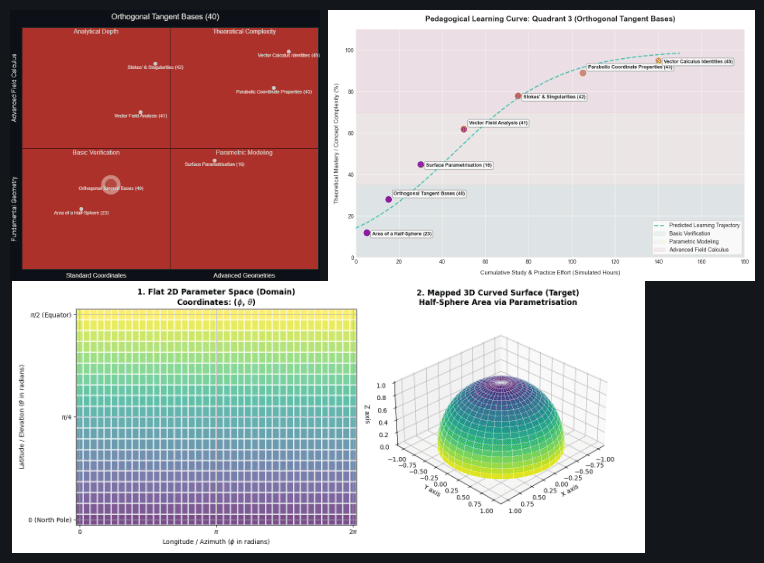
Quadrant 3 functions as the essential "Basic Verification" layer, providing the foundational building blocks necessary for all non-Cartesian coordinate analysis. This phase focuses on fundamental calculations, such as verifying Orthogonal Tangent Vector Bases (40) in cylindrical and spherical systems and solving practical geometric problems like calculating the Area of a Half-Sphere (23). These topics bridge basic geometry with advanced parametric modeling by demonstrating how flat 2D parameters are mapped onto 3D curved surfaces—a process that visually reveals grid distortions and coordinate singularities, such as the "pinched" point at the North Pole. Understanding these mappings is a critical pedagogical step, as it explains the mathematical necessity for metric tensors and scaling factors before moving into more complex field behaviors. Because mastering these abstract concepts is non-linear, the curriculum follows a sigmoid learning curve, moving from slow initial foundational uptake to exponential acceleration as students transition toward peak theoretical abstractions and advanced vector calculus identities.
Comments ()