
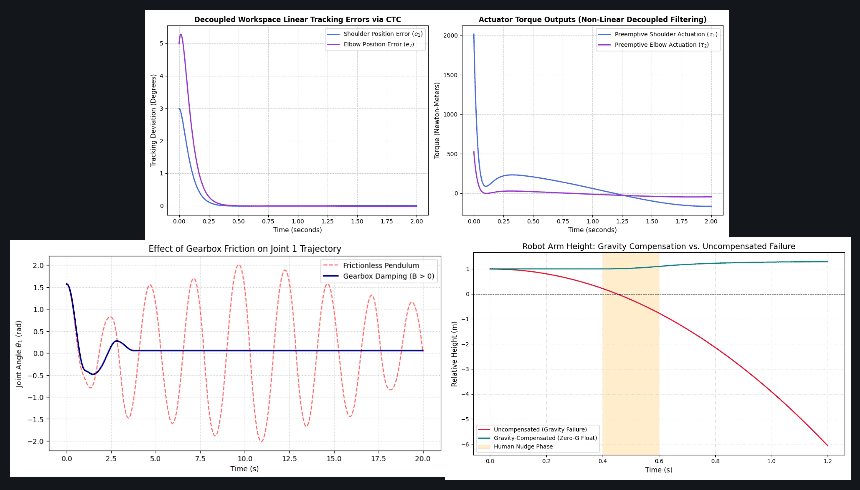
The analysis focuses on the application of orthogonal basis dynamics to streamline complex calculations and ensure **operational predictability** in robotics and quantum physics. In the field of robotics, the material emphasizes Computed Torque Control (CTC), which functions as a feedforward filter to cancel non-linear forces like gravity and Coriolis "cross-talk," effectively decoupling joints to make them behave as independent linear systems. This focus extends to practical safety and usability through Active Gravity Compensation, which enables "weightless" manual guiding of industrial arms, and the Saturating Velocity Scaler, which protects hardware by proportionally downscaling speeds during path navigation. Furthermore, the analysis explores how this same principle of mathematical "un-mixing" enables the separation of variables in the Schrödinger equation, revealing the probability structures defined by quantum numbers. Conversely, the technical focus highlights the inherent complexities of non-orthogonal systems, where specialized tools like metric tensors and contravariant basis vectors are required to maintain computational consistency when coordinate axes are not perpendicular.
Comments ()