
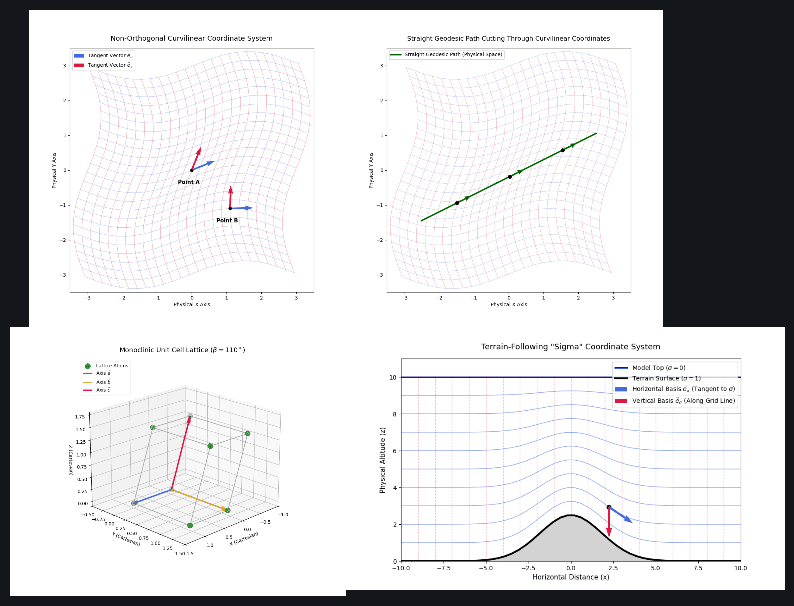
The analysis examines the mathematical architecture and practical utility of non-orthogonal and curvilinear coordinate systems, which trade the simplicity of perpendicular axes for the ability to model complex, warped environments. Unlike static orthogonal grids, these systems feature dynamic basis vectors and a metric tensor that functions as a variable field, adapting to local spatial distortions found in high-gravity or aerodynamic simulations. The material highlights how these non-linear grids require advanced tools like Christoffel symbols to differentiate between actual physical acceleration and the apparent bending of a "straight" path caused by the coordinate warping itself. Beyond theoretical physics, the analysis details industrial applications such as crystallography, where skewed monoclinic axes enable the use of fractional coordinates for simplified atomic mapping, and meteorology, where terrain-following coordinates allow grid lines to warp flush against sloping landscapes to manage complex boundary conditions.
Comments ()